
Fritjof Capra
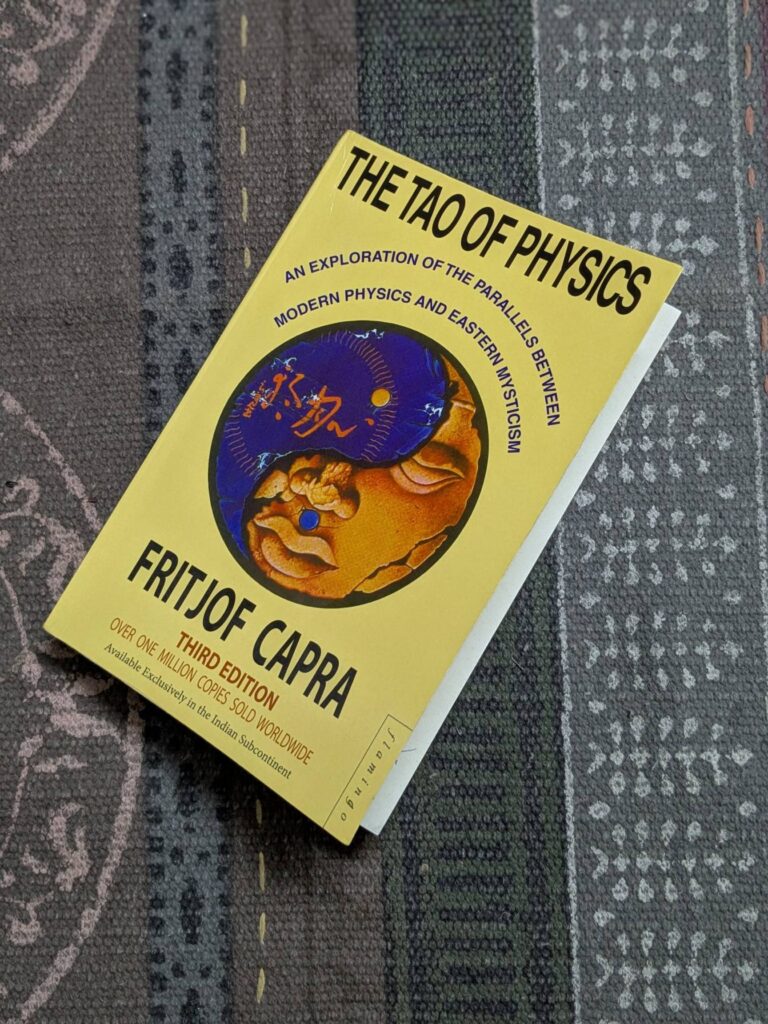
The Tao of Physics was first published in 1975, and I’d say that it’s even more relevant now in the context of science and the direction of human advancement in general. As the subtitle of the book states, the idea is to explore the parallels between modern physics and eastern mysticism.
Both science and religion/philosophy are trying to get to the reality that lies beyond our senses. One approaches it predominantly through rational means, the other through a non-intellectual experience by quieting the mind with meditation and fine tuning intuition. Broadly, it turns out that many Eastern philosophies/religions – Hinduism, Buddhism, Tao, Zen – had already reached the understanding that modern (in the 80s) science later discovered.
The Tao of Physics is divided into three elegant sections – the way of physics, the way of eastern mysticism, and the parallels. Capra begins by summing up the evolution of physics from the time of the Greeks to its modern formulation in the form of Descartes’ philosophy – the separation of mind and matter, which influenced not just the development of modern physics but also the general Western way of thinking – a mechanistic world. On the other hand Eastern philosophies have emphasised the unity of not just mind and matter but the individual and the universe at large.
The human mind is believed to have two kinds of knowledge – the rational and the intuitive. Science has a bias for the former and constructs an intellectual map of reality that mostly works on general outlines and abstractions because of the sheer variety of the phenomena around us. We use shortcuts and symbols but it is not a complete representation, though we often forget that. Eastern philosophies try to get rid of that through various practices to prepare the mind for a non-conceptual, non-verbal awareness of reality – like meditation, that is focused on an individual experience rather than generic laws, and cannot be really taught . Having said that, intuition and rationality also have a role to play in science and eastern mysticism respectively.
The two big pillars of ‘modern’ physics – relativity theory and quantum theory – started bringing the domain closer to eastern philosophies by dismantling the ground rules of classical physics – notions of absolute space and time, elementary solid particles, strictly causal nature of physical phenomena, and the ideal of an objective description of nature. Quantum theory revealed a basic oneness of the universe, with nature showing us a complicated web of relations between various parts, as opposed to ‘basic building blocks’. At the subatomic level, matter only has tendency to occur. The final occurrence depends on an observer.
In the second section, there are a few fantastic chapters that serve as crash courses on the religions/ philosophies of the east – Hinduism, Buddhism, Chinese (Confucianism and Taoism, the former being a philosophy of social organisation, of common sense and practical knowledge, and the latter focusing on observation of nature and the discovery of its way), and Zen.
The rest of The Tao of Physics focuses on the parallels – how physics also now recognises a few things Eastern philosophies have always known – the interconnected unity of all things, how space and time, which are prominent features of reality are creations of the mind and not an accurate representation of reality, how nature dynamically manifests itself in various forms and its essential nature is movement, flow, and change, and solid structures (including us) are only transient manifestations – an event, not a thing or a substance.
Since this is a later edition, the epilogue and afterword provide perspectives based on more recent advancements, and it is interesting that the direction of the book and even some of its specifics passes the test of time, thus far. While some parts do get technical, the majority of the book is very accessible, and one gets a very concise summary of physics and religion in the most simple of language. A fantastic read that I absolutely recommend. In my 2024 favourites.
Notes from The Tao of Physics
1. “Science does not need mysticism and mysticism does not need science. But man needs both.”
2. Maya does not mean that the world is an illusion. The illusion merely lies in our points of view, if we think that the shapes and structures, things and events, around us are realities of nature, instead of realising that they are concepts of our measuring and categorising minds. Maya is the illusion of taking these concepts for reality, of confusing the map with the territory.
3. Karma means action. It is the active principle of the play, the total universe in action, where everything is dynamically connected with everything else. As long as our view of the world is fragmented, as long as we are under the spell of Maya and think that we are separated from our environment and can act independently we are bound by karma. Being free from the bond of Karma means to realise the unity and harmony of all nature.
To be free from the spell of Maya, to break the bonds of Karma means to realise that all the phenomena we perceive with our senses are part of the same reality. It means to experience, concretely and personally, that everything, including our own self is Brahman. This experience is called Moksha.
4. As always, in Eastern mysticism, the intellect is seen nearly as a means to clear the way for the direct mystical experience, which Buddhist called the awakening. The essence of the this experience is to pass beyond the world of intellectual distinctions and opposites to reach the world of acintya, the unthinkable where reality appears is undivided and undifferentiated suchness.
5. The first Noble truth states at the outstanding characteristic of the human situation dukha, which is suffering, or frustration. This frustration comes from our difficulty in facing the basic fact of life, that everything around us is impermanent and transitory.
The second noble truth deals with the cause of all suffering, trishna, which is clinging or grasping. It is a futile grasping of life based on a wrong point of view, which is called avidya or ignorance in Buddhist philosophy. Out of this ignorance, we divide the perceived world into individual and separate things and thus attempt to confine the fluid forms of reality in fixed categories created by the mind.
The third noble truth states at the suffering and frustration can be ended. It is possible to transcend the vicious circle of samsara, to free oneself from the bonding of Karma, and to reach a state of total liberation called Nirvana. In this state, the false notions of a separate self have forever disappeared, and the oneness of all life has become a constant sensation.
The fourth noble truth is the Buddha’s prescription to end all suffering, the eightfold path of self development which leads to the state of Buddhahood.
Two pillars supporting the great edifice of Buddhism – Prajna, which is transcendental wisdom or intuitive intelligence and Karuna, which is love or compassion.
6. Just as a man who wants to go for their and further east will end up in the west, those who accumulate more and more money in order to increase their wealth will end up being poor. Modern industrial society which is continuously trying to increase the standard of living and thereby decreases the quality of life for all its members is an eloquent illustration of the ancient Chinese system.
Leave a Reply