
Context Setting
Man can do what he wills but he cannot will what he wills.
Arthur Schopenhauer
Intelligent people know how to get what they want. Wise people know what’s worth wanting.
Shane Parrish
My typical simplistic approach to problem solving is why, what, and how. So here we go:
Why?
Some 13 years ago, I wrote on happiness vs peace of mind. I equated peace of mind to “acceptance of things happening around you and to you”. Surekha echoed that in her comment – “I consider the latter more as a mature acceptance of sorts… embracing the present and everything that comes with it.” 6 years later, I debated happiness vs joy with myself – ‘a feeling based on circumstances’ and ‘an attitude that defies circumstances’ respectively. (courtesy https://www.lilblueboo.com/)
These days I frame it as happiness and contentment. The first is closer to the joy definition above and the latter is a grateful acceptance for things, people, and circumstances I find myself with/in. Definitions are still iffy, but I am mostly content. I am sometimes happy. And while they are both WIP, it has also involved a lot of work in intentionally answering ‘what do I want?’. This post is a summary of that journey.
Age and baggage
D and I began our life together as a rebellion of sorts (after we arranged our own ‘child marriage’ at 25). Showing people around us that we would succeed was the optimisation at a sub conscious level, but we outgrew that by our mid 30s.
Are we optimising our lives for the people who know us best or the people who know us least? That’s a question that haunts me.
Brent Beshore
Since then, the journey for me has been about going beyond self image. Among my few wants, travel was the last bastion where self image still held out. I think that is over now. D’s emotional intelligence was again my teacher – “it doesn’t matter where we go. So long as I am with you, I’m happy.” 🙂
The broad lessons were this – if I try to anchor my wants to a whimsical world, I am simply going to get lost. If I try to anchor them to my self image instead, I am merely substituting one audience for another.
Calling out the BS – Beliefs & Science, that is
At this age, I prefer an identity that provides the least friction and regrets in the life I want to lead. I will have a point to make on identity later. Meanwhile, I have never really been on the ‘growth lies at the end of the comfort zone’ trip anyway. I believe viewing personal growth through a lens of what one really wants to be is more important. And personal growth is not a competition.
In all the reading that I have done in the last few years, the understanding is that the brain is a learning mechanism that predicts and corrects with experience. And increasingly, it tries to push a narrative that goes with the prediction.
What a man wishes, he will also believe
Demosthenes
The key part – the brain’s objective to survive and control, not know/understand. The reality we experience is a controlled hallucination it creates because any error in the prediction is not good for it. It increases entropy. Simply put, it increases randomness and uncertainty. (A great book to read is Anil Seth’s Being You)
Going along that direction, my thinking is that if I really know what I need and want, and work towards it, the difference between expectations and reality become relatively lesser. That does not mean I always get what I want. It only means that when I get what I want, I will genuinely be happy.
Most desire is mimetic. You want it because others want it too. You love the ‘outcomes’ on the Insta reel, but have no idea of the hidden costs. But you’ll want it anyway. The trick is the difference between wanting and liking. We optimise for the former when we should be focusing on the latter. Simply think of that vacation you took or the job you went for because of peer pressure/money, and the difference (prediction error) between expected happiness and actual happiness. I deep think on my wants until the list of likes and wants are practically the same. More on that later.
I also then realised that meditation too is about removing this prediction error – through mindfulness, and by extension, intentionality. The more I am intentional in making decisions, the lesser the prediction error, and the fewer times I land up in situations where circumstances force my decision.
A direction shift
Where does all this leave me? A good direction, I discovered, is to really ask the hard questions on what one really needs, and then what one wants. Before we get to those, we need to address a related aspect. A necessary detour.
When I thought about it, I also realised that the one thing I deeply cherish is freedom. In life, in relationships, and in work (something that influenced the decision to not have kids). Do things the way I want to do them, rather than being forced to do it. Interact with only the kind of people I want to, than be forced to wear non-biodegradable smiles. In other words, in any circumstance, optionality. Ensuring optionality is a path that I have been on, and very recently, I got a little validation that I was on the right track.
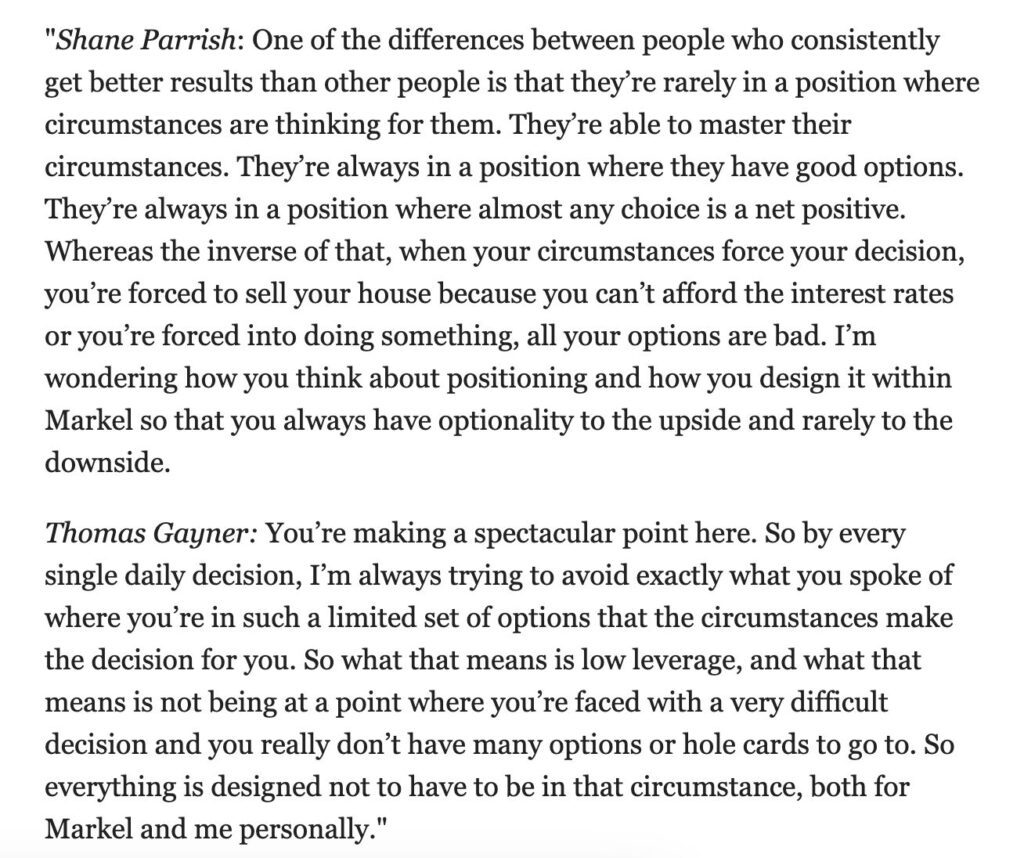
So, how does one create that optionality? A good place to start with is a combination of Marcus Aurelius and Jeff Bezos. 🙂
Most of what we say and do is not essential. Eliminate it, you’ll have more time and more tranquility. Ask yourself, is this necessary?
Marcus Aurelius
‘What’s going to change in the next 10 years?’ And that is a very interesting question; it’s a very common one. I almost never get the question: ‘What’s not going to change in the next 10 years?’
Jeff Bezos
What?
Aim for those things that don’t change. Think, project, and experiment all you want until you arrive at them. Your brain will create different narratives, so question your own thinking. Once you are sure, systematically start eliminating the rest. It’s noise you can do without. It has actually become easier with age in my case.
“Aging is an extraordinary process whereby you become the person you always should have been.”
David Bowie
Working example
At a broad level, I have only three needs in life – health, wealth, and relationships. And I have reasons for that order. Broadly, the loss of the first two endangers the third. I am not in the club of ‘relationships are enough, with or without money’. The world is mostly materialistic.
Having said that, there is a nuance in wealth. Some of it is definitely for wants. Wealth’s ability to bring happiness is minimal after a point. But its ability to bring contentment is ironically infinite enough for my needs.
My relationships are in concentric circles. D is in the centre, a small group of people forms the first circle, then acquaintances whom I like to remain in touch with, and finally a large set of transactional connections.
Now, the wants. On many social platforms, my bio includes “REST (Reading, Eating, Streaming, Traveling) is his story”. Ok, add drinking and fun t-shirts. That pretty much sums up my wants. At level one, I reduced it to this shortlist. At level two, within these, I systematically winnowed it to specifics.
How
Building Blocks
A heart attack was a good wake-up call on health. The post I have linked to echoes the above triumvirate, btw. It hit me because I conflated fitness with health. I thought I could escape the genes with diet and exercise. That was dumb. Now I continue my diet and exercise, but also have regular medical tests, eat my meds, to the extent my doc has started calling me his model patient. Consolation prize.
On wealth, I have had my learning curve of ULIPs and useless property purchases, but equity has been our saviour. I have been a mutual fund investor since 2004, and PMS since 2019. I am a rigorous planner, and that combined with disciplined investing, avoiding lifestyle bloat, and luck, has ensured we should be ok. The other crucial factor in this is my career trajectory. I was never really intentional and it’s only my curiosity that made me an early mover in many things, and got me interesting opportunities with brands. That, and luck. Now, ever since I became a solopreneur , I only work with people I like to work with, and on things that intellectually challenge me. We also have an escape plan for D, with a deadline.
The specifics of wants is also something I went deep on. In books, not bestsellers, not trending, just things I am deeply interested in. Shows/ movies/ my own writing – same as above. Eating – increasingly not the trending places, but comfort places, and new places that make me curious in some way. Drinking rum/whisky on our balcony while watching the sun set is my favourite part of a weekend. And all of this is viewed through the lens of health. Trade-offs. 🙂 I already brought up travel earlier. Go where we really feel like going. The Gram and self image can take a hike.
Speed breakers
From talking to folks, and from my own experience, the biggest challenge is that choices are hard, for multiple reasons.
One, our brains like to use heuristics to make decisions. These tend to become biases over a period of time. Getting over them is difficult because it requires effort and energy. Essentially using System 2. This is not something the brain likes to do, especially when it can use the energy to find a more enjoyable snack or new shoes or an Insta reel. Dopamine.
The second is one’s public image.
“Worldly wisdom teaches that it is better for reputation to fail conventionally than to succeed unconventionally.”
John Maynard Keynes.
More suicides come from shame or loss of financial and social status than medical diagnoses.
Nassim Nicholas Taleb
Reflect on the second one. That shows how much of a controlled hallucination reality is. Over a period of time, our narrative crystallises into an identity. Be careful of it. Because first you make it, and then it shapes your mindset and behaviour.
Finally, choices inherently mean loss. All of the potential rosy futures our mind had conjured up have to be killed. But I have realised that’s also the thing about getting older. It means switching off the lights in rooms you won’t use. Yes, spend a day, or a week, going through the room and its corners and spaces, then sigh and close the door. Come to terms with the futures you will never have. If all goes well, you’ll get over the bitterness and melancholy and replace it with cheerfulness. You’ll feel lighter.
These days, I bug D when she hesitates on choices – what new information are you waiting for that could change your mind? If there isn’t one…
End Notes
Intentionality helps you have your needs and considered likes as anchors. When that happens, a whole lot of clarity emerges – what you spend time and money on, people whom you will go overboard for, how you plan your days, weeks and months, and what can get you out of those lil twinges of envy and seemingly deep pools of a mid-life crisis.
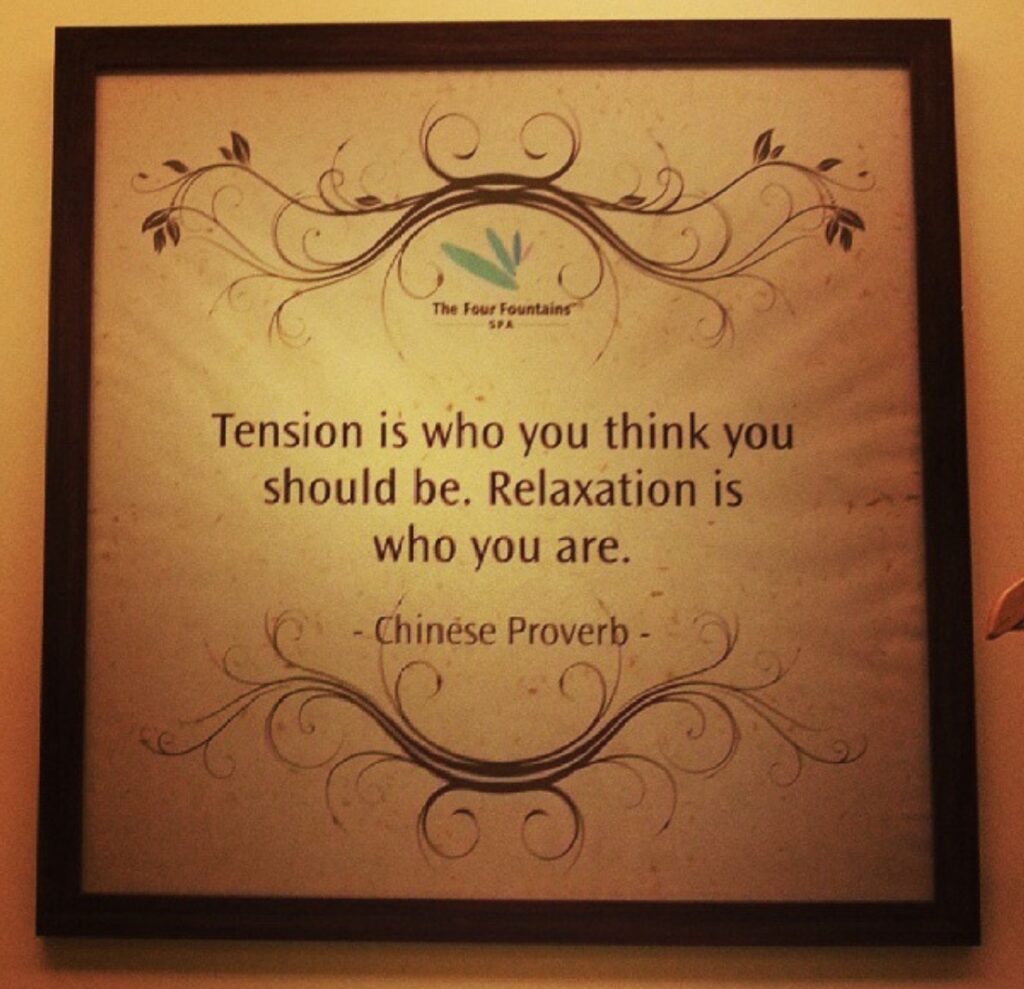
As this spa poster I saw a long time ago goes


Leave a Reply to Shridhar Cancel reply