Month: April 2024

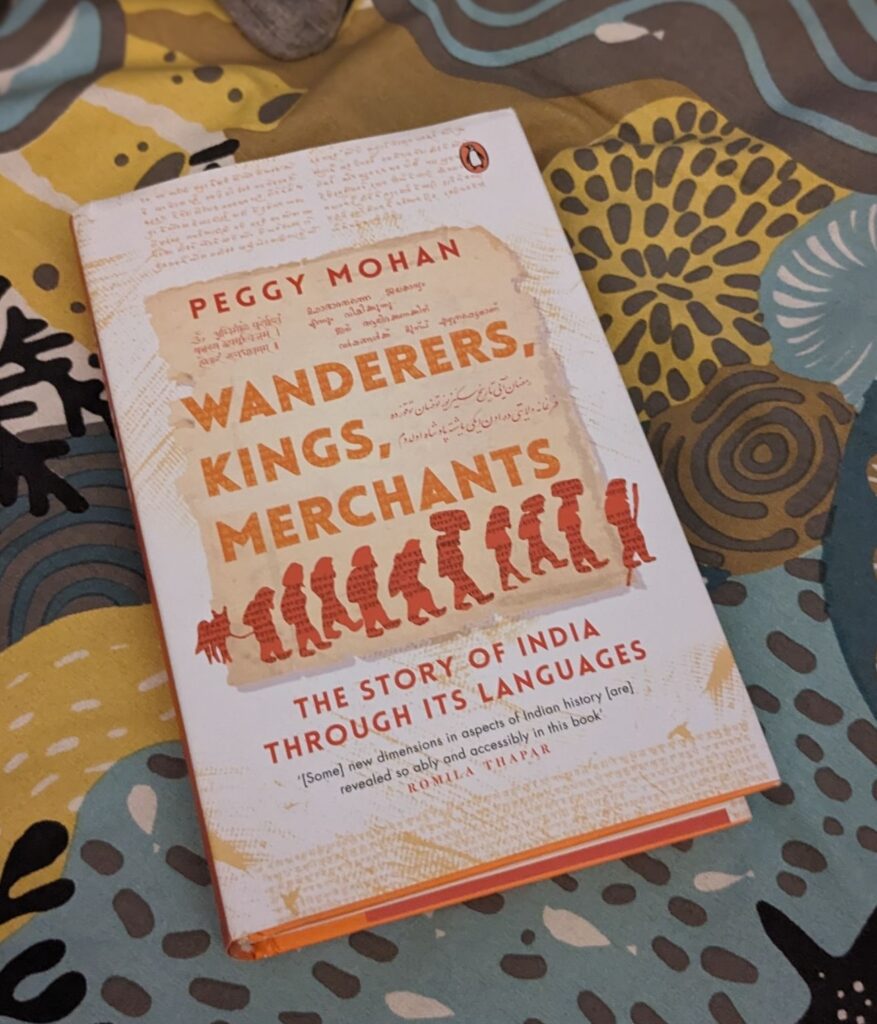
  • Wanderers, Kings, Merchants

    Peggy Mohan

    For a while, I have been fascinated by the similarity in words across languages – from the simple biradar-brother to the slightly more elaborate Agni-ignite. I even started a Twitter thread to keep track of these ‘discoveries’. Linguistics per se, the theory of it though, is less of a fascination. I started reading it with the notion that it would be this, but was pleasantly surprised. I love history and that’s what Peggy Mohan has actually done using language(s) and their evolution as her tool in Wanderers Kings Merchants.

    She gives us a quick introduction with Creoles in the Caribbean, and points out the appearance of the vocabulary layer, which is influenced by the more powerful group (usually male), and the more intrinsic sound and grammar, which is the maternal side of the story – mother tongue. With this background she brings the narrative to India and creates a storyline using different languages.

    She begins with the presence of sounds of Dravidian origin in the recitation of the Rig Veda, and with supporting historical & DNA evidence of a male-driven migration about 3500 year ago when the Harappan civilisation was in decline, traces the Vedic male – local wife combination which led to the Dravidian sounds in the Rig Veda. To be noted that this didn’t happen in the beginning when they were orally preserved and transferred, but around 700 years later when they were formally compiled, edited and written down, reflecting a Sanskrit which by then had vernacular sounds. This was also when the Kuru super-tribe spread east and south, from Kabul to Andhra, taking Sanskrit along. This Sanskrit then mixed with the language of the elite in these regions and created the first versions of Prakrit. As the language trickled down from the elite to the masses, or rather, locals moved up in lifestyles and hence words used, the influence of the latter’s native tongue became stronger and around 1000 CE marked the beginning of the Indo Aryan languages, first as dialects in small areas, and then gradually expanding their domain.

    Meanwhile, in my little state of Kerala, around 800 CE, brahmins relocated from the north – Namboodiris, at the behest of local kings. As with the story up north, male-driven migration + local women and an elite happened. The brahmins’ original Apabhramsa language (a ‘corrupted form of Sanskrit that didn’t follow Paninian rules) faded because they had to pick up Malayalam in the long-term, and centuries later, a new language Manipravalam emerged – Sanskrit nouns in (erstwhile) Malayalam sentences. Interesting that a sociopolitical tumult also happened here around the same time – the rise of the Second Chera Empire and the beginning of a strong Malayali identity distinct from Tamil/Cholas. In parallel, a resurgence of Hinduism at the expense of Buddhism and the re-emergence of Brahminical Hinduism.

    Similarly, the Central Asian influx into the north (Delhi Sultanate, Mughals) brought with it Uzbek, which quickly vanished as the Central Asians started using the dialect in the region (Hindi) as their vernacular. It was only in the late 1700s that they moved from using Persian as the official language and started writing in Hindi – then renamed Urdu, with an infusion of Persian nouns.

    She then takes us to the contemporary example of Nagamese – the grammar of Assamese and a small portion of Naga. It grows even as the both Assamese and the Naga languages continue to exist. The flashback on Assamese is Ahom, courtesy migrants from Burma. This itself is a later episode of the SE Asia + Munda people of the Magadha region. This combination, and the presence of the Vratyas, a pre-Vedic Arya group, is what makes the Magadha languages different from Dravidian.

    The most recent play- British and English. The British not only created a Hindi-Urdu divide which hadn’t existed before, but also, thanks to having Indian employees, got the latter to pick up English, though mostly in ‘Prakrit English’ form in the beginning. Ironically, English really spread only after Independence, because the elites wanted to retain their hold on power using language as an access point, and were helped by the fact that no single language had the heft to cover the entire country. And that’s where we are now. ‘What had started as a code to identify the elite snowballed into something set to replace our older languages and cultures as it trickled down, forging a new homogeneity.’

    I have to admit I glazed over some of the parts where she decided to go a little deep (by my standards) on technicality of language, but I found the book to be mostly accessible, and definitely fascinating. If you’re even vaguely interested in history, this is a must-read.

    Interesting points
    Cows as a metaphor for women in the Rig Veda.
    The uncanny resemblance between Panini, and the Phoenicians (Poeni in Latin)
    Ditto Turkic Ordu (army) and horde
    Urdu got its name in the Deccan in 1780, and in its later usage was practically the same as Hindi, both belonging to Hindus and Muslims, until the British decided to cause a split by trying to create a shudh Sanskritised version of Hindi, and in addition the use of Devanagari script. The idea being that they wanted to undermine Urdu, written in Persian script, because it was associated with the Mughal empire.
    Wanderers, Kings, Merchants
  • Dam’s Kitchen

    I hope to see Kammanahalli (Kalyan Nagar) given an honorary status as a Korean suburb in my lifetime, for its contribution to popularising the cuisine in Bangalore. But then again, that would make the place a candidate for multiple citizenships! We were in the mood for Korean and this one came up when we did some Seoul searching. #oksorry

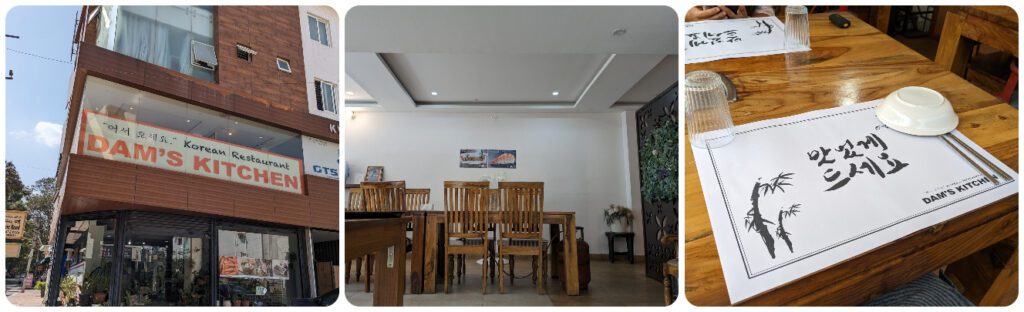
    Dam’s Kitchen is off the main road, on two floors, is non pretentious, and manages to use the typical partitioning in Korean restaurants to create small cosy spaces, complete with your very own gas cylinder for the barbecues!

    Dam's Kitchen

    We ordered the Yukgaejang (right) and Dwaeji Meori Gukbab (middle) first. The first is described as the spiciest soup available, and is made with beef strips and vegetables stir fried and boiled in brothy soup. It wasn’t too spicy, and the rice anyway tempered it. We loved it, but on a relative note the Gukbab was the winner. It has pork, soy sauce, miso, rice wine, sesame oil, bone broth and all this made for a fantastic hearty soup. Really chicken soup for the soul (see, I resisted the urge). While the stomach was full, we wanted something to nibble on and ordered Chilli Chicken (without the rice and condiments) Deep fried, chilli sauce and chopped chillis. Great taste, and texture, just the way it should be. We ate half and packed the remaining for dinner. 😌

    Dam's Kitchen

    We felt lighter by just a little below Rs.2500, which included some kombucha. They only had Soju, not Makgeolli. The service is quite friendly and prompt, and the overall ambience is quite peaceful. Lovely place for a lazy Sunday lunch.

    Dam’s Kitchen, 301, 5th D Main Road, HRBR Layout 2nd Block Kalyan Nagar Ph: 9148553661

  • Affluenza

    Oliver James

    The title grabbed my attention, but the book remained on ‘want to read’ for a while. But the moment I started Affluenza, I knew I would be biased. For starters, it was echoing my own worldview, and that too, quoting Erich Fromm, whose Fear of Freedom was in my favourites list in 2022. However, here’s the kicker – when I showed an excerpt to a couple of people whom I thought would especially benefit from it, they immediately acknowledged that it was a great insight for the current times. Except, this book is from 2007. That could fill you with hope or despair.

    Oliver James introduces Affluenza as a virus that inculcates a set of values that increase the chance of emotional distress. Its source – a political economy that he calls Selfish Capitalism, a mix of unregulated capitalism and consumerism. The book is a critical examination of the impact of consumerism and materialism on society and individuals.

    In eight of the chapters, he uses research from multiple countries to highlight the psychological, social, and environmental consequences of the pursuit of material wealth and argues that affluence, rather than bringing happiness and fulfilment, can actually lead to a range of psychological problems and social ills. Advertising and marketing campaigns are designed to exploit our insecurities and desires in order to create an insatiable appetite for consumer goods. As a result, people become obsessed with their own image and status, constantly seeking validation through the acquisition of new and more expensive possessions. A vicious cycle, creating in addition to the familiar haves and have-nots, the have-mores! The end result, as Fromm also predicted, is person-as-commodity, and thus unbridled self-promotion.

    The chapters move from personal to familial and then societal, and offer a point of view at the end (of each) called ‘vaccines’. At the individual level, ironically, as we make all efforts for attaining more material wealth, the impact of affluence on our psychological well-being is not automatically great. He argues that material wealth can lead to a range of mental health problems, including anxiety, depression, and addiction. This is because the constant pursuit of material possessions can never truly satisfy our deeper emotional needs, leading to a sense of emptiness and meaninglessness in our lives. In fact he sees emotional stress as a rational response to sick societies. The chapter on motives and goals is the one I found to be critical to break out of the ‘zombie existence’.

    At the familial level, the focus is a lot on parenting and parenthood. This is particularly important because childhood circumstances have a huge impact on our wiring – motives and goals. Given where we are, he recommends understanding them and replacing them systematically. He does have a few controversial views on motherhood and career orientation, but I think they are up for an objective debate. (The case of a 3 year old in China with the packed schedule was appalling)

    At the societal level, it is not just about the selves we present to each other, and the ‘keep up with (and overtake) the Joneses’. It is also about the kind of education and priorities we pass on to the next generation. Additionally, there is also the impact of consumer culture on the environment. James argues that our obsession with material possessions is leading to the depletion of natural resources and the degradation of the environment. He suggests that we need to adopt a more sustainable and responsible approach to consumption in order to protect the planet for future generations. He also takes a sharp shot at what Selfish Capitalism has done to the ideas of neoliberalism – meritocracy, egalitarianism, female emancipation and democracy (see excerpt below)

    The book has its fair share of criticism, but I think by asking us to question our own values and priorities, and to consider whether there might be more fulfilling and sustainable paths to happiness and well-being, he is on to something. “The solution is to think hard about what you really enjoy. The chances are that you have not done this, truly, for a very long time.” I think that’s a good place to start.

    Excerpts

    Modern education has been sold under a false prospectus containing three untruths. The first is that it will bring meritocracy, which it has not; and the pretence of it, requiring absurdly long hours devoted to passing mind-sapping, pathology-inducing exams, is hugely harmful to our children’s (and especially our daughters’) well-being. The second is that by enabling people to rise up the system, it will confer well-being, which it does not. The third is that exam results are crucial for our individual and national economic prosperity, and that is simply not true.

    Let’s look at the four basic, closely related, defining political ideals of modern social organisation which my travels call into question, at least in their present form: meritocracy, egalitarianism, female emancipation and democracy itself. I want to examine them not because I doubt their desirability, but because I fear they have been hijacked by Selfish Capitalism. All the ideals have been rock-solid vote-winners: what majority of Western electorates would not want to be able to advance through merit rather than class, to have equality of opportunity and to liberate women from their traditional role? As time passed, both ruling parties subtly perverted the use of these words to refer to Virus values, rather than their true meanings. Insidiously, meritocracy became a method for educating the workforce and selecting the most promising managers of an economy increasingly geared to making the rich richer and consumers carry on consuming. Opportunity became a mantra for becoming rich, for the material aspiration of everyone to better themselves, so that consumption would flourish. Female emancipation became a cracking good stunt for increasing the size and quality of the workforce and enabling employers to smash the unions in an economy with gender- neutral jobs. Democracy became the right to vote for people who would make you richer and better able to pleasure yourself. All these changes were invariably served up with lavish helpings of the word ‘freedom’, which must have set George Orwell turning in his grave, muttering ‘remember double- think, remember doublethink’. The problem was not with the four ideals but with what was done in their name. If they had been implemented to increase our emotional well-being, rather than the wealth of a tiny minority, they would have taken very different forms.

    Affluenza
  • I am the absolute

    The translation of Ahaṁ Brahmāsmi. Don’t worry, it isn’t my ego talking.

    I was reminded of this thanks to this fantastic episode on Lex Fridman’s podcast – with Joscha Bach.

    I remember it was a while back when I first heard the postulation that Adam & Eve hurriedly covering themselves after eating the apple was an allegory for humans first developing consciousness about themselves. Joscha extends this and talks about how the Bible, specifically Genesis 1, has sections on the mind systematically creating a a game design that helps interact with the world. In his own words,

    where it’s being described that this creative spirit is hovering over the substrate and then is creating a boundary between the world model and sphere of ideas, earth and heaven, as they’re being described there, and then it’s creating contrast and then dimensions and then space, and then it creates organic shapes and solids and liquids and builds a world from them and creates plants and animals, give them all their names. And once that’s done, it creates another spirit in its own image, but it creates it as men and women, as something that thinks of itself as a human being and puts it into this world. And the Christians mistranslate this, I suspect, when they say this is the description of the creation of the physical universe by a supernatural being. I think this is literally a description of how in every mind a universe is being created as some kind of game engine by a creative spirit, our first consciousness that emerges in our mind even before we are born and that creates the interaction between organism and world. And once that is built and trained, the personal self is being created and we only remember being the personal self, we no longer remember how we created the game engine.

    This is basically the development of consciousness. And we cannot remember the time we made it. The game engine is the universe we keep building until we are no longer around.

    And the Bible is not alone in this. Remember Samudra Manthan from Hindu mythology, it is full of symbolism. An individual in this world seeking immortality. Transcendence. The mountain Mandara represents the human mind and the manthan is its churning in the vast collective consciousness. The devas and asuras obviously are the positive and negative influences. Vishnu’s koorma avatar (turtle) which stabilises the mountain during the churn point to how we should try to focus our mind. (on God, but I will abstain from that part :D)

    Halahala, the emergent poison that Shiva swallows (earning him the name Nilkanth) shows how we must confront our inner demons . From Kamadhenu to Airavata to Kalpavriksha, there are all sorts of distractions that are possible. Dhanvantari appearing with the amrit symbolises the importance of health. The amrit is what allows you to merge with the collective consciousness and thereby in a sense become immortal.

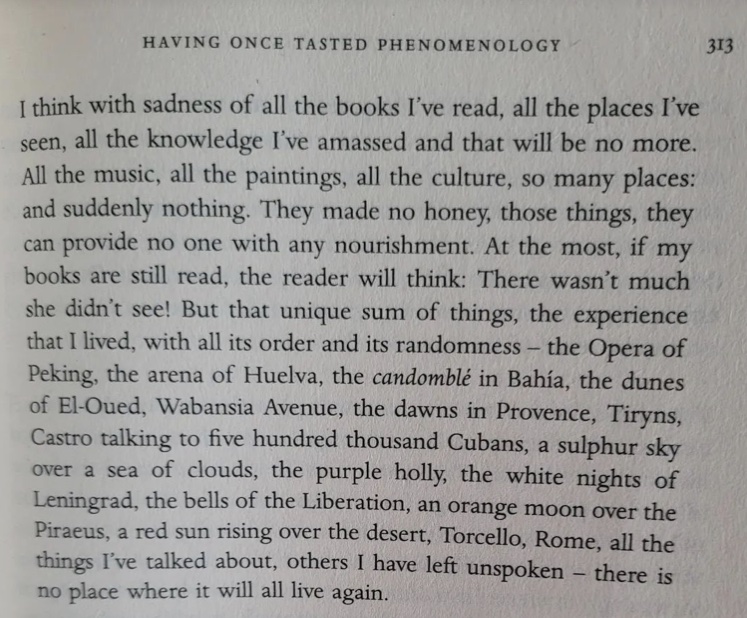
    Ok, snap. I don’t think I will get there. In The Flavours of Death, I had posted an excerpt from Simone de Beauvoir’s The Coming of Age

    Simone de Beauvoir Death The Coming of Age

    …’there is no place where it will all live again’. And that’s just it. Outside of photos, notes like these or maybe conversations with friends, the universe that was created in my mind will no longer exist when I die. It dies with me. And thus Ahaṁ Brahmāsmi. The universe that I made with all its affections and peeves and desires and animosities and fears and longings and expectations, disappears when I take my final breath. I will not be around in the aftermath to feel that sadness, but I am here now, and I do feel the twinge.

    Aham bummed asmi ? #okbye