Month: March 2022

  • The Cyberiad

    Stanislaw Lem

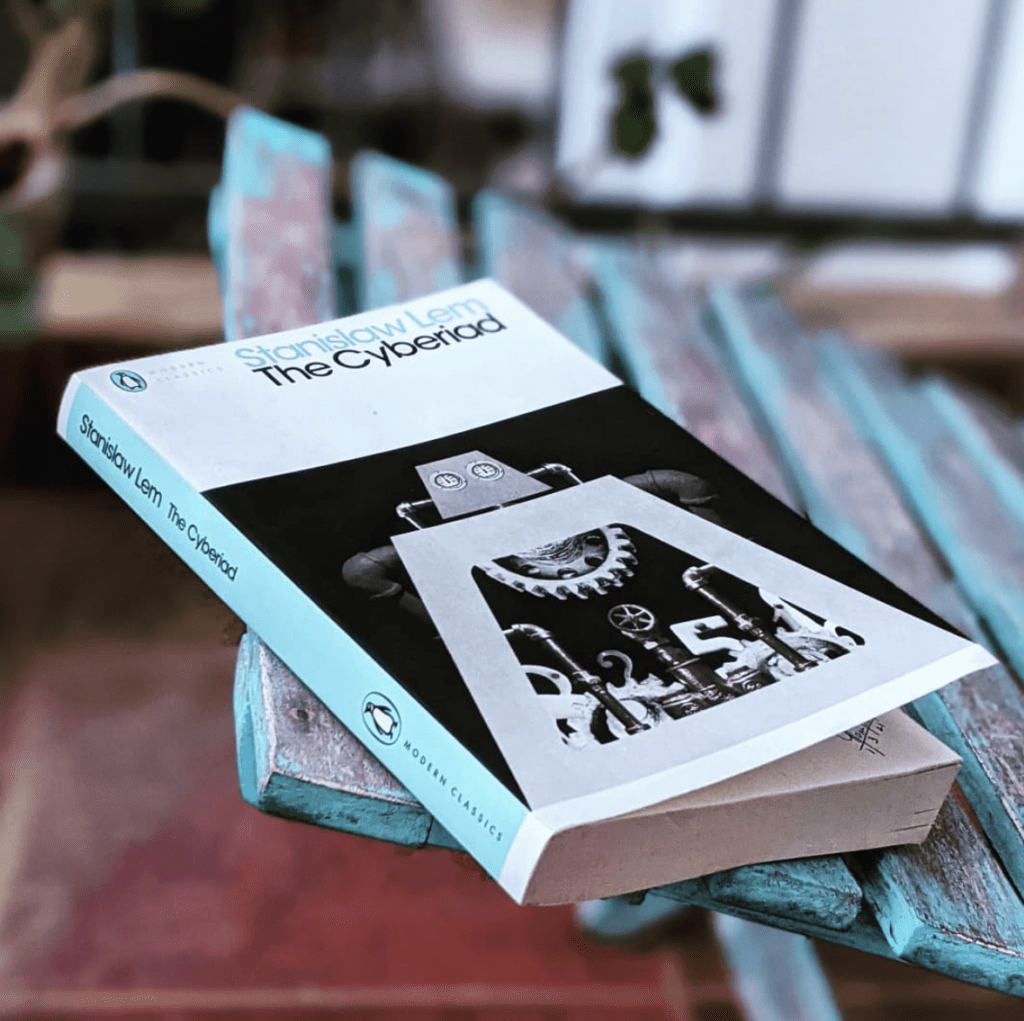
    I discovered the book thanks to an online post that extolled Lem at the cost of my favourites like Asimov. The book was written in Polish in 1965 and translated in 1974. The introduction provides great context to the author, his work, and his relationship with his peers, especially the Americans. He was rebuffed by them, and apparently Philip K. Dick even contacted the FBI claiming Lem was a Communist agent. 

    The book is a collection of Lem’s stories most of them involving two constructors – Trurl and Klapaucius, who come up with things like “a machine that can create anything in the world, provided it starts with the latter ‘n’”. Now what happens if you tell it to create nothing? It’s definitely not by doing “nothing”. But I’ll let you read the story and find out. 

    One of my other favourites was a story within a story. In Tale of the Three Storytelling Machines – there is a character called Chlorian Theoreticus the Proph. One of his essays is The Evolution of Reason as a Two-cycle Phenomenon – a fascinating theory of how Automata and Albuminids create each other back and forth across eternity. 

    The stories, characters and expressions all actually sound quite silly (might remind you HGTG), though I enjoyed the play of words, which point to the intelligence beyond. But it’s when you scratch the surface and think about the underlying ideas and philosophy that you discover the genius of the author. They are deep and profound – sometimes a commentary on the society and politics of the time, and sometimes on the nature of the universe itself. A completely different take on science fiction from anything else I have read in the domain. Fascinating stuff. 

    P.S. A special note of appreciation for the translator, and you’ll know why after you read the verses and use of the English language. It cannot have been an easy job to reconstruct the ideas and their renditions in a new language.
  • Khmer Kitchen

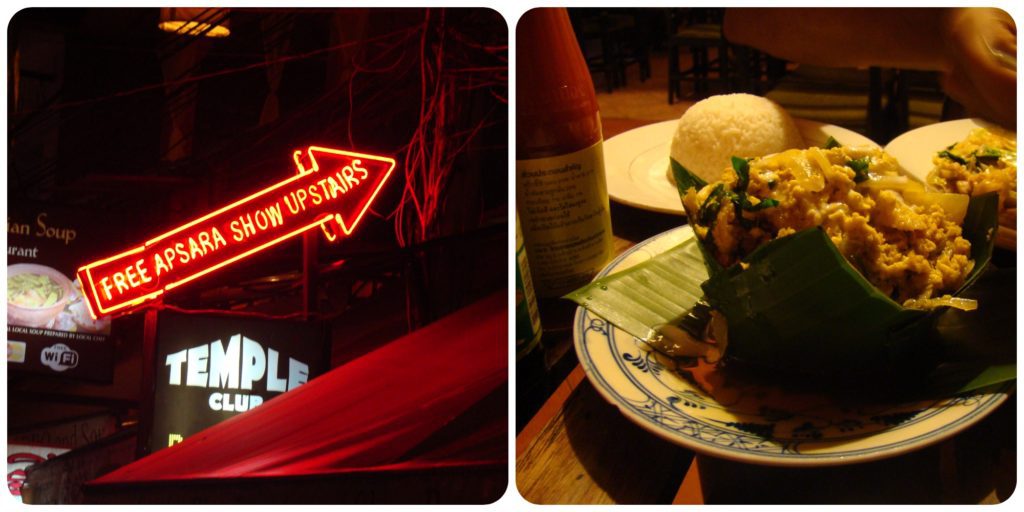
    While the current story is about Khmer Kitchen in JP Nagar, the backstory took place in 2011, when we visited Cambodia. That was when, at Temple Club Balcony, which lured me in with an Apsara show, D discovered her favourite dish – Fish Amok.

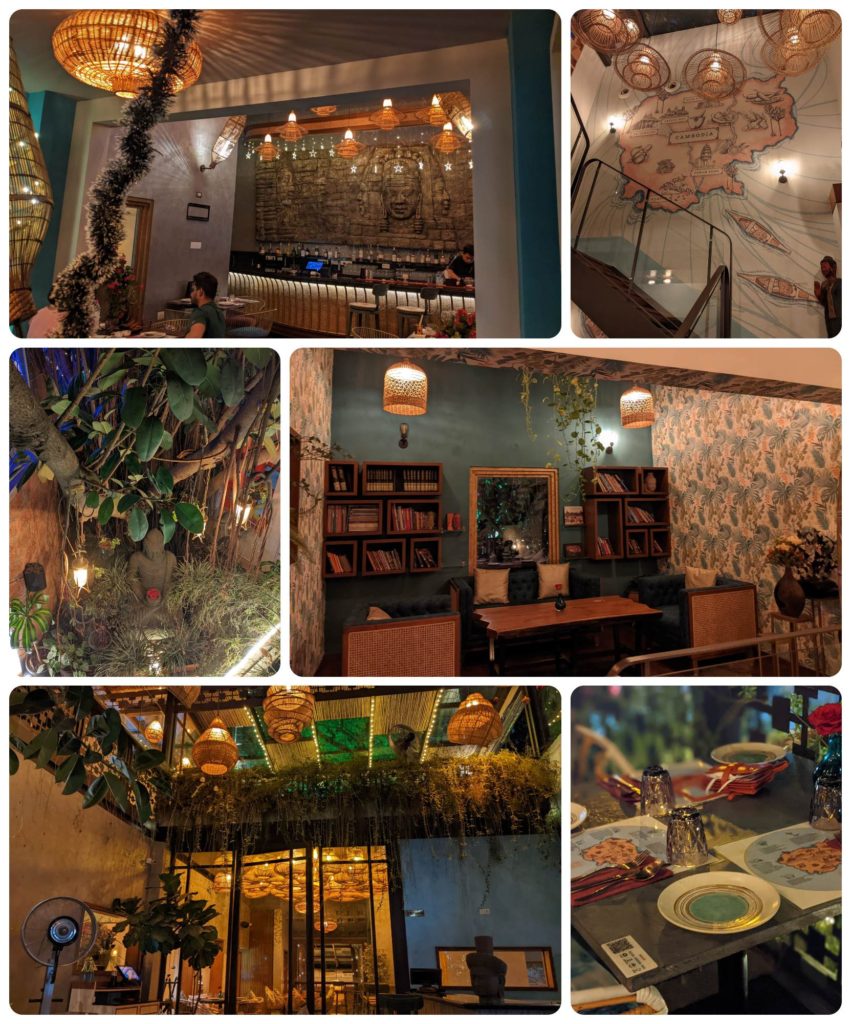
    Back to the present, when D decided that her birthday treat would be her favourite dish. That’s what took us on a road trip across Bangalore, during which I wondered whether going to Cambodia might have been easier! An hour and a half later, we finally landed up at (what was formerly) Girish Karnad’s residence. Since he never invited me, I can’t make a comparison, but now, the place is BEAUTIFUL! Trees, mini waterfalls, a koi pond, Khmer sculptures, all help in transporting you out of the mad rush that’s only a few feet away. Add to it a library, wicker furniture, and an exquisite terrace seating, and you’ll fall in Instalove with Khmer Kitchen.

    Khmer Kitchen

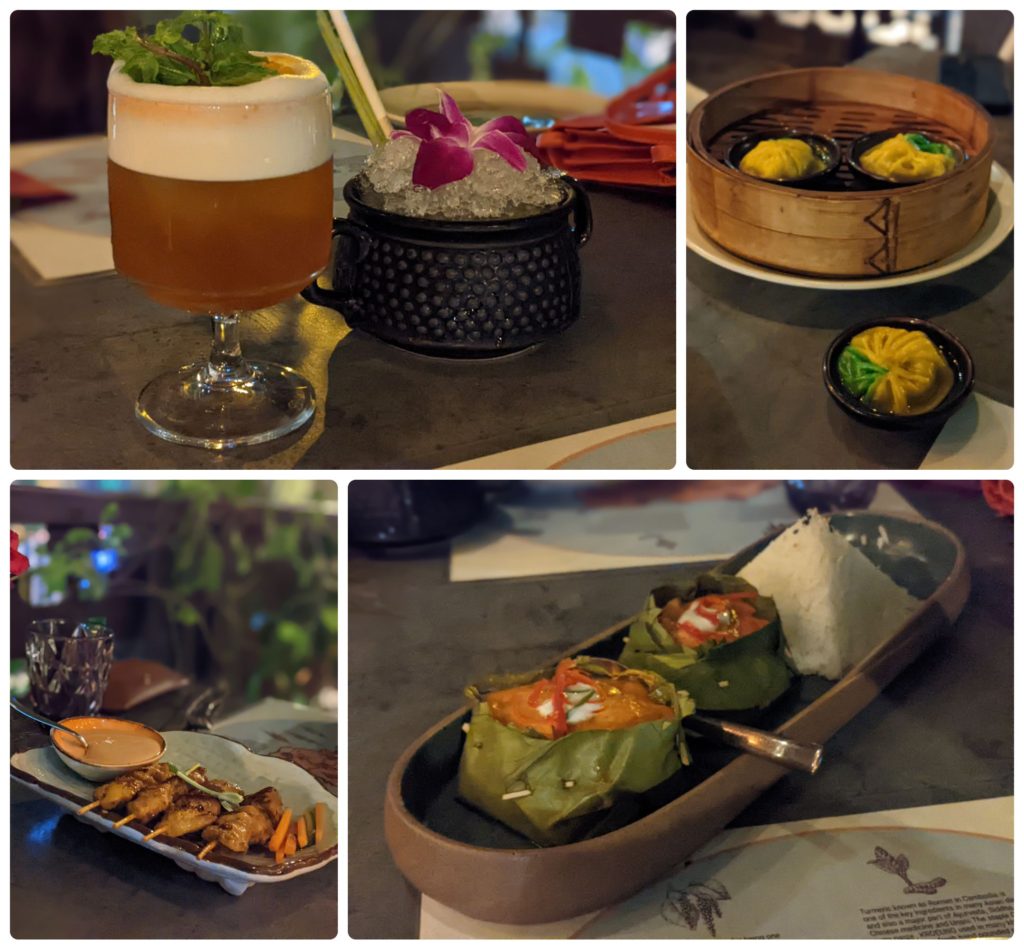
    It’s no wonder that the place starts getting full at 7PM. Thankfully, we had made a reservation. The current menu seems like an abridged version of the one on Zomato. And thus went out my Siem Sunset plans. I settled on a Thom Storm, which was essentially a version of Whiskey Sour, with the Souchong tea adding a bit of a variation to the standard. As is usually the case, D’s drink – Wat de Ampil was easily better! Tequila, tamarind, peppercorns and jaggery might sound like a curry recipe, but it looked and tasted great.

    The Chicken Tom Yum Xiao Long lived up to its artisanal categorisation by taking its own sweet time to arrive. I studied the little plate, tipped it to the side a bit and finally said that I felt cheated out of the promised soup. D (with an eye roll) pointed out that the soup was inside the dimsum. Subtle flavours in the filling, and a slightly chewy wrapper made this a just-so dish. The Cambodian Chicken skewers, on the other hand, arrived fast, and with the Sriracha mayonnaise, was bursting with flavours. And finally, what we had made the journey for – Fish Amok. tl;dr – Khmeh. While the presentation was fine, the coconut milk seemed a little off as did the colour, and the texture of the dish was different from what D remembered. Oh well, we had to try.

    Khmer Kitchen

    The food was a mixed bag. The service was friendly even if not exceptional. The wallet lost about Rs.2600 but for this ambience, happy to pay! The place looks fabulous, and probably warrants a visit only for that.

    Khmer Kitchen, 697, 15th Cross, 100 Feet Ring Road, 2nd Phase, JP Nagar, Ph: 7337808157

  • Station Eleven

    Emily St. John Mandel

    Disclaimer: I have not really seen/read a lot of apocalyptic/post-apocalyptic content, so pardon the n00b reactions. Contains some spoilers.

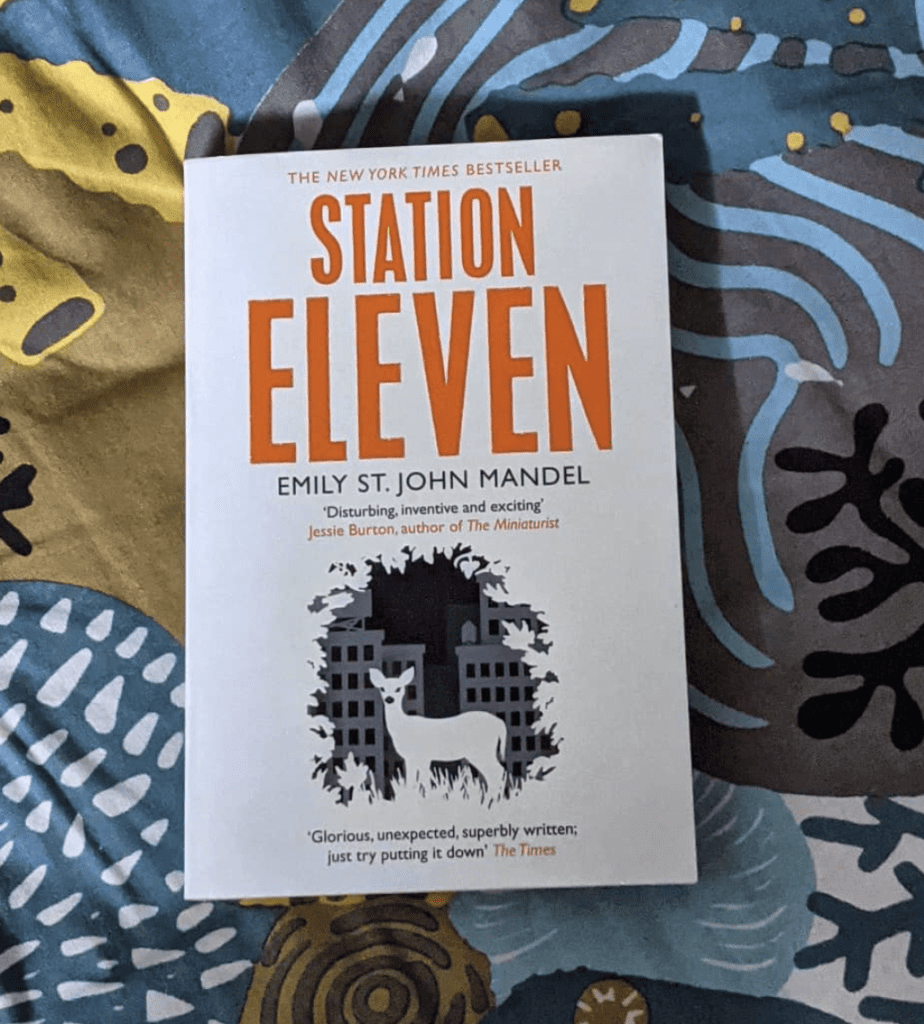
    When a famous actor Arthur Leander dies on stage while performing King Lear, the world does not realise that it is the last celebrity news that it will hear. Because Arthur Leander is only a side note in the larger drama playing out – unknown to those watching the play and many outside, the Georgia Flu is on its way to wiping out 99% of the world’s population. 

    The reason I liked this book that its narrative captures the impact at three levels, at least to some degree – individual, community, and civilisation. The pandemic systematically takes out the infrastructure of civilisation, and we see it play out through the experiences of different characters – predictably, the super markets get raided first, and people try to escape the city (though no one knows where to) even as traffic pileups extend for miles. The book is self aware – “Jeevan’s understanding of disaster preparedness was based entirely on action movies, but on the other hand, he’d seen a lot of action movies.” The world might have systems, but systems are after all, manned by people. The television networks go silent, internet access goes, and then the era of electricity is over. Days become weeks become years. 

    In Year 20, Kirsten, a child actor who was in Leander’s King Lear, is a performer in the Travelling Symphony, a band of actors and musicians who roam the land entertaining the communities that have sprung up in the post-apocalyptic world. Their motto – “Survival is insufficient,” borrowed from an episode of Star Trek: Voyager. Kirsten owns a few comics from a limited-edition hand-drawn series called Station Eleven. The creator is Miranda, who in turn is linked to Jeevan, a paparazzo turned paramedic. 

    And then there’s the airport. This made me stop and reflect. Imagine, you’re on/coming back from a vacation/business trip, your flight gets rerouted, and you land at an unfamiliar airport. First, you treat it as an inconvenience, then a temporary aberration, a story that you can tell friends, and then, after a few days, you realise you are permanently grounded, there is no going back. And finally, a community begins to form. And in that community is a curator who begins to collect the vestiges of a lost era – mobile phones, gaming consoles, credit cards. The very things that make up the mundaneness of our current life. This was almost visceral, and after 2020, an absolute possibility. 

    The narrative switches back and forth, in time, and among characters, zooming in on details that bring out characters and their varied experiences before and after the pandemic. In the flashbacks, we see the span of Arthur’s life – from obscurity to fame to the realisation of a life slipping away. We also see Clark’s view of Arthur’s life, as his closest friend, how it changed over time, and how Clark finds purpose after the pandemic. Clark was my favourite character, I could relate a lot. Kirsten has vague memories of a different world, and specific memories of her own past – she is part of a bridge generation between those who knew a life before the pandemic and those who didn’t. In all of these, there is nostalgia, memory, a yearning for the past, and the grief over its loss. It affects different generations differently – “The more you remember, the more you’ve lost“, because the longing for something you have experienced already hurts more. We go from Sartre’s “Hell is other people” to Mandel’s “Hell is the absence of the people you long for“. 

    I found it a poignant read, probably because of a life stage, and the specific time we are living through. 

    Station Eleven
Emily St.John Mandel
  • An IG Story*

    *Cheap thrills: Instant Gratification Story sounded less cool

    More than half a dozen years ago, in a Guardian article with bullet points fired against Powerpoint, Andrew Smith astutely noted that ‘In this century, it seems to me, our greatest enemy will not be drones or Isis or perhaps even climate change: it will be convenience.‘ We are now so deep into the convenience era that this would be met with ‘What’s wrong with convenience?’ Dennis Perkins, in a Vox article on video stores, had provided the answer – ‘The victim of convenience is conscious choice.

    I was reminded of this by the venture capital funded ‘who can deliver grocery fastest?’ pi**ing contest happening on Indian roads. I don’t know about the rules of venture capital, but road rules are definitely being rewritten by the delivery boys. Wrong-side riding, simultaneous road-screen navigation and so on. But that’s a whole different story.

    This is not just an India phenomenon. In its 2022 Media trends report, Dentsu has at least two points covering it – Omnichannel Everything (p9) and the Bring-it-to-me economy (p11). From Netflix to grocery and every consumption in between, these two trends rule.

    As Kavi notes in It’s too soon to say, our priorities are increasingly immediate over long-term. In everything from company results (QoQ) to bulking up with steroids to climate change. In a subsequent post, he continues this line of thought of us over indexing speed and time, and notes that this comes at a cost (and provides a useful framework to evaluate this for self). Intentionality is key, and this aligns well with my thoughts in the context of freedom.

    In a previous post – Default in our stars – I had written on the journey from Netflix’s Shuffle Play to the surveillance capitalist creation and exploitation of our behaviours. On the way, there are effects at an individual and societal level, including the loss of learning and the faculty to create and debate shared understandings.

    Increasingly, the convenience-based thinking and decision-making wiring that powers instant grocery delivery has started manifesting everywhere else. Politics was something I had pointed out around 4 years ago – In Other Fake news. As nuance does a speed-walk towards extinction, everything from the side you choose on Kim vs Kanye to pro-vax or no-vax is an us-vs-them all-out war. This is the meta level play of what Farnam Street calls The Small Steps of Giant leaps. Small choices on small things gradually removing the ability to think independently, form a point of view, debate it out with those who offer a counter-opinion, and replacing it with easy heuristics on which side to choose. When I think about how our species has advanced because of planning, sharing ideas, and finding ways to work towards them, I wonder if these are in some way the Chesterton fences of the mind that we are systematically removing.

    A related effect is the increasing inability to even conceptually think in years and decades. This has a disproportionate impact on two of the most important areas in life – health and wealth, or rather Insta-slim and Insta-rich. The unfair advantage of being able to think in decades on both is unfortunately lost to vast swathes of people once the instant gratification wiring takes hold. To quote from Farnam Street again, we win the moment at the cost of the decade. What’s more, one of the main ways to get this perspective – acquiring knowledge if not wisdom from those who have spent the time and effort isn’t spared either – we have 15 minute book summaries too. Zooming out, I wonder how much of narrative control we have already ceded.* How will one ever know!

    While cause and effect are still hazy, in my mind there is indeed a correlation between this instant gratification and being on stage and under scrutiny all the while. The mirror has been replaced by a selfie camera, and you can imagine what that would do to reflections!

    *Related Read: Because your algorithm says so