Month: June 2021

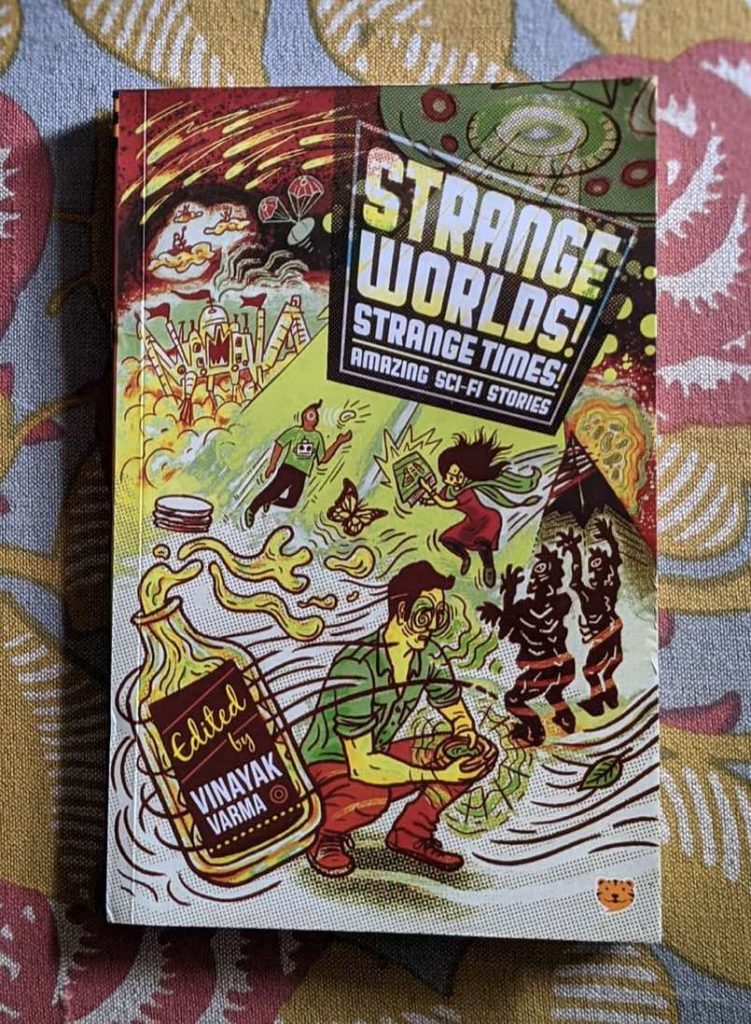
  • Strange Worlds! Strange Times!

    (edited by) Vinayak Varma

    I think I’ll just gush, because this, I guess, is what the entire “kid in a candy store” feeling is like! But to begin with, I have to confess I didn’t read the first 20 pages! It was quite a coincidence that a book with this title mysteriously arrived without them. That meant that I missed the Manjula Padmanabhan story, and dove haphazardly into the Srinath Perur one. Jerry Pinto made me gaze up at the stars again with a delightfully profound take on “outer space and inner space” – a phrase that Vandana Singh uses in the last story in the book. 

    Zac O’Yeah manages to catch Bluru’s little idiosyncrasies superbly and had me cackling away for quite a while. And then Rashmi Ruth Devadasan does the same to Chennai (?) with a dose of zombies. Vinayak Varma, who needs to be thanked separately for stitching this all up together, does a neat border town story with sniper shots at saffron and creation! 

    And there’s a (translated) J.C Bose story. Oh yes, the very same, and a fascinating back story (actually stories) on how this work came to be. I have never been much into comics (though recently Kavalier & Clay did make me think deeply on the subject) but Sunando C’s few pages of work were fascinating! A walking Taj Mahal, and telekinesis – Indrapramit Das’ imagination is evident. Shalini Srinivasan gives us a dose of reality – a parallel one, that is. And to end it all, Vandana Singh writes a brilliant story involving dimensionality (I was reminded of Liu Cixin’s sophons) 

    What made me love the book was the sheer diversity of texture and context. All the stories have an equal grounding in some part/aspect of India as they do in science/speculative fiction. And it’s almost as if the writers have let themselves go at it in total abandon. Delightful and amazing indeed! 
    P.S. Loved it so much that I sent it to three unsuspecting folks! 
  • Image and identity

    “You can either be judged because you created something or ignored because you left your greatness inside of you. Your call.”

    James Clear

    In an earlier post – An impulsive path to freedom – I had identified my own self image as a barrier to the freedom I desire. I wonder if it’s because it’s something I constantly think about, but I saw interpretations of it across a couple of pop culture phenomena I consumed recently.

    (more…)
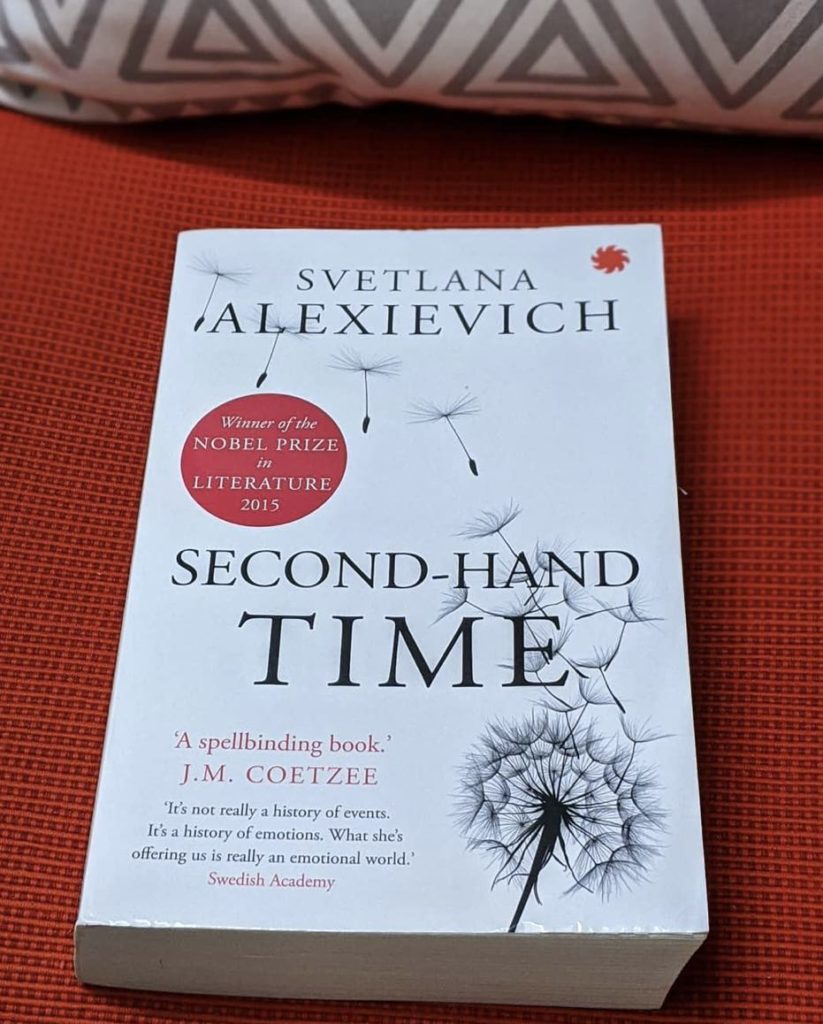
  • Second Hand time

    Svetlana Alexievich

    As I was reading the book, I wished it were fiction. But unfortunately, it’s contemporary history – lives lived by people, and events that impacted their life. To think that millions of lives have been spent in ways that one could not even endure for days – conditions that are not just physically gruelling, but mentally debilitating. Ordinary citizens of the former USSR and current Russia, whose belief systems, values and hopes went through upheavals as the country’s political system experienced two decades of turmoil after the fall of the USSR.

    Different generations whose worldview has been shaped by leaders from Stalin to Putin. Housewives, small traders, ordinary soldiers, students and staunch party workers, no one was really spared as the political, economic and social systems went through multiple changes upending millions of lives. Savings, livelihoods, lives, all lost, thanks to the whims and fancies of the powers that be. At an individual level, relationships with parents, siblings and friends were affected as the state created paranoia. Everyone was a potential informant, after all. 

    The author documents the atrocities of Stalin as told by folks who lived before, during, and after the era. Many acknowledge that the system could not have been this ruthless if there weren’t people to operationalise it. Was it by choice? Between making great history, and leading a banal existence. Many also believe that the Soviet became great because of him, and what he did was justified. Khrushchev opened up the system, and people even started making jokes about Communism (“A communist is someone who’s read Marx, and anti-communist is someone who’s understood him”).

    Brezhnev brought in stability, and some success in foreign policy, but corruption, inefficiency and a widening technological gap with the West was the trade-off. It was hoped that Gorbachev would bring in the “happily ever after”, but glasnost and perestroika didn’t lead to better socialism, it paved the way for capitalism. The dissatisfaction and a foiled coup led to Yeltsin, and the rise of oligarchy. And then came Putin, in whose regime, there are confrontations between different ethnic factions. And at full circle, there are now many voices who hope for a return to Stalinism. 
    In all of this, even as ordinary people suffered hardships, the pride for the purity of thought, and belief in the power of a united country persisted for many. Ideas and idealism stayed alive. But for most others, the only desire was to escape the system. 

    It is quite a brutal read, and I found it depressing, but these are stories that must be told.

  • An impulsive path to freedom

    One of the things that I have been very interested in recently is the abundance mindset. The internet offers many definitions, but at this point, “I know it when I see it”. It is also something I don’t have. Yet. Or at least, it is sporadic. And that’s something I want to remedy.

    I know at least a couple of people who display it in most circumstances. They are calm like Stoics, but I think they embrace life and its flavours much more. And I have seen that this mindset makes their lives better – both professionally and personally. This is reason enough, but something I read recently also gave me an a-ha moment – George Saunders’ convocation speech at Syracuse University for the class of 2013. 1

    What I regret most in my life are failures of kindness.

    Those moments when another human being was there, in front of me, suffering, and I responded…sensibly. Reservedly. Mildly.

    (more…)