Month: January 2021

  • Inntense Restobar

    We made the trek to Indiranagar because the first part of the name described the last few months, and the second half was exactly what we needed. Actually, it happened to be midway for all parties, and it was expansive with no air conditioning. Am I justifying too much? Ok. Let’s move on.

    The entry to this place is a little tricky. I suspect that we were not the first folks to try the entrance behind the 3M showroom. We saw another couple do the same while we were leaving. But only a few would have climbed up four flights of stairs before realising their mistake! 😐 The tiny gate after the 3M building is the actual entrance, and thankfully, there’s only a lift!

    It was surprisingly packed for a Saturday afternoon, and I don’t think they were prepared for it!
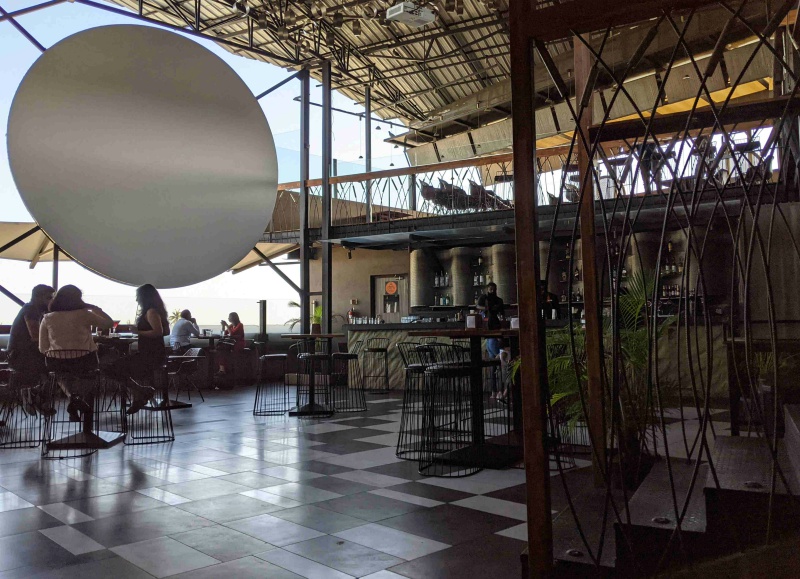
    It all began sweetly. Actually, a little too sweetly. I can understand the Belgian Chocoholic (dark chocolate ganache and dark rum) and even the Sangria being sweet, but the Old Fashioned needs a balance. And they didn’t get that right. The Sangria was actually not bad, and thanks to the dose of brandy, D was extra happy until late evening!

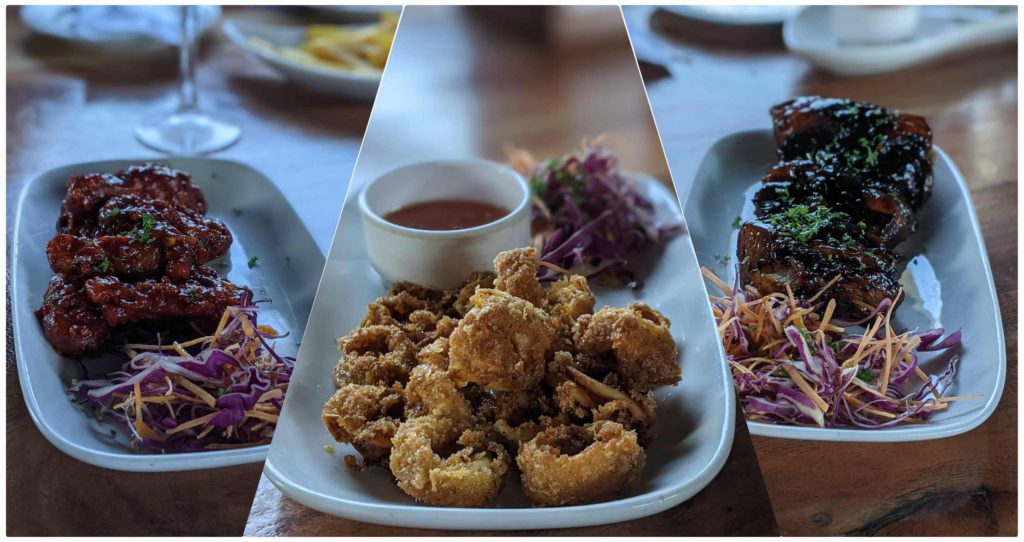
    We were famished by the time we got there, ans thankfully, they were able to get the Wings pretty fast. The Bhoot Jholokia version wasn’t available, and we were recommended the Peri Peri (not on the menu). This was spicy enough to make me forget the sweetness of the Old Fashioned for a while. But then began the extensive delay!

    We had to remind them about all the dishes we ordered, at least twice. When the twice-cooked pork belly finally arrived, it was half cooked. The insides were frozen! A complete waste of pork. The Calamari was probably fresh – judging by the delay, it had arrived at our table straight from the coast!
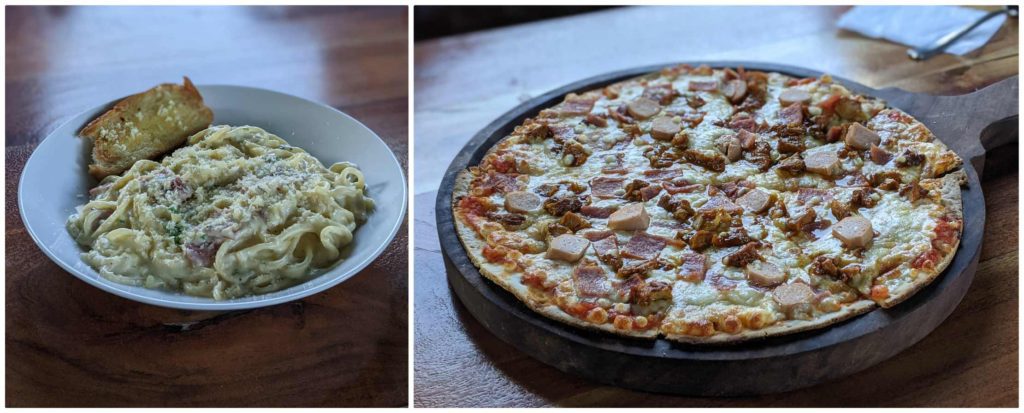
    Such were the delays that we worried that the mains would equate to dinner! But we persevered. Unfortunately, it wasn’t worth the wait. Both the dishes we tried – the Spaghetti Carbonara and the Fully Loaded Meat pizza were insipid in terms of flavours. Meanwhile, even by the end of the meal, the Akuri on toast we had ordered a couple of hours ago hadn’t materialised.
    But a word of mention for the courtesy of the staff. They tried their best to make up for the inefficiency of the kitchen (I think they were short-staffed). They even got a couple of milkshakes for the kids, though it wasn’t on the menu.

    A meal for two with a couple of drinks, and an equal number of starters and mains would set you back by around Rs.2500.

    Inntense Restobar, 4th floor, Smart Square Complex, #3, 100 Feet Rd, Indiranagar, Bengaluru Ph: 9513099663
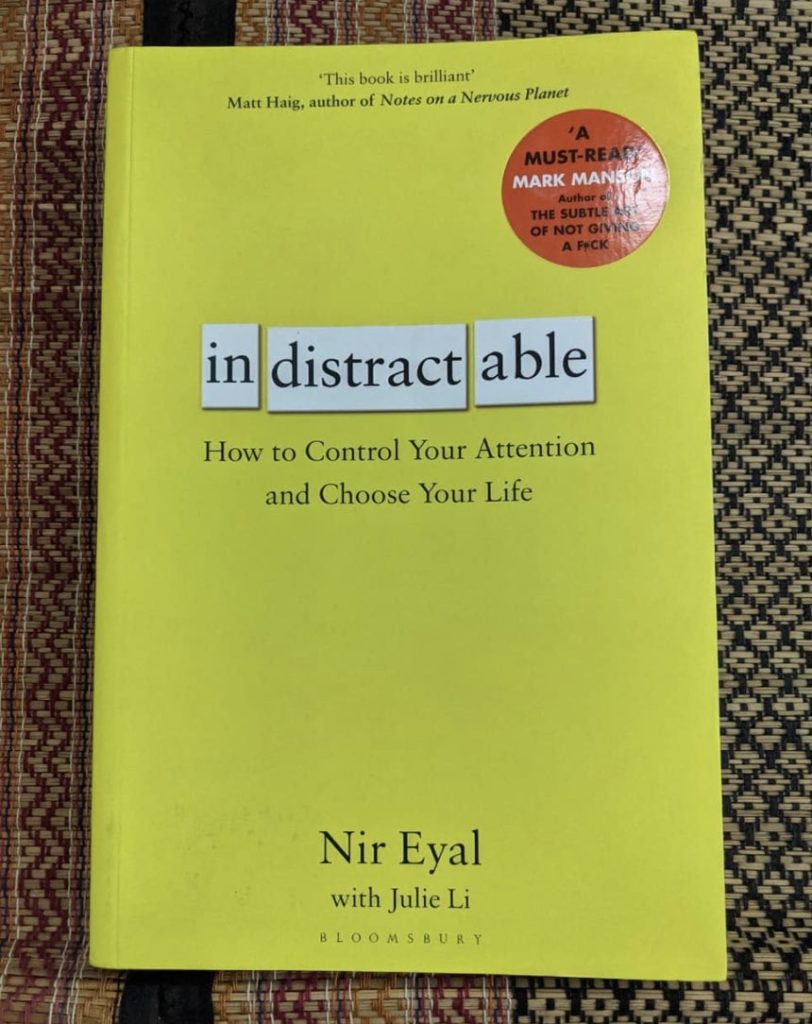
  • Indistractable

    Nir Eyal

    Towards the end of the book, the author cites a survey which found that “almost a third of Americans would rather give up sex for a year than part with their mobile phone for that long”. Sex has been hardwired in us by evolution, and it’s a testament to technology that it has managed to hack even that! But then again, there was a time when even the printing press was called the biggest source of distraction. So this isn’t a new story. But we do live in a world in which the attention economy has optimised its notifications and nudges to ensure that it is heard/seen/felt. All the time. Whether we need it or not. It has us hooked and sometimes we don’t even know how much!

    This is the challenge that Nir Eyal writes about in Indistractable. He approaches it with a simple framework of internal and external triggers and distraction and traction (some nifty wordplay, that). The first thing to focus on, he says, is our own motivations – internal triggers. Not just the proximal reasons that are making us distracted, but the root cause. Our distractions are more often than not a way of escaping something we do not want to confront. He also believes we never run out of willpower and warns us against labelling ourselves as “easily distracted” or “addictive personality”. An opinion that I am not sure I agree with.

    The rest of the book is a step by step guide on how to get to an “indistractable” state – from making time for traction (things we value) to taking control of external triggers by various means in personal and professional lives, and in social settings as well as when you’re by yourself. The suggestions are practical and quite doable once you decide that they need to be done. Ironically, the section that I found most interesting was how to inculcate this quality in children. Ironic, because I don’t have any. What made it interesting was the logical approach, one that seemed quite feasible.

    The book keeps it simple, and is a good guide if you find yourself distracted more often than you’d like to be. I have been doing my own wrestling with “staying in the moment” for a while now and found most of the things mentioned a validation of what I try to practice.

  • Can brands be truly empathetic?

    Originally published in Business Insider

    This Diwali, brands that didn’t need festive-offer advertising to light up their sales figures used a sound strategy instead – empathy. From Facebook’s Pooja Didi to India’s first-ever hyper-personalised ad (this claim is disputed) by Cadbury, brands used the travails of a Covid-hit society to maximum effect. Health workers, local businesses, parents, domestic help, dabbawalas – everyone was at the receiving end of a psychological hug. However, it’s hard to distinguish between moment marketing and actual empathy these days. A mini primer on empathy helps elaborate my concern. 

    (more…)
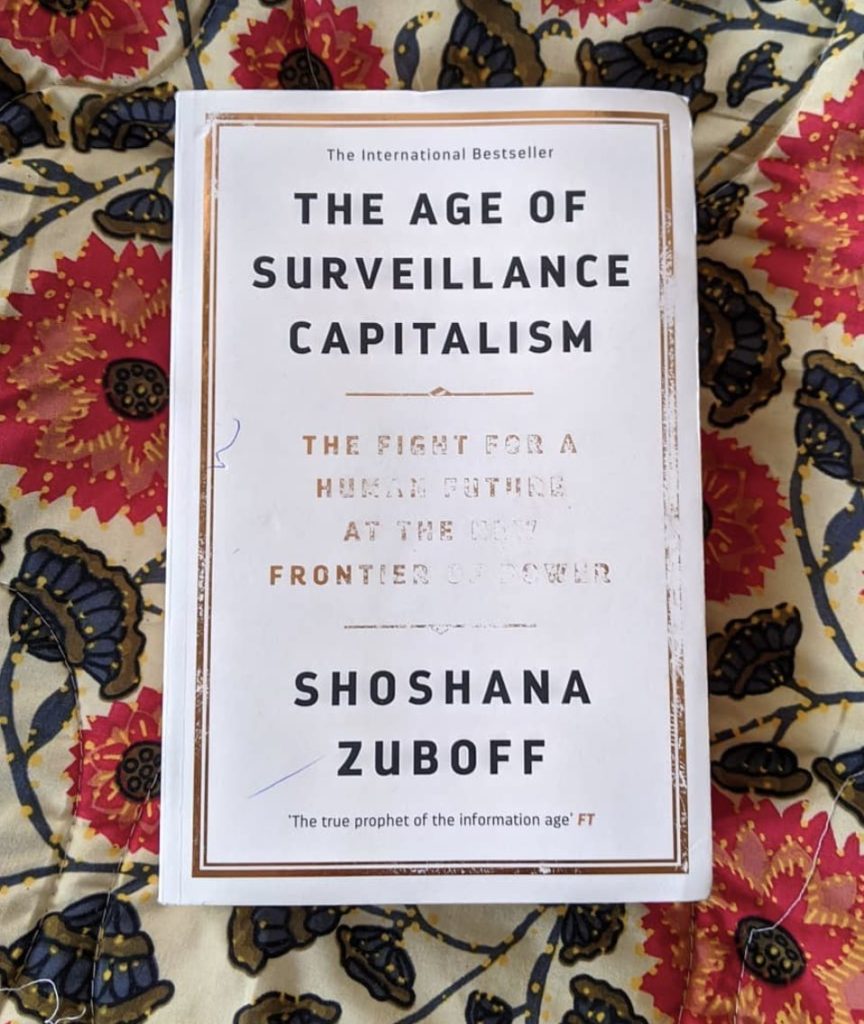
  • The Age of Surveillance Capitalism: The Fight for a Human Future at the New Frontier of Power

    Shoshana Zuboff

    Around the same time last year, I remember tweeting a quote attributed to Jamie Bartlett – “The end result will be ad targeting so effective that you may well question the notion of free will altogether“. Connecting digital advertising to free will seems absurd, but it wasn’t a facetious remark. It reflected the reality of our times. This is the reality that Shoshana Zuboff explores and confronts in The Age of Surveillance Capitalism, frequently echoing the thought that keeps cropping up in my mind – how did we get here?

    She begins with a deeply personal story about her home, and brings up an “aware home” project in 2000, which among other things, assumed that the rights to the knowledge would lie in the hands of the human living in it. She then juxtaposes it against the current privacy policy and usage agreements of Google’s Nest, which all but completely gives the ownership to the search giant. This is just one example.

    Industrial capitalism thrived by exploiting nature, and surveillance capitalism is thriving by using human nature as a resource. That means that even though, due to rapid industrialisation and mass production, we got to a “second modernity” that provided millions access to experiences which were until then the preserve of a smaller elite, we are now being led back into a “neofeudalism”, a consolidation of elite wealth and power. How did this happen?

    Google plays the primary antagonist in this narrative, and though Brin and Page were initially reluctant, the 2000 bust set Google on a path that used the “behavioural surplus” generated by users. At a basic level, it is probably difficult to imagine that when one carries out a search on Google, the machine is searching for patterns in the expressed intent, and making rapid incursions into one’s life. And yet, that’s exactly how it works. It then leads to prediction products, economies of action and future behaviour markets, fuelled by an ever expanding scope of information extraction. Those ridiculous permissions apps require make sense now? And how does a corporation create and grow a future behaviour market? Simple, behaviour modification, whether you realise it or not.

    Over a period of time, Google has institutionalised its invasions into private human domains, helped in the beginning by the national security imperative following the 9/11 attacks. Chrome, GMail, Android, Photos, YouTube and so on have created a dependency that now borders on feeling left out of the societal narrative if one is not using these. The behind-the-scenes look at Pokémon Go is chilling – in terms of how users were giving away data of their own volition, how partners were brought on board to expand the scope of surveillance, and how human behaviour was controlled at global scale.

    Facebook makes its presence felt in the latter half of the book, thanks to its exploitation of social connections. By creating a prototype of a hive mind through the weaponisation of peer group reinforcement, it increasingly shapes minds and behaviour, especially that of young adults. The author uses Goffman’s framing in The Presentation of Self in Everyday Life and shows how the “backstage”, where individuals are truly themselves, is now shrinking thanks to the omnipresence of social incursions. Where does this lead to? One example is when the state starts using this power – China’s social credit system now has a direct impact on an individual’s life, driving economies of action in the real world. More broadly, totalitarianism, driven by powerful corporations.

    The consequences are that there is increasingly no refuge, no sanctuary, from the relentless efforts of corporations that are intent on controlling every facet of an individual’s existence. At a broader level, it threatens the fabric of society and democracy itself. Capitalism’s latest avatar has clearly gone rogue, refusing to abide by the reciprocal nature of every kind of interaction we have experienced thus far. Regulation isn’t really keeping up, except for some efforts by the EU. But there are those who refuse to give up – activists, and artists who use technology to keep out surveillance. However, this is a fight we have to contribute to, because what’s at stake is what makes us human – free will, or at least the notion of it. This is not an easy read, but it is a must-read.

  • #Bibliofiles : 2020 favourites

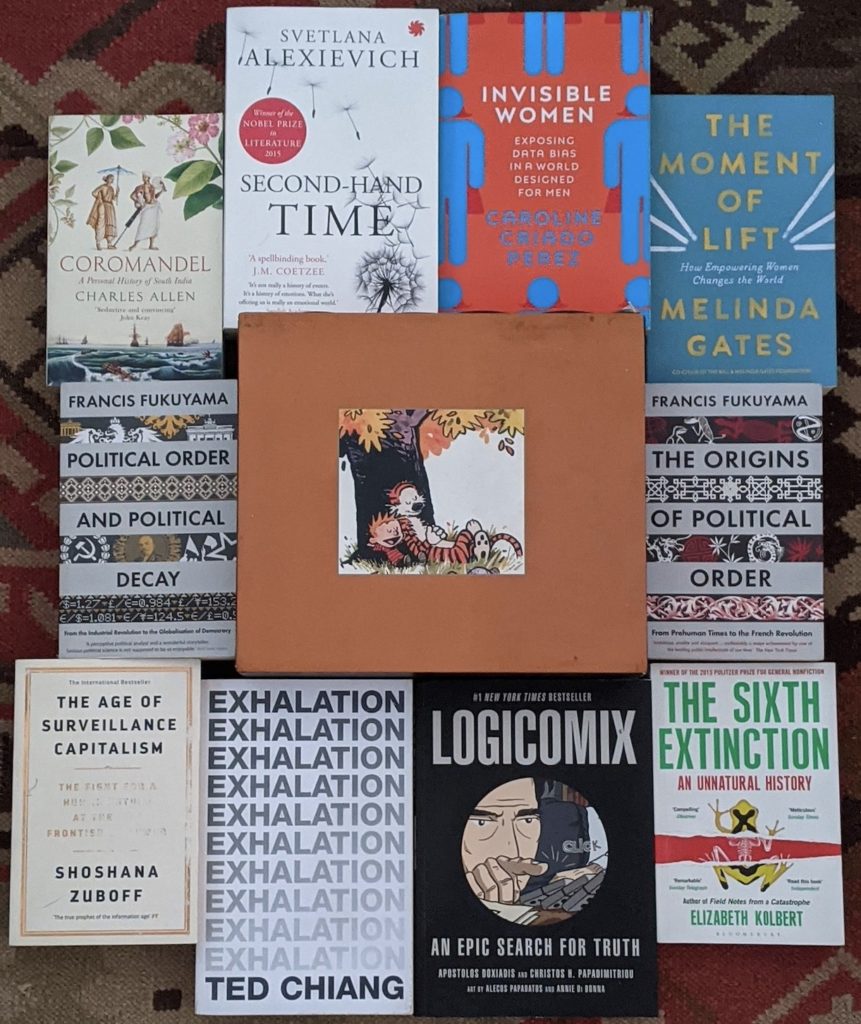
    The other primary activities – travel and eating out – took a hit in 2020, but reading prospered! Not just in terms of number of books, but the quality too. That’s why this year has a larger set, and that’s after some painful culling. And the numbers are enough to warrant a group photo, unlike last year!

    (more…)