Month: October 2020

  • The Presentation of Selfie in Everyday Life

    I will get to that “weird” title in a bit, but two things triggered this post. The first is the number of people urging, well, other people, to watch “The Social Dilemma”. Quite amazing. Especially considering how much of this advice is on WhatsApp groups. All I’ll say is, well done Facebook. Not to mention the irony of watching it on Netflix, which as I tweeted, is quite a paragon of virtue when it comes to behavioural manipulation. The second is the connection to the “Occult of Personality” – something I posted a few weeks ago. While the second order consequences on an algorithmically driven landscape was worrying, I realised that celebrities and “leaders” getting professionals to manage their social media presence was only a second order consequence of how they behaved as people on social platforms.  I also realised that this was in essence an early stage of algorithms dictating humans. Because who’s really in control when you’re always “appearing” as opposed to being?

    That provides a good context to the title, which is a bit of a wordplay on an excellent book that was written many decades ago – The Presentation of Self in Everyday Life. The author Erving Goffman uses the metaphor of a theatrical performance to explore the nuances and interplay that occur in practically every interaction we have. A deep analysis of “All the world’s a stage” and the “performances”  we give everyday to guide others’ impression of us. “Shelf worth’ on Zoom calls is a recent example. Goffman uses “backstage” as a space where we can be true to ourselves, and not be putting on an act. These days, thanks to the ubiquity of the mobile phone and social media, “backstage” is shrinking. And thus the title.

    Because we’re busy scrolling, and judging others and ourselves, and putting on a show. Leading to never-ending validation cycles that include feelings of inadequacy and envy. Once upon a time, there was happiness about something we did/experienced. As I wrote in Peak Abstraction, maybe, as we continue posturing, we will reach a stage when our signalling of happiness and its effect on others will become our measure of our own happiness. Or maybe it has already happened. Thanks to the highlight reels as presented on Facebook/Instagram/WhatsApp, things have escalated far beyond Keeping up with the Joneses. After all, with social media, everyone is a neighbour/friend, and as Gore Vidal famously said, “Every time a friend succeeds, I die a little.

    Evolution has hardwired envy in us. In the early stages of human evolution, because we were competing for resources and mates, it was an important tool that ensured we adapted, survived, and passed the gene to the next generation. Has it changed a lot, if we look at dating, jobs, promotion etc? Probably not. But it depends on whether we consider these as necessary for survival, and whether we think of them as zero-sum “games”. Journeys inward are tough, but ultimately satisfying. Asking the self about happiness is one such. Understanding it, and being able to influence yourself would be quite an amazing feat in the age of influencers! Looking evolution in the eye, and overturning its effect is also a good way to show respect.

    (in context, a wonderful short film I discovered on, wait for it, social media!) 😉
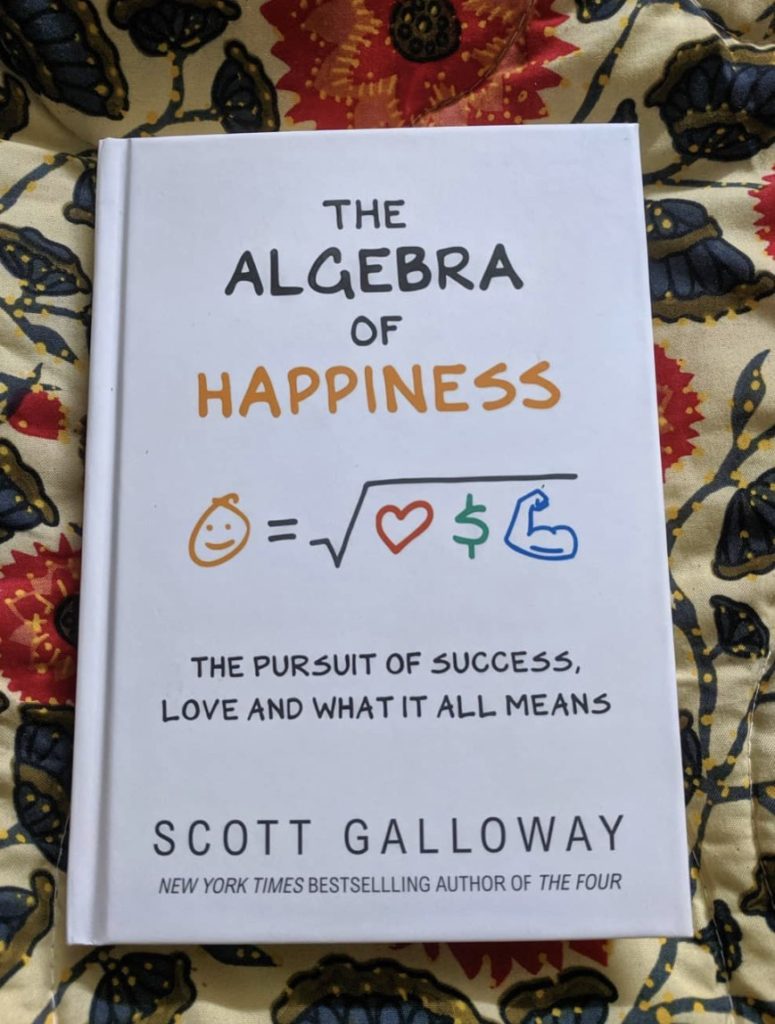
  • The Algebra of Happiness: Finding the equation for a life well lived

    Scott Galloway

    I’m familiar with Scott Galloway thanks to his various talks on YouTube. Funnily enough, I haven’t read his other book – The Four – which is related to the YouTube videos. But given the logical nature of his talks, and the reasoning behind the conclusions and predictions he makes, I was curious to find out how he approached happiness as a concept. Apparently, this is also the subject of the last session of his Brand Strategy Course at the Stern School of Business, NYU.

    If you’re not familiar with his work, it might be a good idea to watch one of his videos. For nothing else but to prepare you for his tone. It’s blunt towards abrasive, but laced with humour, and since it’s usually about brands worth billions, a roast is probably fine. I mention this because the book, despite being about happiness, follows the same style and tonality. I enjoyed it, but if you’re expecting a serious book that delves deep into the theoretical construct of happiness, this might not be the one.

    The author begins by admitting that his life is not exactly the perfect framework of happiness. Perhaps that’s what places him in a perfect spot to deconstruct happiness. Multiple entrepreneurship experiences, failed marriage, complicated relationships with parents and friends, all tend to give you perspectives of what happiness actually means.

    The book is divided into four section – basics, a deeper look at success, career, ambition, money and the professional life in general, love and relationships, and finally introspection. The age arc of happiness, the importance of having a right partner, alignment on money, not keeping score, being accountable to those who you care for and being present in their last days, understanding your own values, not being an a****ole – the lessons are delivered pretty much staccato outside of the broad sections. Profoundness and profanity coexist, and adds a lot of texture to the narrative.

    At the risk of repeating myself, this is quite unlike the standard “happiness” book you will read, but it delivers a bunch of insights that I found valuable. There is bluntness, but there is also humour and empathy, and together it ensures the book gives you some happiness.

  • What makes a full stack marketer?

    On Twitter, GG asked a question that I felt compelled to answer because I have used this on LinkedIn for a while.

    I did borrow the phrase from tech, but sounding cool didn’t quite cover it. 🙂

    To begin with, why do I use it? First, the people I want to connect with on LinkedIn are from the consumer tech, digital marketing and brand domains. This usage would be familiar to them, and would help frame my experience and expertise. The experience straddles the offline and digital space, and has media, FMCG, e-commerce and fintech brands. The second part is to do with the skill sets that I think qualifies one for that description. This is my attempt to elaborate on the latter. The “frontend” and “backend” of marketing. It covers demand generation, lead generation, and conversion but I have refrained from classifying it because it is context-dependent.

    Disclaimer: These are my perspectives of things I have worked on. I do this with the understanding that “as our island of knowledge grows, so does the shore of our ignorance” (more…)

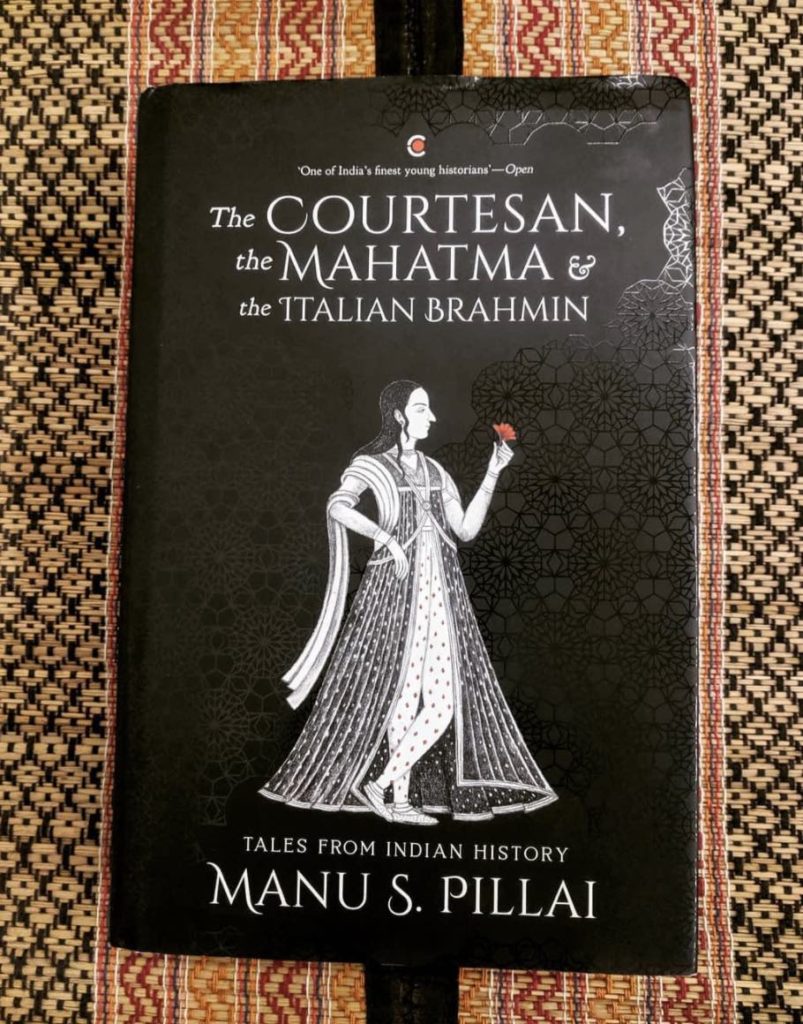
  • The Courtesan, the Mahatma and the Italian Brahmin: Tales from Indian History

    Manu S. Pillai

    I had really liked the author’s earlier work – The Ivory Throne – and particularly the last 100 or so pages where he brought out the humans from behind the aura of regality. I began seeing them in a different perspective and my engagement with the book was much richer. I think the author has repeated this in The Courtesan the Mahatma and the Italian Brahmin as well.

    The book is divided into three parts. The first part is set before the Raj, and the second, during. We’ll come to the third in a bit. All the essays are around 6 pages and I initially found this a little annoying. But it became easier once I got used to the format. The good thing is that many of them generate enough interest to make you go through the sources and that’s a lot of future reading!

    The first section definitely has the shadow of the Mughal empire looming, but barring a couple of essays, the focus is not on them. Through a collection of very interesting characters, the author illustrates the multicultural diversity of India. This section also shows how history itself changes from the time the event happens to now, and how they it lends itself to various narratives that suit a particular social context.

    The second section is relatively more contemporary, and in addition to well-known figures like Annie Besant, Veer Savarkar, V.K Krishna Menon, Vivekananda etc, it brings out those who occupy the by-lanes of history and some whom history too has left behind. I liked this more than the first section, probably because of the poignancy of stories like The Champion of Tuticorin and The Seamstress & The Mathematician. This section also offers a couple of interesting what-ifs – what would India have looked liked without the Raj, and what if the Mahatma had lived to 125 (the life span he preferred)?

    The final section is an afterword – an essay for our times, and makes excellent points on why our multiplicity is our strength, and the complicated fabric that holds us together is not something that hyper-nationalism should try to tear.

    The writing is lucid and the past does come alive. The tales are interesting in many ways – one features a Mappila Ramayana with Ravana as a sultan and Surpanakha seeking sanction from the Sharia, another one has Wajid Ali Shah trying to divorce twenty seven wives in one shot, there are a few with the East India Company’s honchos in India, and from the Italian brahmin to kamasutra to football, it covers vast tracts of history. Highly recommended if you have an interest in history, and especially off the beaten path journeys into the past.
    P.S. A few hundred more pages would have been welcome though!