Month: March 2011

  • Running for eternity

    I must confess that I didn’t like Mitch Albom’s “Tuesdays with Morrie” as much as his other book “The Five People you meet in heaven“, but writing anything negative about a non-fiction book such as this is not in good taste, so I refrained from doing a review. I also think that it is not so much a bad book and this takeout is more to do with my evolution than the writing or the concept itself.

    The good thing though is that it does have quite a few nuggets that you can chew on for quite some time. 🙂 This is my attempt to thread together a few. To be precise, three of my favourites.

    At least a couple of times in the second half, Morrie talks about how people run after the next house, vacation, car, job etc because they think that this will grant them the elusive ‘meaning, and how our culture has ‘forced’ people to feel threatened when they stand to lose their materialistic gains. This is what makes money God, and them mean. This is, of course, completely debatable, but I brought this up only for context. It led me to think that how, in infancy and in old age (from several instances I have seen, read about) and perhaps sickness, we are more concerned with needs, and at all times in between, it moves towards wants.

    On a tangent, I remembered the ‘proof of good times’ thought that I’d shared earlier, more than a year back, in ‘Progress Report‘, and how we capture images and notes, sometimes for ourselves, and sometimes for others. Ourselves, for memories, and perhaps posterity, and others, because, I thought ubiquitous social connectivity is perhaps making us inadvertently live a life we want to portray to others. I discovered a nice usage in the book that connected to this thought of eternity attempts “And tapes, like photographs and videos are a desperate attempt to steal something from death’s suitcase“.

    And while on posterity and eternity, the last one, a quote from Henry Adams “A teacher affects eternity, he can never tell where his influence stops”. I think, in that sense, every being is a teacher, and thus lives on.

    until next time, wednesdays with manuscrypts, okay? 😉
  • Book My Banquet

    [scribd id=51587905 key=key-x1misfzkbd6wo1sg7jp mode=list]

  • Oyster Bay

    In continuing with Koramangala’s tradition of multiple options for each cuisine type, we now have a seafood restaurant called Oyster Bay on the Jyoti Nivas college road. (map) This is right next to Bhima Jewellers, another good example of how we’re slowly converting it to Keramangala, the official Bangalore #mallu outpost. Oyster Bay also has a Kerala owner, I was told. 😀 The BBMP has a free parking lot nearby, so parking shouldn’t be a problem at all.

    Now I’m one of those strange Malayalis who have an allergy for most kinds of seafood. Stop looking at me like that! Piscean that I am, I’m fishy too, okay?! So I was a bit afraid that I wouldn’t have too many options here. But I checked out the menu beforehand on Zomato and found that I did have more than a few options after all.

    I quite liked the ambiance – stylish casual dining. Bright colors, functional but elegant furniture, and excellent (dish) presentation. You also have a chance to point and prey – a  seafood live counter of sorts, though only D checked it out.  (they also serve alcohol and have a sort-of lounge space)

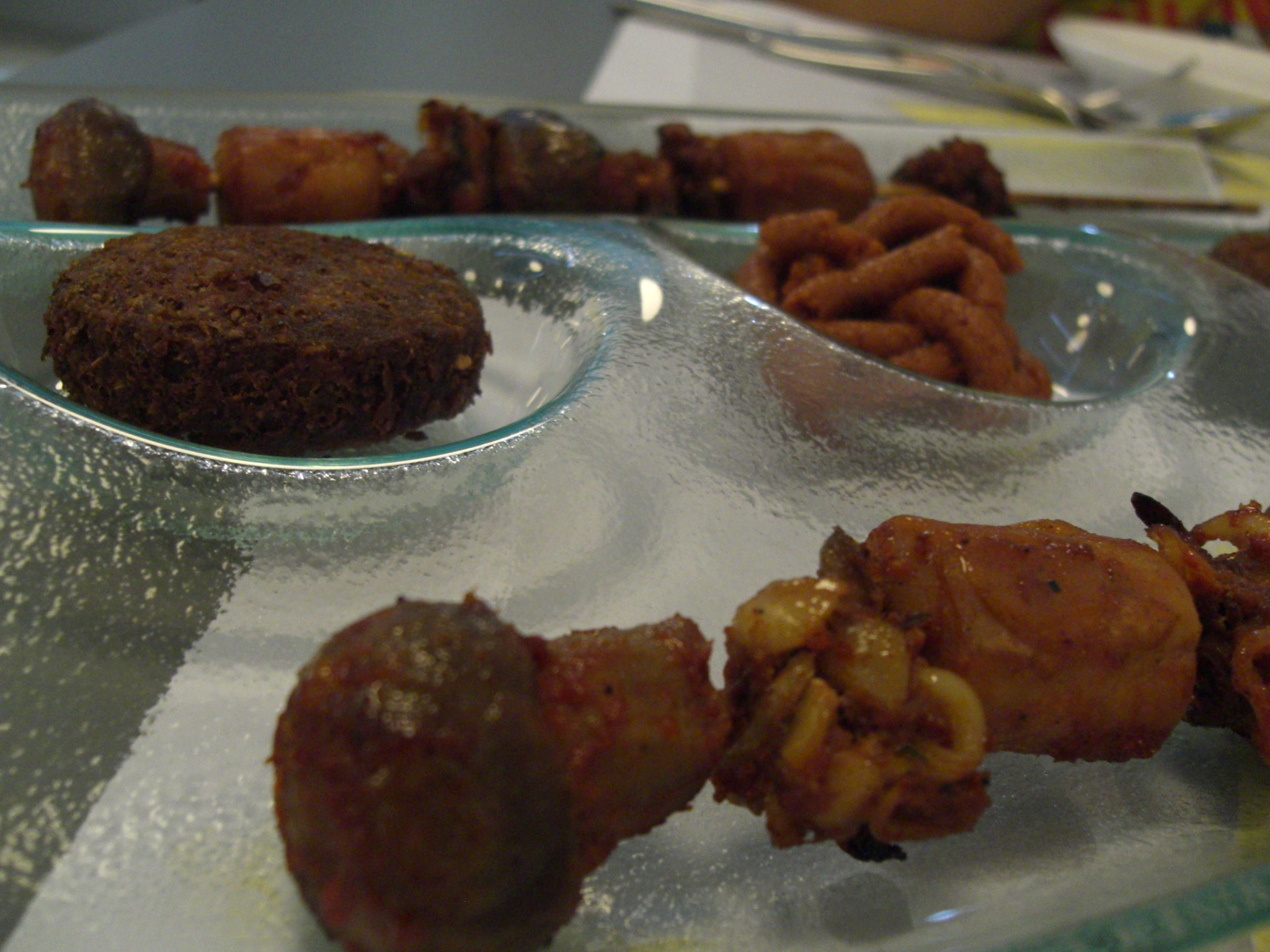
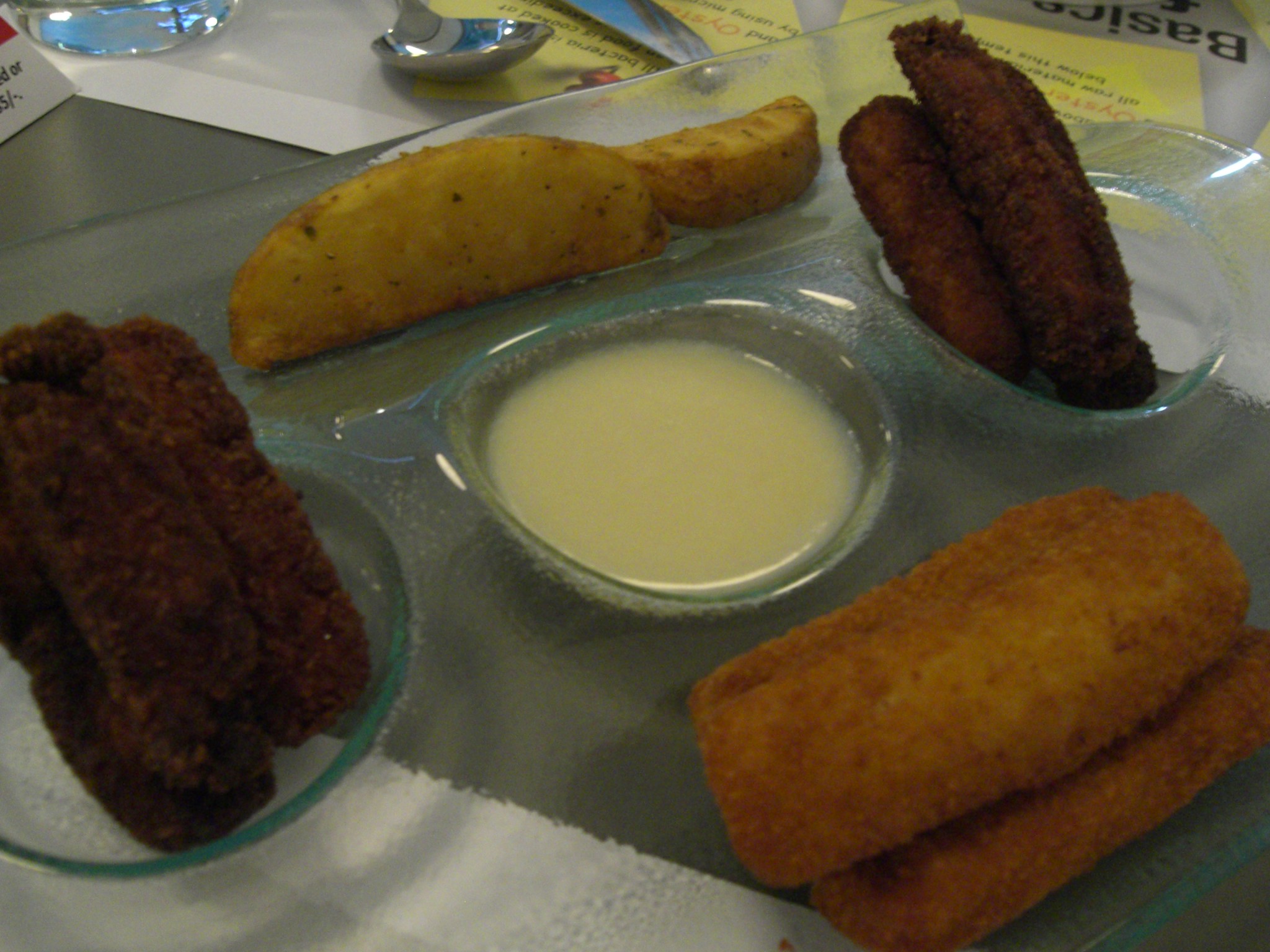
    Though we contemplated the veg soup option, we finally settled on two starters – “Mussels and Sausage Satay” and “Finger 3”. (cubed) As you can see, the former also has mushrooms for company. The ‘paste’ in the centre, I thought, had a peanut flavour, D wasn’t sure, but it was quite good. With each starter, you also get a complimentary veg starter portion. In this case, we asked for  a ‘Hara Bara Kebab’, which was reasonably ok. Overall, worth a try if you like mussels. The other starter has 3 kinds of breaded ‘fingers’ – fish, chicken and cuttlefish. The cuttlefish was excellent, the fish came a close second and the chicken was only average. The complimentary potato wedges were decent too. Most importantly, I added cuttlefish to my seafood gastronomic repertoire. 😀

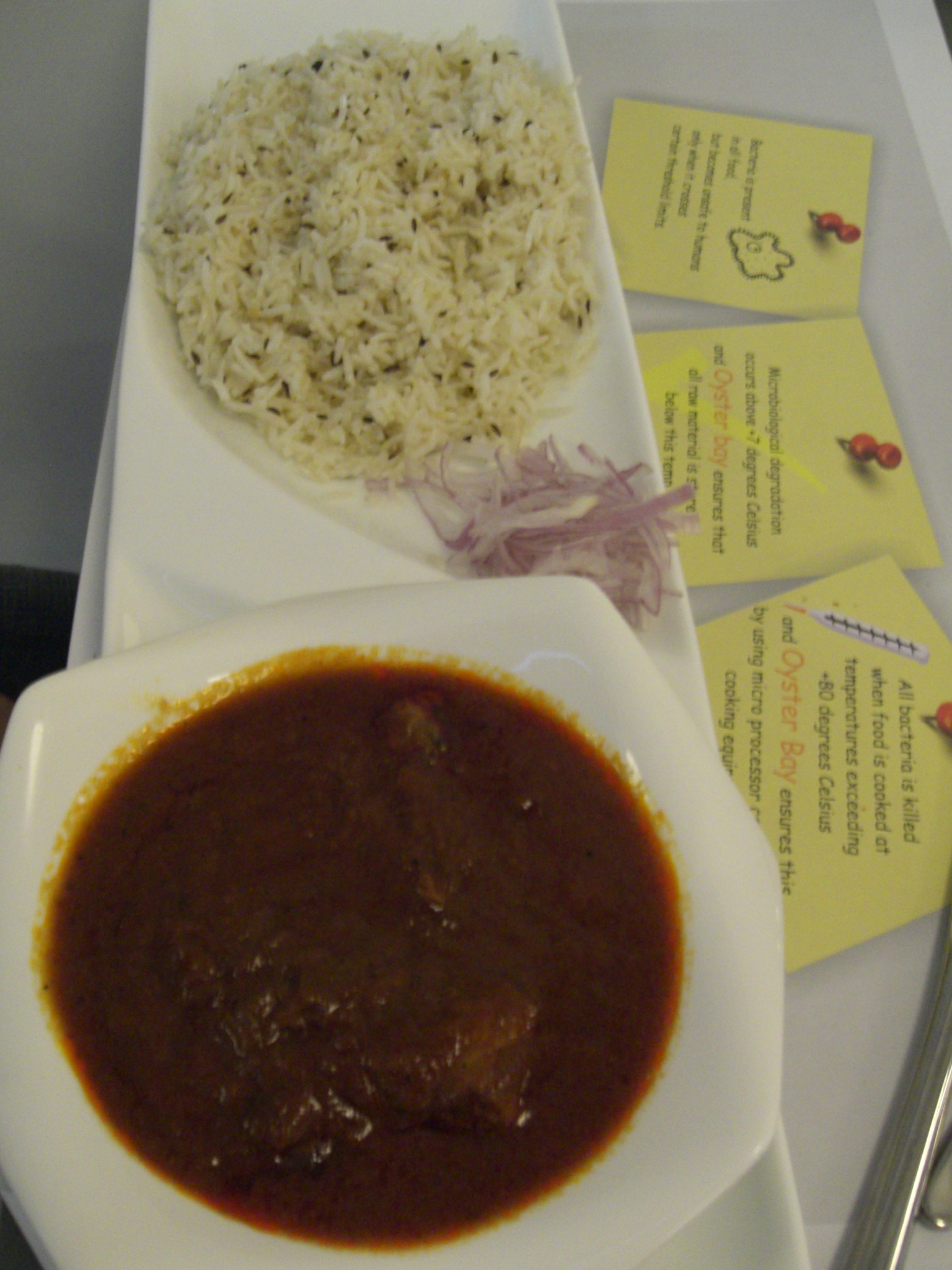
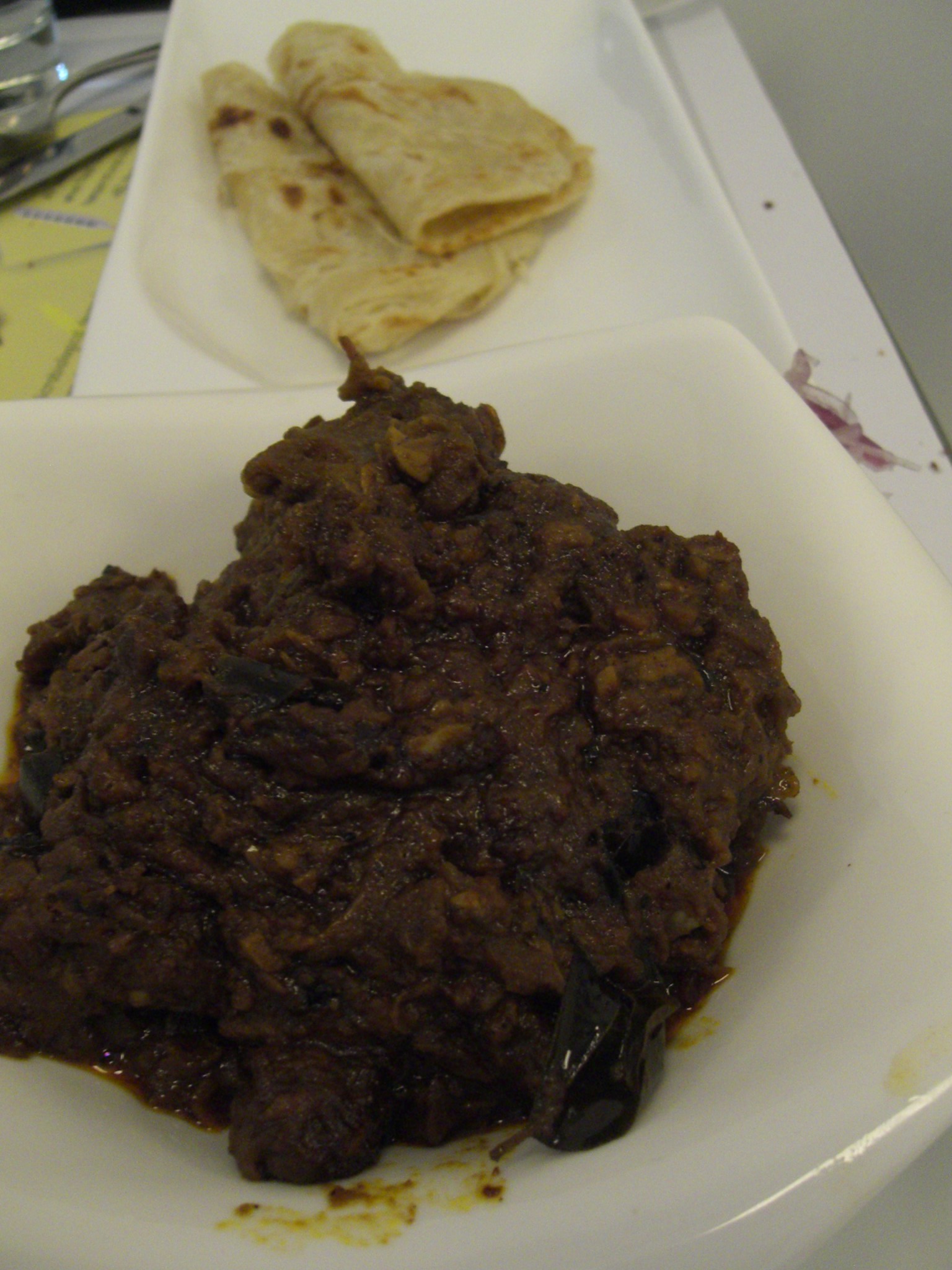
    For the main course, D ordered a Shark Ambotik and I asked for a Country Duck Roast. For all main course dishes, you can choose from Steamed Rice, different Pulaos, Parathas etc. D asked for a Jeera Pulao and I asked for Kerala Parathas. The shark dish is a Konkan one, and is sweet and spicy, though the former dominated more than I’d have liked it to. It went well with Jeera Pulao and even the plain rice which we ordered later. Shark was, I discovered, just like any other fish. 😀 The Duck Roast, despite the bones, was spot on in terms of flavour. I told D that I could actually imagine the Syrian Christian Kottayam home where it was made. 🙂

    We skipped desserts, despite a Palada option. All of the above, including a service charge and tax cost us just over Rs.950. The service was extremely good – helpful and prompt, despite the place being almost full by the time we were on our main course. If you’re into sea food, this place is a must visit. Even if you’re not, you’ll survive and judging by my experience, thrive 😀

    Oyster Bay, 77/A, Cygnus Chambers, Jyothi Nivas College Road, Koramangala Ph: 42090000

  • Weekly Top 5

    [scribd id=51588949 key=key-46fgvef6f50df3m562g mode=list]

  • New media indeed

    When I wrote this in last week’s post – “‘social’ as it relates to friends and followers’ overrules ‘social’ as a relationship between brand and consumer”, in the context of how brands use social media, I also became  more conscious that despite me relating to Facebook and Twitter as a means to connect with friends, the platforms themselves were clearly seen as a media by the world at large. Even LinkedIn now apparently has a news aggregator.

    It is true that I consume large amounts of content via (or on) Facebook and Twitter, but I have always seen it as content shared by friends, not as media like a newspapers or TV channels. It is probably because I have always associated media with information and entertainment and never social. But that’s only a personalised view, I realise. The larger picture shows a content delivery platform – media. I guess when social scaled it didn’t know what else to do but become media. Interesting how the new media platforms worked from social connection towards utility and the old media are trying to make the journey from info and entertainment to social.

    And thus when I saw a few recent Facebook developments, I viewed it through the prism of FB as media. Facebook launched Sponsored Stories a while back, using friends’ actions as an ‘advertisement’. It updated Pages giving functionalities that helped brands interact more. Now it has completely knocked off the ‘Share’ button and replaced it with an omnipotent ‘Like’ button that will transmit a story blurb complete with thumbnail instead of the earlier single line in ‘Recent Activity’. (details) Publishers won’t complain since content will be more visible now. Facebook’s comment box plugin also got revamped with better moderation, social algorithms to surface the comments that will be most interesting to you (indicated by social signals from friends) and better distribution – now, when a user utilises the “Post to Facebook” button on a site with FB comments enabled, it can be replied to on FB and will automatically be reflected on the original website as well. If the publisher has a Page on FB, it can respond to the comment and include the people who have ‘Liked’ the page into the conversation. (details) That’s a first from FB – allowing conversations to go out. Wonder what they’re after – interest graph, a perpetually signed-in user, sole web identity provider, all of the above? But in essence, a new media platform that connects publishers with users. And in this age, brands are after all content creators too, eh?

    I would think the progression is obvious – first build a user base with awesome features, then focus on publishers  (including brands) who will make it a distribution channel, and the next step would be to make the advertisers spend more.

    While Google is busy dealing with content farms in search results, I realise that we have very little means to stay away from the Facebook way of throwing content at us. Watch your newsfeed as Facebook uses you and the content publisher to make itself more indispensable as a platform. Like I tweeted, the hope is that in trying to be everything – mailbox, location, photo storage, for everyone, Facebook might lose itself. The effect all this will have on ‘trust’ in networks, I’ll leave for another post.

    Media has always been aggregating audiences by providing information..+entertainment..+social connections… and then leasing it to brands. (advertisers) With advances in technology, it’s perhaps time for brands to create their own direct lines to consumers, outside of the new media barons. Otherwise, in their immediate comfort state of using yet another platform as media, the way they’re accustomed to, it is possible that they will continue to be at the mercy of a third party and have to play by their rules, sometimes at the risk of antagonising the end user.

    until next time, mediators = media + dictators? 😉