Month: June 2010

  • Only time will tell…

    My reading list during the Sikkim trip consisted of “The Immortals of Meluha” and “Chasing the Monk’s shadow”, fiction and non fiction respectively. Sometime during the trip, I completed the former, the latter was completed long after the trip.

    The first book is a work of fiction that treats Shiva, the Hindu god, as a real person and tries to look at mythology through a historical perspective. The second is a journal of a person who retraces (almost) the epic journey of Xuanzang (the latest spelling of the person we learned about as Hiuen Tsang in school). One myth, one history. One is a possibility, the other ‘factual’.

    The first, about a Tibetan tribal chieftain who is looked upon by a civilisation as the messiah promised in their legends. The second, a monk with an insatiable thirst for India.  In this age of rapid advances in communication, it was quite an experience to be transported to a time when people got news years or even decades after it happened. A monk who starts a journey based on a certain information, only to realise that while he was traveling towards his destination, things had changed – kings deposed, lifestyles changed, faith forgotten….

    The passage of time gives us a bird’s eye view of what happened then, allowing us to dwell on the possibilities of how/if Gods were created, to interpret snippets of information gleaned from remnants of a life, what it must’ve been like. From our vantage point, we see patterns, lifelines almost crossing each other, tantalisingly close, with the possibility of drastically changing the flow of events that transpired later. All this, after patiently sifting through the layers that have been added over the years.

    I wonder if, thanks to the way we consume and share information, later archaeologists will have a reverse problem, of having to go through mounds of information- multiple perspectives to separate facts from opinions. Or maybe, it has always been like that, and the sands of time have a way of burying it randomly. It is quite humbling to think of the possibility of Iceland’s volcano being a footnote in history, because it so happened that what survived was a casual, unaffected post which treated it as a minor news, as opposed to the anguished post of someone whose plans went awry, all thanks to it.

    Another reminder that history and beyond is just a perspective we get from what survived.

    until next time, time consumes too 🙂

  • Naati Manae

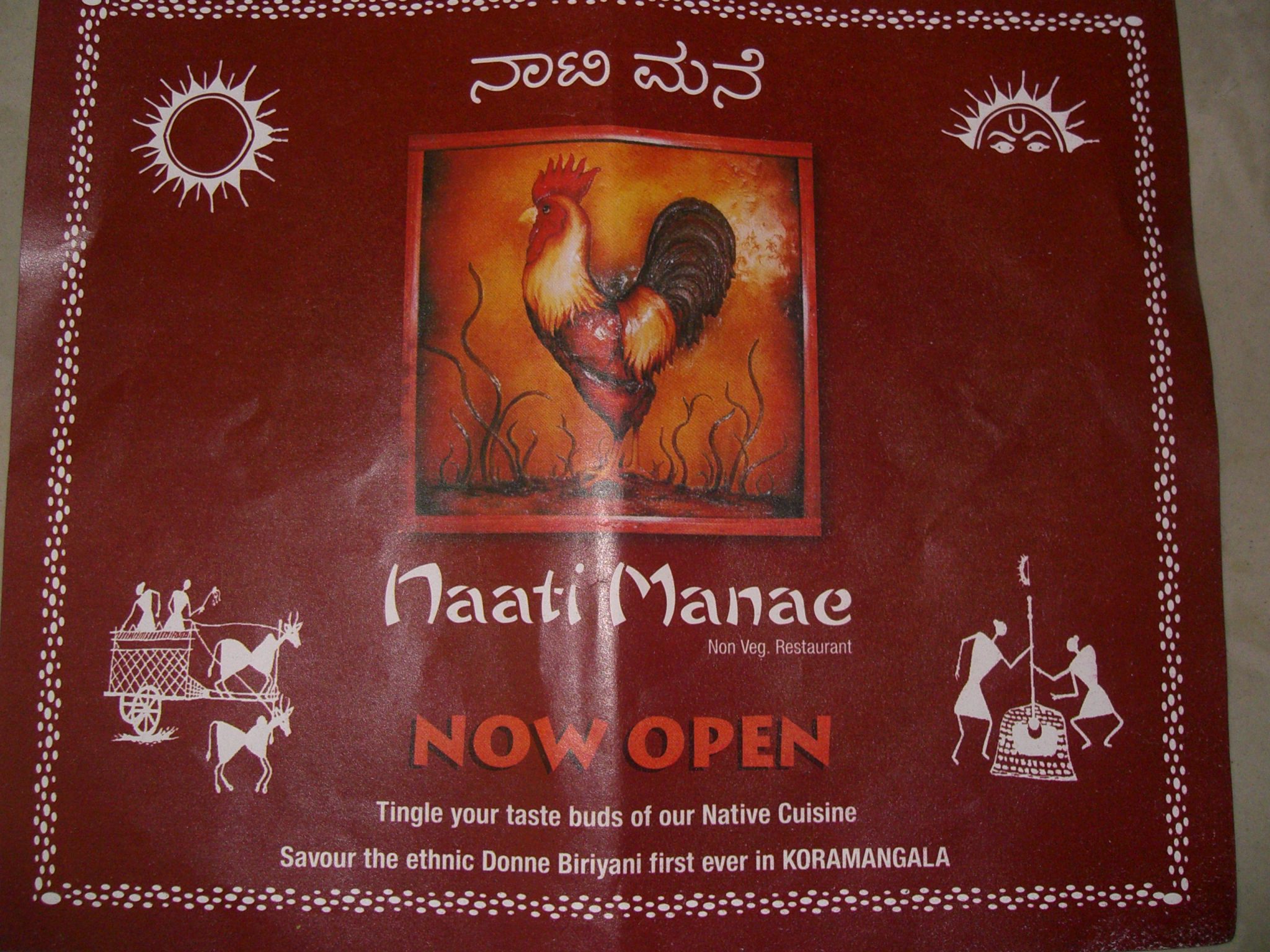
    Last weekend, we happened to go to Anjappar, and the food left us disappointed. From experience, I’ve learned that the only way to purge the memories of such occurrences is to overlay it with better ones. And that’s how we ended up at Naati Manae, which promises to “Tingle your taste buds of our Native cuisine”. The non-vegetarian wins over the grammarian easily. The good news is that we didn’t have to go to Gandhinagar/Rajajinagar or any of the Pet places that house eateries which serve this cuisine, Koramangala scores again!! Naati Manae is off the one way that goes from the Intermediate Ring Road to Jyoti Nivas College. Take the right immediately after Coconut Grove/William Penn, and then take the first left. You’ll see Naati Manae on your right. If you’re familiar with Koramangala, you could approach it from the other one way too – the one that has Oye Amritsar, China Pearl etc. Here’s a map of the area. Parking isn’t too much of a problem.
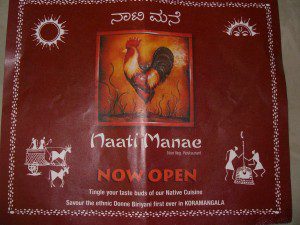
    CIMG1228We arrived at 7.30 and easily found a table. But from the experience later, perhaps we were early. The decor remains true to the ‘Naati’ theme, lots of paintings and a matching version of the spices glass topped table decor. There’s a general area which is non-AC and a ‘family room’ with AC, that’ll cost you 10% extra! The idea, I think, is to replicate the general feel of the restaurants of this genre and add to it a little bit of refinement so it appeals to the different audience. In that sense, it works. Its clean, has a no-frills ambiance, the seating is comfortable, and there’s a uniqueness that sets it apart.

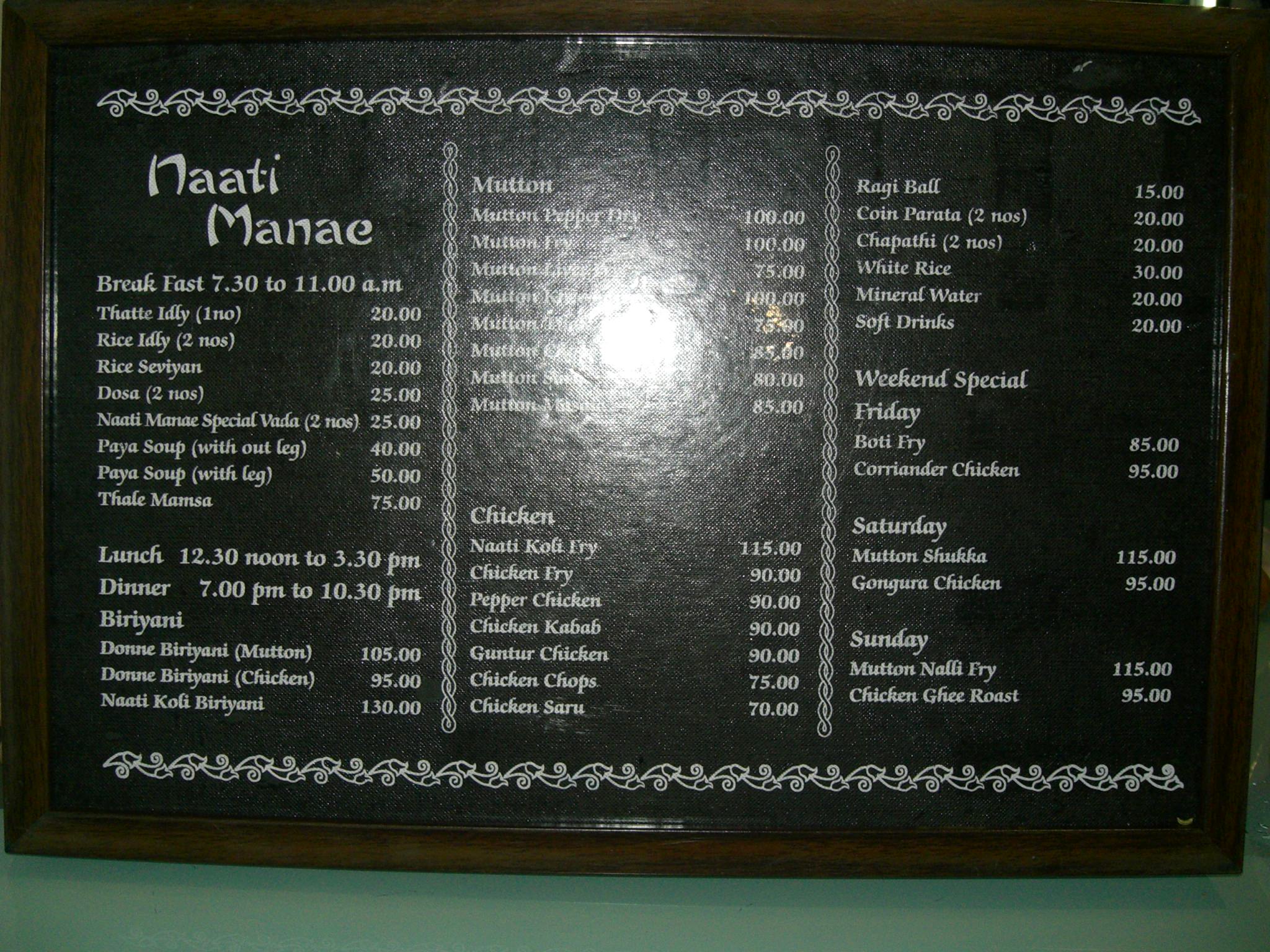
    CIMG1220The menu is kept pretty simple too (click to enlarge), with specials during the weekend. Vegetarians, as you can note, the rest of the post might be a waste of time for you. Sorry about the ‘flashy’ mutton, still getting used to menu photography 😉 (After pepper fry, there’s fry, liver fry, kheema fry, thale mamsa, chops, saru and masala) We wanted to try the day’s special ‘Mutton Shukka’ but were told it’d take at least 20 minutes. So we asked for a Mutton Pepper Dry and were given the same answer. So finally, we asked for a Thale Mamsa which we’d wanted for the main course. Its Thale, and not ‘pure’ brain, so in addition to the meat, there’s a lot of bone and hair too. A combination of thick-headedness and hunger meant that I missed taking a snap! The dish is definitely unique, with a slightly spicy flavor, and worth a try, but at Rs.75, I’d vote for Imperial/Chandu’s version of brain.

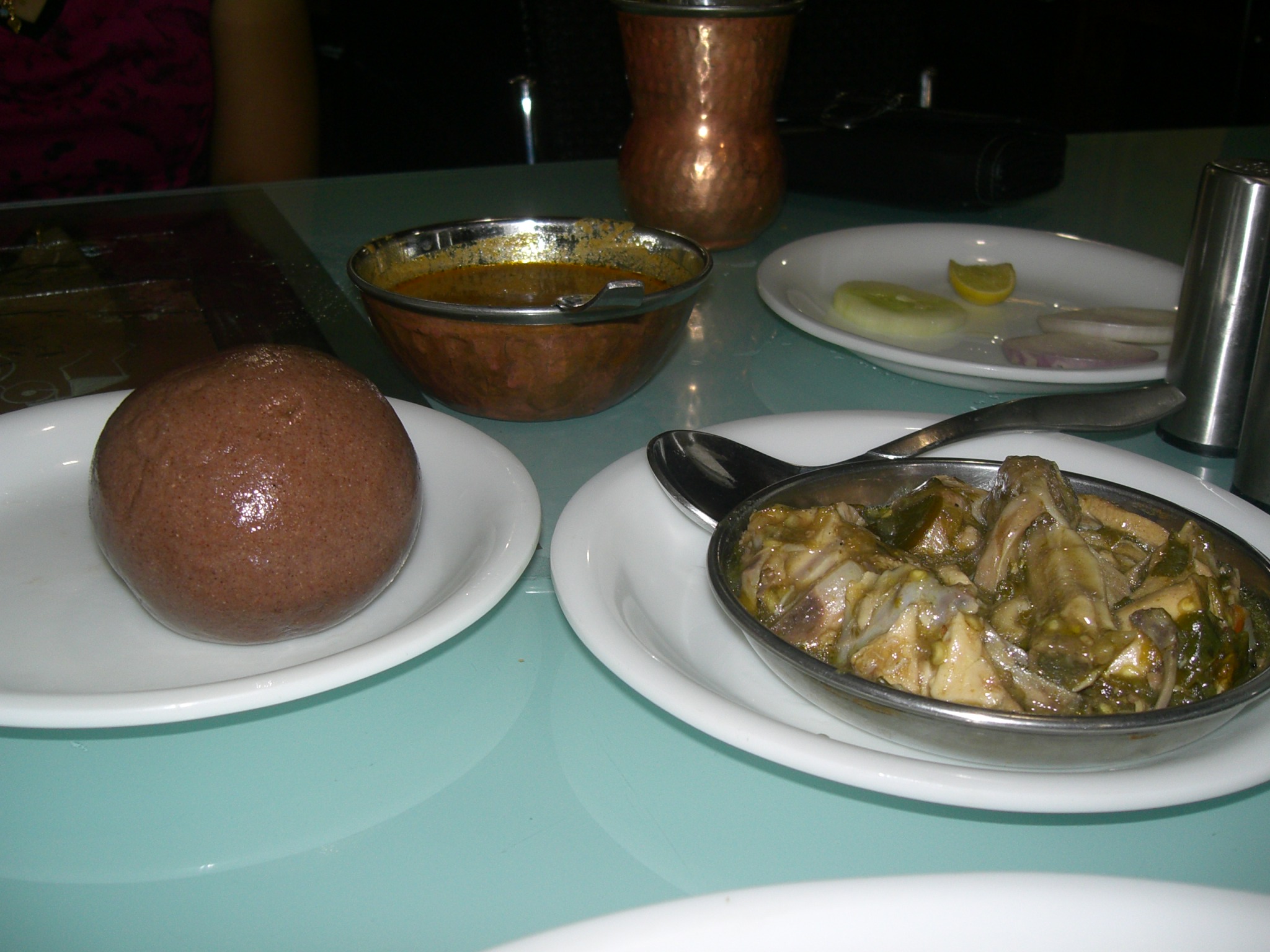
    CIMG1221Next up, we asked for a plate of coin parathas and a Guntur Chicken. Oh yes, a ragi ball too. The ragi was quite good, and exorcised previous demons of chewing gum like consistency!  The gravy that came along helped. Now, we’d read the Bangalore Mirror review and the description definitely didn’t match the dish that came to us. We checked, and it wasn’t! Christobelle Joseph, I owe you one. So we waited, with rapidly cooling parathas while the impersonator was replaced.

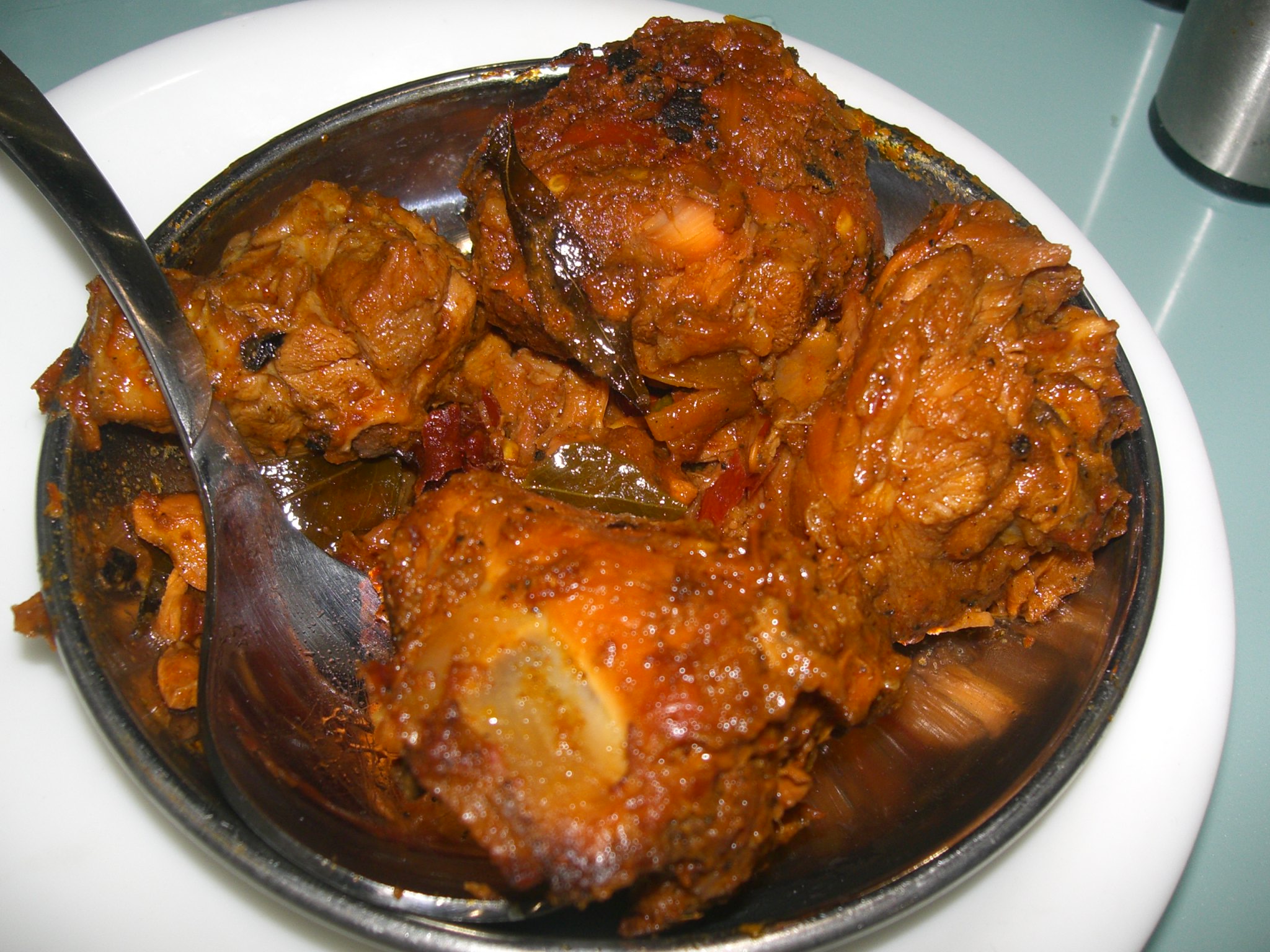
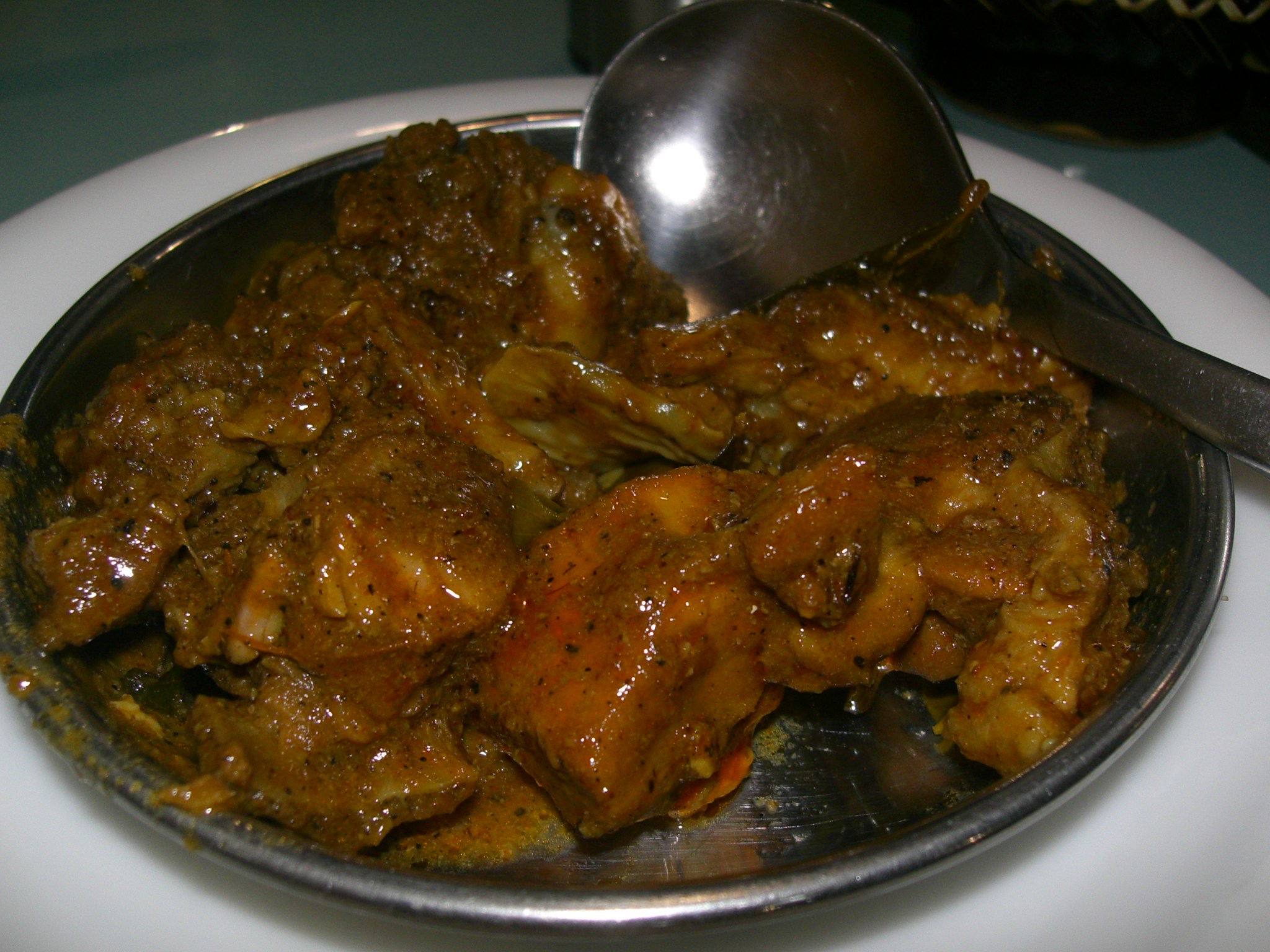
    CIMG1224Thankfully, the Guntur Chicken was worth the wait. Very spicy, especially if you also happen to consume the red chillies in the masala, and goes extremely well with the coin parathas. It’d been more than half an hour since we’d asked for the Mutton dishes, and judging by the 20 minute explanation, we thought we could try a Shukka with the Donne Chicken Biriyani.

    CIMG1225But unfortunately, it wasn’t. I really couldn’t understand the logic of having a special for the day, advertising dinner from 7 pm on, and then not having the dish ready by 8pm. Nattitude sucks! 🙁  Anyway we were told the Mutton Pepper Fry was a good option. A few minutes later, the biriyani arrived along with the explanation that the Mutton Pepper Fry was over. I stopped trying to seek explanations. The mutton fry was rumoured to be available. Once again, we waited, this time with a cooling biriyani. Thankfully, it didn’t take long.

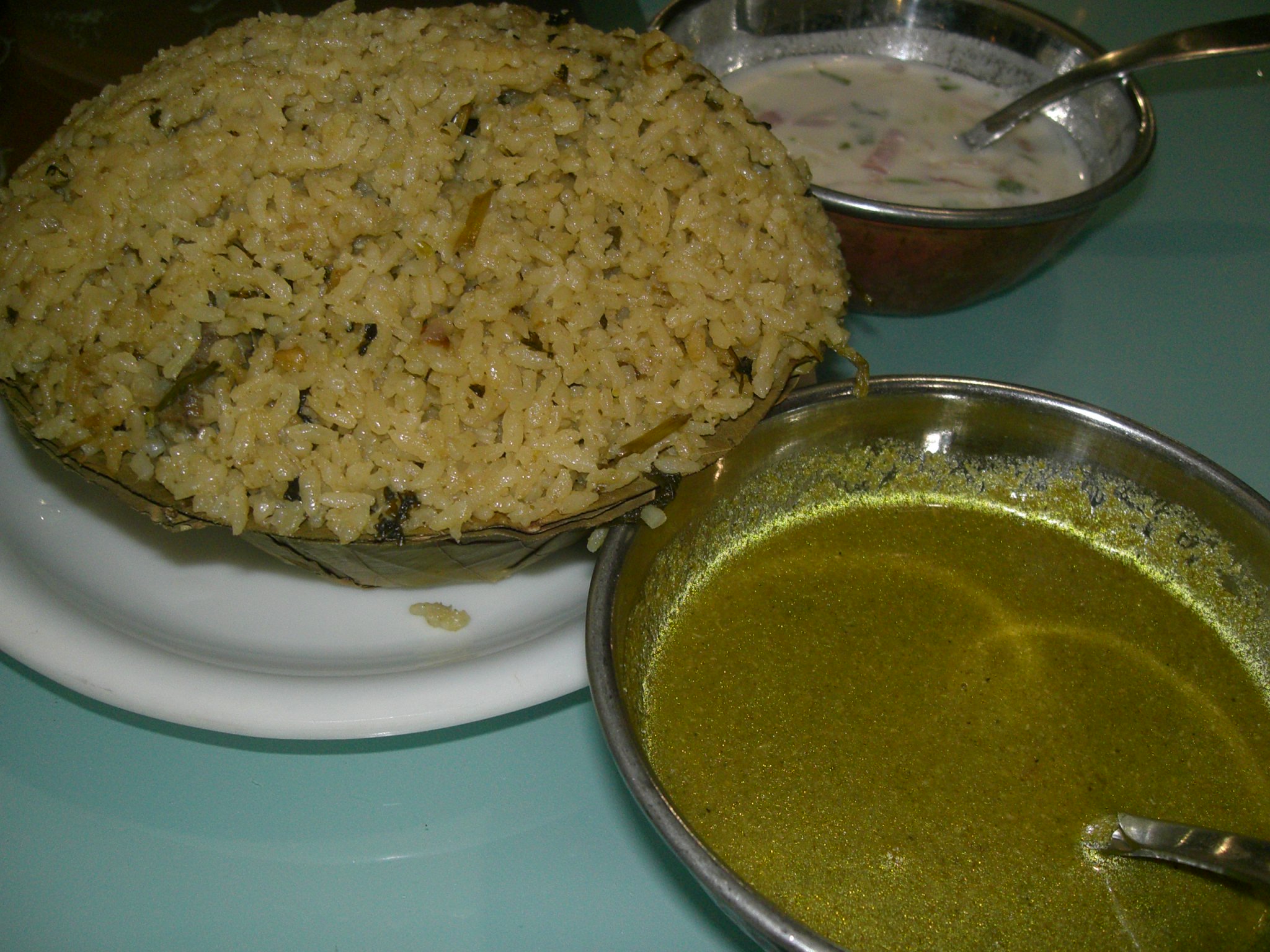
    CIMG1226The donne biriyani was easily the best among the dishes, and truly value for money. The leaf bowl really does add to the taste, exactly like I’ve heard. Highly recommended. The mutton fry was quite ordinary, and the meat seemed to exist in a confused state – cooked or uncooked.

    The service was quite pathetic. Whenever we asked for the day’s special, we were told to go for the Mutton Fry! Serving wrong dishes and recommending something not available made me wonder if I had unknowingly made Naati etiquette mistakes. Wearing shorts are not okay? 😐

    What is surprising is that though the total cost came to only Rs.395 and we were quite stuffed, I’d hardly call it value for money if I took each of the dish separately. Maybe it was the profusion of bones or the general irritation brought about by the service. But despite all that, it’s still worth a visit for a unique menu (in these parts) and the biriyani. Oh, for the record Natti Manae, you aren’t by any means the first place that serves the Donne Biriyani in Koramangala. 1st Main Road, 1st Block Koramangala, opposite Rolls United, check it out!

    Naati Manae, #334, 17th C Main, KHB Colony, 5th Block, Koramangala Ph: 40986160/1

    Menu at Zomato

  • Square Routes

    Despite my niggle with location based services (specifically Foursquare) – that the game part is taking away from the social/utility part of it, I still believe that they’re an excellent step towards bringing reality and the virtual social networks closer. And hence, I do pay attention to the developments in the domain – from how they stack up against each other in terms of features (and an excellent infographic) to futuristic scenarios and thoughts, which give some good pointers on where these are headed, and the features being added in specific LBS players and the omnipresent trio – Google, Facebook and Twitter.

    Foursquare is the only one I use, and hence I’m a bit biased. But it really has been setting a scorching pace in terms of creating opportunities that widen its scope. Badge fatigue is definitely something I’d been wondering about basis my usage, and I read that they’re now looking at adding more real value to badges, beyond the regular ‘mayor specials’ kind of deals. For example, “users who check-in at an Internet Week venue will unlock a special badge. That badge — when presented to bouncers — will guarantee users priority entrance into some Internet Week parties and events.” (via Mashable) The association with WSJ for the ‘Add to Foursquare’ button- to add venues with a single click when they are mentioned in articles – is quite a good move, both in terms of publicity, as well as utility. (because WSJ also adds a tip, with a link, so they get traffic later)

    Scoble has an excellent post with suggestions on what Foursquare should be doing, going forward. I think all of them are essential – especially badges as a platform so companies/establishments can use it too (read recently that they’re doing it, but can’t find a link), giving more importance to tips (I don’t even get points for them), adding multimedia content (Brightkite has started this already), and the checking out feature. I’d also like to add to the wishlist – the ability to (direct) message (not shout) other users, (actually buy Meet Gatsby)  a way for select users to preview my (say) weekend plan, a way to ‘like’ existing tips so future users can have some kind of mechanism to judge,  tie ups with the group buying players (see The Dealmap), and please, an app for Nokia (especially valid for India). Oh yes, these real badges and other merchandise, how about adding some Augmented Reality/Stickybits to it? That goes for the stickers that are coming out soon too.

    Meanwhile, Google has rolled out Tags – an advertising feature for local businesses that allow them to post additional information (eg. deals), Twitter is going ‘Places‘ which will allow users to tag tweets with places – its already integrated with Foursquare and Gowalla and automatically goes to a page associated with the place, and as SearchEngineLand notes, could in time, provide some good competition to Google Places. Ok, Yahoo’s trying too, remember, it bought the Indonesian service Koprol last month.  In addition there are new players set to arrive on the scene too, like Placebook!! (via) That reminds me, the Facebook ‘location’ buzz has been happening for long enough now, and I’d say that once the privacy talks have been sufficiently muted, there would be an announcement. For the record, Facebook ain’t the only ones with privacy issues. The aggregators have also arrived on the scene – Fourwhere.

    RWW has a classification of three different webs – data, people and services, all of which are the basis of mashups – current and near future. The web of people has thrown up the issue of privacy and the amount of personal data users want to share. Location based services stretch this even further. (Do read ‘Publicy and the erosion of privacy‘) As we live in the stream and move towards new social and data arrangements, what I find interesting is that without the data we share, mashups might find it difficult to throw up personalised recommendations. Users, services as well as brands will need to walk a fine line on this. Services, I think, have to do the balancing act most. They have to keep users comfortable in terms of privacy and what they receive for sharing the data. Placebook sounds good in this context. They also have to help brands deliver value to the user.  But as of now, the business models are still evolving. A recent study showed that only 10% of businesses would be willing to pay for Foursquare.  But as users evolve, consumption, social behaviour and data sharing comfort levels change and intersect, and services gear up to accommodate all this, we will surely see a rapidly changing landscape.

    until next time, location based relationships next?

  • Coincide

    A friend of mine, Soubhagya, is an avid photographer, who, despite my best efforts, still shies away from running his own photoblog. So when he asked me to take part in a writing experiment, I thought it would be a relatively painless way of introducing him to blogging, and hopefully, he’ll like it enough to do it on his own. The idea’s pretty simple – he’s given me a couple of pictures he has shot recently, and wants me to write a few words on each. Here goes

    the face of money‘The face of money’ is what Soubhagya calls it.

    What’s my value? To a politician, I’m a vote that will help him in his quest for power. To my employer, I am a worker who gets paid for the job I do. To the places I eat out in, to the shops I buy things from, I am a source of revenue. To the people who care for me as an individual, these are perhaps not the parameters of calculating their value for me. It’s a different currency. So the question is complete only if I ask “What’s my value to …. ?”  Now, what if I were to pose the question to myself? Do I measure myself by my financial status, or the lack of it? Is it the ‘Likes’ on Facebook or the followers on Twitter? Or is it by the number of lives I have touched, in one way or another? Is it a combination? Is it what I deem as my potential? How much is that dependent on externalities? And doesn’t that change with time? Which brings me to..

    Burnt out ‘Burnt Out’

    Purpose. I have always been interested in the purpose of our lives. All life forms in general, and of course, specifically us, humans. Generally, at different stages in life, we get stuck with different routines, sometimes by choice, sometimes not – school, college, work and so on. There is a short term purpose to it all, so we rarely look for something beyond. By my definition, ‘purpose’ gives a meaning to what we do, something beyond the money that it brings in, something that really makes us happy just by doing it, as though we are destined to do it. One could rationalise and say that the money then becomes a tool to ‘buy’ the things that give happiness, but that’s arguable.. We prioritise according to our baggage, some are okay with trading an amazing weekend and regular holidays for mind numbing work, some wouldn’t be able to manage it at all, and there are tons of options in between. The candle reminds me of the passion that we bring into what we do, and I believe that depends on our approach to ‘purpose’. Burn brightly or be a shallow flame? In both cases, there is a finite lifetime in which it has to be done. For me, even the task of finding a purpose is a tough one. Whichever way one sees it, there is always the possibility of a burnout. Such is life. So burn you must, and light up the place as much as you can. 🙂

    until next time, wax eloquent 😉

    PS: Now split ‘coin-cide’ and you might figure out a new possibility

  • 1984

    George Orwell

    Winston Smith thinks it is 1984, but it could be 2050, for all you know, for all you know is controlled by Big Brother. For as the book constantly reminds us “He who controls the present, controls the past. He who controls the past, controls the future.” An amazing dystopian novel that explores how an oligarchical society can completely control the minds and actions of large masses of humanity over a seemingly endless period of time.

    Winston Smith, the protagonist, is a bureaucrat working in the ‘Ministry of Truth’ in London, chief city of Airstrip One, a province of Oceania. Winston’s bob in the Records Department is to revise historical records to match the Party’s current stance on people, events etc. As he edits the past to match the present, he also maintains a secret diary in which he records his dissent against the party and its policies. This, according to the party is ThoughtCrime, and if he’s caught by the Thought Police, he would be executed. As he himself notes, ‘ThoughtCrime IS death.’. In a world where telescreens watch every movement and children are trained to spy on everyone, including their parents, to detect ThoughtCrime, Winston lives dangerously.

    Winston’s life changes when he falls in love with Julia, they carry on a clandestine love affair (that’s a crime too) in their love nest in a ‘prole’ (proletarian) neighbourhood, where they believe telescreens are not watching them. They then come into contact with an inner party official, who they believe belongs to The Brotherhood, which works against Big Brother.

    The novel is dystopian, and there’s no happy ending. It works on at least two levels levels – the obvious dangers of totalitarian societies, and the working of the human mind and its perception of reality.

    An amazing book, and well deserving of its classic status.