I read something beautiful on a LinkedIn post sometime back. Yes, miracles do happen.
उन्हें कामयाबी में सुकून नजर आया तो वो दौड़ते गए,
हमें सुकून में कामयाबी दिखी तो हम ठहर गए !
Not that I had scaled some Himalayan peak of success, but the first line fits my 30s, and the second, my 40s. The underlying mindsets are different, and so are the journeys that give me joy. But it took the larger life journey and the choices of my past self to get here.
You cannot stay on the summit forever; you have to come down again. So why bother in the first place? Just this: What is above knows what is below, but what is below does not know what is above. One climbs, one sees. One descends, one sees no longer, but one has seen. There is an art of conducting oneself in the lower regions by the memory of what one saw higher up. When one can no longer see, one can at least still know.
Some would say kids are spoilt these days. I’m not going there, but kids are definitely spoilt for choice when it comes to chasing their interests, academic pressures notwithstanding. But what’s a deep interest and what’s a fad? What’s a passion and what is a routine that has overstayed its welcome?
I thought it was an excellent reminder that not all childhood interests need to become lifelong pursuits. Maybe a reminder for adults too – both influencers suffering burnouts as well as us standard mortals. For those interests that are staying beyond their shelf lives, and for those that haven’t seen the light of day, because they are dictated by habit/self image/identity?
I wrote this on LinkedIn in the context of a Hyundai ad that ended with “Never give up on finding what you love. There’s joy in every journey.”
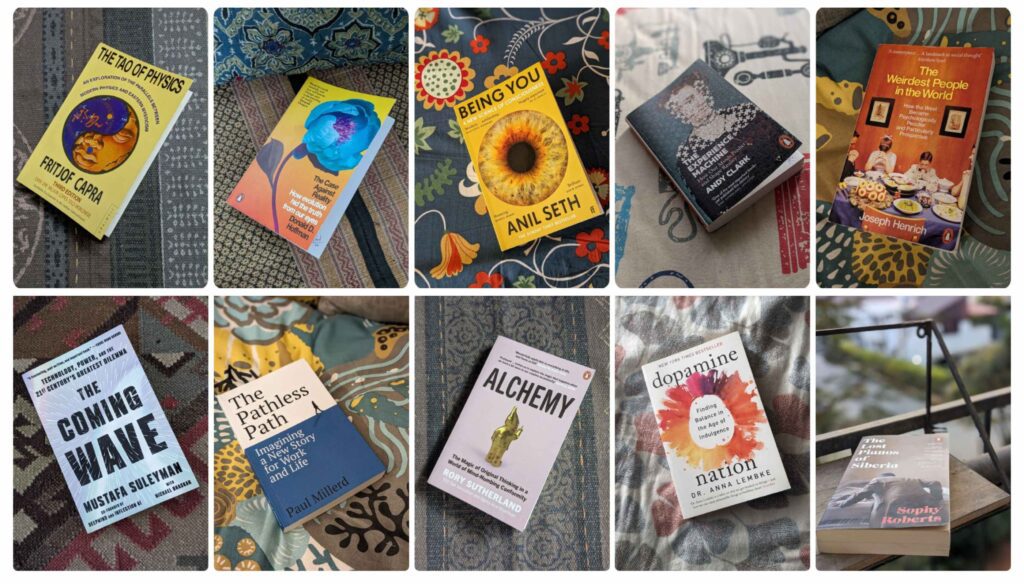
In 2024, the mind seemed to be obsessed with the mind and the reality it perceives, and that’s a good thing because I was able to take a shot at some synthesis on why I am the way I am. When you see the books, you’ll know why/how. And so, as per tradition – from 2019, 2020, 2021, 2022 and 2023 – we have this year’s list of ten (plus a few extras 🙈). From the 63 books I read in 2024…
A recent event reminded me of a post about karma I had written half a dozen years ago. The idea of the post was thanks to Umair Haque, who had a definition of karma that was different from the garden variety ‘consequences of your actions’.
Karma isn’t what you “have” or something you “do”. It’s what you are….. Karma is all the concepts and notions you hold in that tiny little head. All those concepts are stitched together by the idea of “you”, right? So karma is all those concepts, together, which determine your intentions, actions, behavior, all of it.
Japan was always the plan, it was only a matter of when. 🙂 We planned well in advance, but even then, thanks to it being Sakura season, a lot of hotels were sold out. The visa took less than a week to get processed. Bangalore has a direct flight to Tokyo. So all you have to do is, to quote Amrita Rao, ‘JAL lijiye’. Interestingly, the pilot took off immediately after we landed, confusing all of us! We finally landed again after about 20 minutes. Tokyo was our first stop. We began, and ended, our 11-day Japan trip in Tokyo. This is our list of where to stay, what to see, and where and what to eat.
What’s a visit to Scotland without a trip to the Highlands! Thanks to the Rabbie’s Tours itinerary, we were able to cover a decent bit of ground in 3 days.
Stay
Our base technically was Portree, where we stayed for two nights at the Pier Hotel, run by a very homely Effie and family. The place is right next to the water, and less than 5 minutes walk from the town square. The building, Effie told us while making us breakfast, was more than 200 years old. But for a small stay, it’ll do just fine.
The one on the top left was our room. That meant a good view of the water.(more…)
It was a little over 4 years ago that I first brought up the increasingly transactional nature of our interactions and even existence in general. I was reminded of it while listening to Amit Varma’s podcast with Nirupama Rao. Interestingly, they brought up contexts similar to what I had used – mails and rails. I had used birthday greetings going from long mails/cards to a ‘Like’ on someone else wishing the person a birthday. Travel was the other context, and I liked Amit’s example of train journeys being a unique experience. In contrast to say, the flight from point A to B.
Last year, around the same time, I had framed it as An Efficient Existence, and used the example of Taylor Pearson’s 4 minute songs – the timeframe he had mentioned for songs in the context of certain rules that creators need to follow if they want their work to be consumed and appreciated. I had brought up an earlier era of Floyd, Springsteen, Fleetwood Mac etc whose songs didn’t follow that template. Demand or supply, what happened first, I asked. Does it have to do with the abundance of choice now, and the demands of instant gratification? While templated packages for all sorts of consumption are increasingly the norm, people also want to finish and move on to the next thing on their list. Transactions. (Generalising), there seems to be very less desire to have an immersive experience. Outside the screen, that is. As the Spotify ads show (unintentionally and literally) we’re usually in a bubble, oblivious to our surroundings.
D and I watched Crime Stories: India Detectives on Netflix a few days after it was released. The episode that saddened both of us was “Dying for Protection”, which was based on the murder of a sex worker. Not surprisingly, it turned out to be the subject of discussion on a Saturday late evening, which these days are spent on the balcony, in the company of spirits, watching the sun and the world part ways. Yes, that is privilege.
The thought first occurred to me a couple of years ago, when I realised that thanks to outsourcing and automation, we would struggle today to do many things that were once life skills. We also lost a little more than that – learning.
Sometimes directly, and sometimes, through the interactions with the world, they facilitated a learning experience that taught one how to navigate the world and the different kinds of folks that made up its systems.
It was continued with a bit more specificity in a subsequent post.
Instagram, Facebook, Tinder, Spotify, Netflix, Amazon – everything is a feed of recommendations, whether it be social interactions, music, content or shopping! Once upon a time, these were conscious choices we made. These choices, new discoveries, their outcomes, the feedback loop, and the memories we store of them, all worked towards developing intuition.
Intelligence, intuition and instincts. The journeys in the first two are what have gotten the third hardwired into our biology and chemistry. When we cut off the pipeline to the first two, what happens to the third, and where does it leave our species?
An excellent coincidence that I finished reading James P Carse’ “Finite and Infinite Games” the same day I wrote this post. The book helped me frame thoughts to my satisfaction.
There was an age when accumulating possessions – from apparel brands to places visited to career designations to property ownership and anything that signals prosperity – was the game I played. Or games, because a milestone was a victory in that finite game, and I quickly moved on to another. Trophies that the world dictated. (more…)
Benjamín Labatut (translated by Adrian Nathan West)
When we cease to understand the world is one of the most unique books I’ve read in a while. Though it can broadly be classified as historical fiction, that would fail to capture the essence of the book, because the subject is science, mathematics and the deep mysteries underlying reality. Almost philosophy.
Featuring real historic figures and events, it could even be non-fiction as it explores the lives and discoveries of scientists and mathematicians who changed the way we understood the world. More interestingly, it also puts focus on the moral consequences of their work, the effect it had on themselves, and the impact it had on the world. Apparently, the scientists and their discoveries are all factual, the personal lives include some fiction.
Now that I think of it, there are at least four ‘spiritual predecessors’ for this post on the blog. It began with ‘In a world of abstractions‘ (2017), followed by Peak Abstraction (2018), The Presentation of Selfie in Everyday Life (2020), and A Proxy Life (2022). Each of them are continuing explorations of how we have abstracted a bunch of real things, and created proxies by which we measure them.
Going by the story so far, it’d be fair to say that the more things we consume, the less time we have to get into details, and the more we rely on proxies. And across time, our consumption has only increased. And so our proxies have also multiplied.
Material accumulations as a proxy for wealth
Stock price/funding for a company’s health
Popularity for excellence
Price for quality
Fitness for health
Books Read (including that 5 min YouTube video) for intellect
The Status Game had been on the list for a long while before I managed to get to it. Though there were a few perspectives that I had already read about in other books, most notably Joseph Henrich’s The WEIRDest People in the World, and to some extent Wanting by Luke Bergis, I found the overall narrative compelling and insightful.
In The Status Game, Will Storr explores the deep-rooted human drive for status, which has existed since our hunter-gatherer days, and makes a case for how it is one of the fundamental motivators of human behaviour, and how status-seeking influences everything from our personal health, happiness and identities to cultural and societal structures.
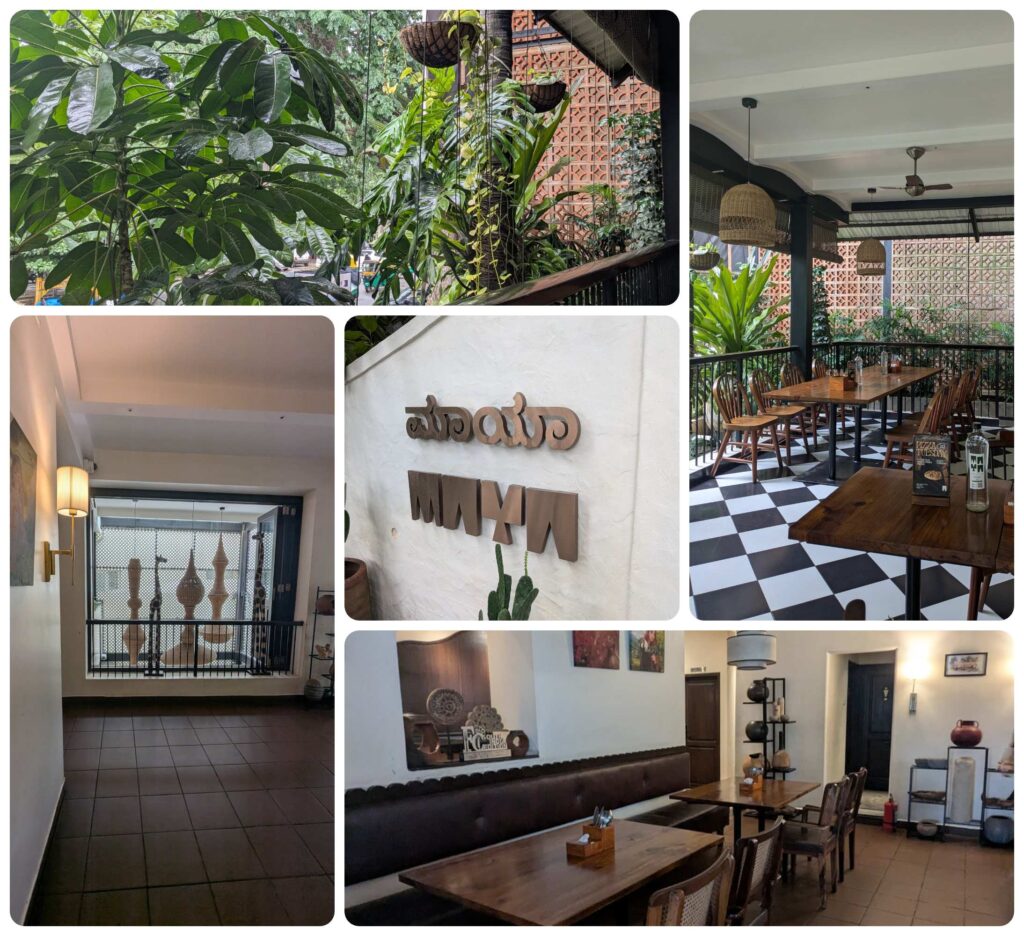
High Brew is quite far from our standard hunting grounds, and we landed here because of a whimsical ‘staycation’. We needed a Schengen Visa and didn’t want to endure the long distance journey from Whitefield to VFS, JP Nagar with the threat of being late for the appointment. So we decided to make the journey the evening before, stay overnight nearby and walk over in the morning. While searching for a place to dine at, we came across High Brew, and it won out because of one interesting thing.
The place itself is pretty vast, with three floors of seating. If you reach early on weekend evenings, you might get a view with greenery. I was told we could even see peacocks sometimes, but I am not sure whether that is true, or simply a testament to the quality and/or quantity of beer consumed. We were too late to get those seats, but found ones with the road view that was good enough.
The interesting thing that got the vote was the High Tide Palm toddy. It was decent, but we didn’t think we wanted 500 ml of it. We also tried the High Cool Cucumber Salt Lager, and made the same verdict. High Smoke (not what you think) was smoky German, and not our kind either. We finally settled for the High Cloud (Hefeweizen) and it was surprisingly good. I think the live music helped too!
The food menu is pretty standard. The Chetti Omelette sounded intriguing and was tasty enough, but didn’t go far beyond a masala omelette. The Kurpalli chicken was described as fiery but didn’t really get to that level of spice. The Kalpasi pepper Fry also was just passable.
The bill, thanks to a DineOut discount came to just under Rs.1600 and that’s probably the most I’d pay for the overall experience. Barring the Hef and the live music, High Brew was reasonably meh. Unless you stay in the ‘hood and this is your comfort hangout, I’d give this a pass.
High Brew, 3rd Main Rd, Dollars Colony, Sahyadri Layout, J. P. Nagar
A lot of the books I have read in the recent past have to do with trying to get a working definition of life and/or consciousness. I picked up ‘Life as No One Knows It’ to get more perspectives in that direction, but it gave me something else by shifting the frame. At exactly halfway through the book, there is a line that goes “what will really be alien are examples of life (biological or technological) that have traversed a completely different evolutionary trajectory than we have.” And that’s important because if we keep looking for markers based on life on earth, we may not find it anywhere else in the universe. It’s thus important to find a framework that is agnostic of life as we know it, so that we have a measurable way of recognising and classifying signs of life/intelligence when we come across it.