
Tag: YouTube

  • Weekly Top 5

    [scribd id=51588949 key=key-46fgvef6f50df3m562g mode=list]

  • Social Media – beyond strategy

    Unilever CMO Simon Clift, at Ad Age’s Digital Conference, spoke about the increasing role of social media in brand management, and said that the internet allows consumers to hijack conversations inspite of the huge money spent on advertising. From Unilever’s experience with Dove also comes the understanding that its not just the communicated parts of a brand that comes under scrutiny, but also the corporate’s entire set of credos – sweatshops, impact on environment are a few things he mentioned. Unilever has prominent corporate signatures in its advertising in UK. He also spoke about the increasing penetration of mobiles, of “marketing program with social benefits”, and a product centric approach.

    In essence, it reiterates the decline of one way communication, consumer participation, of brands being ‘deeper’ than the marketing that is done for them. But it was good to hear it from a leading FMCG corporate. The most interesting part of the article for me, however, was this, from the author of the post

    Social media is not a strategy. You need to understand it, and you’ll need to deploy it as a tactic. But remember that the social graph just makes it even more important that you have a good product. Put another way: The volume and quality of your earned media will be directly proportional to the impact and quality of your product and ideas.

    I think that nails it. All this while I was considering social media as strategy. Now I think its more than that – its something that will make the organisation really focus on what they’re delivering to their consumers, how they are doing it – not just from a delivery platform/operations pov, but also from how socially and environmentally conscious and responsible they have been. In Mr.Clift’s words “enlightened self interest”. The ways and means of communication – brand advertising, promotions, PR etc, will follow much later.

    Meanwhile, the Marketing Pilgrim asks an interesting question – does social media really have the pulse of the people? It cites the Johnson & Johnson Motrin ads that had raised the hackles of mom bloggers a while ago, and caused them to remove the ad. Apparently a research was done later that threw up some interesting stats – 90% of women had never seen the ad, and when they did see it, 45% liked it. It also speaks of the Skittles – Twitter experiment, and a research in which only 6% of 300 people sampled had heard about it. Those on Twitter would’ve heard about both these, but the Pilgrim asks whether these voices resemble those outside at all, and how much of influence do they have outside.

    I, for one, still think social media is a good microcosm of the real world. It does give varied perspectives, and the key is in evaluating the perspectives, digging further where required, and deciding on a course of action that fits larger objectives, and not knee jerk reactions. Wonder if there would have been different results if J&J and Skittles had attempted to carry the community along in their efforts.

    But the bigger opportunity, I have always felt is that it allows brands to experiment with segmentation. On one hand, the net allows extremely targeted communication to a core segment, and on the other hand, cheaper distribution allows the brand to also communicate with different segments of the long tail of consumers. It means that brands can play different roles according to the consumer’s interests, and varying with the context, by tweaking its communication, even while sticking to its core objectives. There are new monitoring tools being developed that will aid of this.

    Most importantly, it allows brands to find evangelists in each segment and work with them to improve and communicate. Consumers who find a product interesting and appealing will communicate it on their own, adding their perspective and giving a human touch of ‘interestingness’. I’m increasingly seeing posts about marketing ideas that have differed from the norm – Penguin India’s ‘Blog a Penguin India Classic’, which I wouldn’t know about if Karthik didn’t mention it on Twitter or his blog (though I do think they could’ve done it better by using social reading lists like Visual Bookshelf – on Facebook as an app too, Shelfari etc to reach Penguin readers – can easily find that through book titles), product placement ideas for Nestle evolving from the “Mad Men” on Twitter. Cisco’s comic book experiments via Chris Brogan’s post (Webex in Marvel Comics), and Kara Swisher on All Things Digital ( The Realm, an entire comic series). All appealed to me as a marketer, and one as a bibliophile too. Social media is not one thing – the channels vary in audience, kinds of interaction etc – Facebook, Twitter, You Tube all allow new ideas ( I thought Volvo’s Twitter stream inside a YouTube banner ad was very interesting) and fresh engagement rules, and ways to break advertising and brand communication stereotypes.

    I wonder about the role of strategy in a social media landscape where many things are still unfamiliar. The standards, processes and even objectives are in most cases, hazy, and evolution is happening on a regular basis. In such a scenario, perhaps organisations should first take a long look at themselves and their customers – current and potential, and start by setting goals that go beyond social media.

    until next time, lab time

    Bonus Reads: Social Media tools popular among marketers (via Digital Inspiration)

  • @having Maggi

    A couple of days back, I happened to see the TVC made as part of Maggi’s 25 years in India celebrations, and the association with the brand was so strong that I had to check it out and write a post on it.

    Right from school, when I used to exchange part of my lunch gladly for a classmate’s Maggi, until a little more than a year back, when Sunfeast Pasta replaced it, Maggi noodles used to rule the category. And even now, it makes its presence felt in the household, in the form of sauces and soups.

    The TVC has been well made and features the Maggi moments in the lives of different consumers – “camping wali maggi”, “first impression maggi”, “hostel ki maggi” etc, and even a “mumbai flood maggi”. I hunted for the TVC on YouTube, couldn’t find it, but thankfully remembered the site url from the ad. So you can take a look at it here – meandmeri.in – unfortunately no permalink, so click on the watch, and then ‘Currently on air’.

    From a consumer’s perspective, Maggi has built its entire equity based on a great product (they actually lost market share when they tried to change the product taste) . From a marketer’s perspective, the positioning has been awesome, they’ve created some memorable campaigns (most of us would still remember the Maggi jingle), and all of this has led to much emotional connect.  There are a million Maggi stories waiting to be told. So, to me, the web provided some great opportunity for the brand to connect with its consumers.

    I wanted to start with this urban legend(?) of a research which I have heard in B school, about how market research had predicted that Maggi would bomb as a product in India. It was often cited as THE example to ridicule the MR loyalists. I couldn’t find it online, but what I did find were some very cool notes. For those interested in Nestle’s brand strategy, positioning etc, here are a few links – Growth Strategy, an interview with the Nestle India MD (2007), and a case analysis.

    So, what are they doing online? I checked out the Nestle India corporate site and couldn’t see any mention there on the campaign or the microsite. Thankfully I remembered the microsite url, though I wonder why Maggi does not figure in it. The microsite is built on the concept of consumers sharing their Maggi stories, pictures, videos, and even recipes. The interface for that is decent. But what I liked best was the Maggi time machine, which shows ads from years back!! I wonder what prevented them from enabling comments on them!! So, in essence, except for a few ‘stories’, I couldn’t find a lot of conversations there.

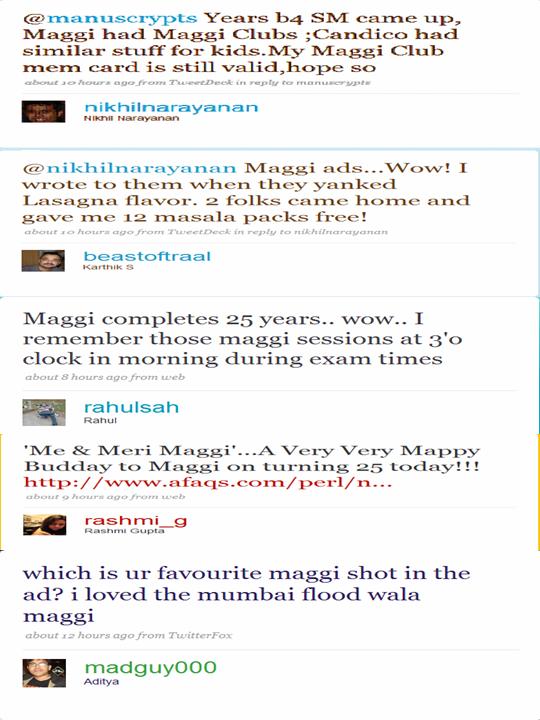
    Later in the day, I was on Twitter, and lo and behold – Maggi conversations.

    maggi

    (click to enlarge)

    I also got to know from @additiyom that there was a Facebook fan page too. While I did get a couple of Maggi pages with 5 figure fan followings, they were the international versions, and I thought this one (found on page 3 of search) with close to 300 fans was the desi version. There are many Maggi groups on Orkut, one with almost 40000 members, and 4 others with more than 5000 members. In the first group, there are about 160 responses for ‘which maggi flavor do you like most?’

    It made me think once again, of how brands make a website and  forget about the internet strategy. I’d have loved to see a more well thought out web campaign – with the microsite also serving as an aggregator of content from places where the conversation is happening, for starters. By all means use mass media and promote the site, but if the idea is about getting in touch with consumers, it definitely helps to seed and maintain conversations over at the usual suspects – Facebook, Orkut, YouTube and even Twitter. The audience is already there.

    until next time, 2 minutes definitely makes sense in real time 😉

    PS: Remember the old Maggi joke when Sourav Ganguly was out of form? 🙂

  • Where’s the movie tonight?

    Google has been struggling to get some money out of You Tube for sometime now, and a few days back,  introduced ‘Paid Search’ in You Tube. They appear on the right hand of the page and one small image and Google Adwords style text ads, as ‘Promoted Videos’. These link to the advertiser’s channel on You Tube itself, and sometimes to their homepage. You Tube has anyway been a fertile ground for viral campaigns. This should well work for branding, leads remains to be seen, since (unlike Paid search) users are only looking to be entertained on You Tube. On an aside, they also have a deal with CBS now to play CBS programs on the site, and Google TV advertising.

    The latest monetising attempt from You Tube is click to buy. (via Marketing Pilgrim) If you happen to see a good music video on YouTube, and are wondering where you can buy the track, there are Amazon and iTunes links nearby to help you out. As of now, this works only in the US, but of course, this is only a start and Google will work on scaling this up for additional content and product partners, and international users. I wonder how this will affect the distribution model of sites that promote indie music? On another front, Facebook is plotting a move into the digital music business.

    Meanwhile, closer home, Medianama recently carried a story of Landmark making a foray into online music sales, with a ‘pay per song’ model. I agree with the article and wonder how this model can work with piracy that’s so rampant. I wonder if someone would try out the Popcuts model, about which i’d written about earlier. Otherwise, mobile seems to be the only way for digital music.

    While audio seems a tough place, there is definitey some action happening in the video space. Here’s a review of Moviemart, an online DVD rental company, and a report on the DVD rental market in India, on Trak.in. I also came across the news of Hulla’s release on BigFlix, simultaneously with its release in cinemas. I think Vivah was the pioneer in this.

    With DVD rental companies getting their distribution in place, online video sharing sites figuring out revenue models, and DTH, with its ‘movie halls’, increasing its penetration, I wonder if we’ll see the simultaneous release of mainstream Bollywood and regional movies on DVD, DTH & online (a pay per view model) and cinema screens. I’ll be particularly interested in the online piece – a social angle to it by tying Bigflix with Big Adda, and involving movie communities to do word of mouth publicity, ‘invites only’ premieres and so on? Perhaps a virtual multiplex screening on Second Life later? 🙂

    until next time, so many tubes..
  • One for the elephant

    आप ट्यूब says Google Translator when I asked for a translation to celebrate the launch of You Tube in India. This will give you the details including the content partners that has the likes of NDTV, Zoom, UTVi, Bindass etc. I’d written earlier about the other video sharing sites. This launch should be a huge blow to all of them unless they can really do some differentiation.
    All this attention for India had already made me feel very globally wanted 🙂 and then I read this in the morning about Yahoo India launching a different kind of search – Glue. What is different? Lets try an example – Aamir Khan. Unlike say, a Google/Yahoo search which gives you links, and you can make it images or videos or blogs etc at a button click, what the new Yahoo Search does is give you not just the links, but also quick facts, videos, images, (boring?) Yahoo Answers , LastFM top tracks ( :p you didn’t expect those ). Interesting, don’t you think, even though it would be significant only for celeb entities and not for people like moi? Of course, Live Search does give some images, but this goes beyond that. And for now, i think, it happens only in India, and so we’re no longer glueless in search (okay, i shall refrain) 🙂
    I had this sense of deja vu, which i thought was because of a blog platform experiences of a similar nature, but I was wrong. A bit of search in my Favourites pointed me to this. Not surprisingly, from yahoo themselves, and a while back. Okay, this one doesn’t throw up Radio (Yahoo Music? for international version), but hey, its got Wiki, and you can customise your search. Take it for a spin and see if you can discover more.
    I have a suggestion, considering that you’re looking at search, and the world is going social, how about including one of my fave Yahoo acquisitions del.icio.us also in this new search page? Think about it, if i have searched for some stuff on our currently used example Aamir Khan, and if i found it interesting, I’d have bookmarked it. Of course, while privacy settings do exist, a lot of this kind of content would be public. Which means that the search might also throw up (through the del.icio.us links) some interesting but not so well known links about Aamir. In addition, Yahoo also gets some mileage for Del.icio.us.
    But meanwhile, sigh, all this for the 9% broadband penetration. The elephant had better get a move on, if all this interest is to be sustained.
    until next time, a search engine for soulsearching 😉