Tag: Yahoo

  • Square Routes

    Despite my niggle with location based services (specifically Foursquare) – that the game part is taking away from the social/utility part of it, I still believe that they’re an excellent step towards bringing reality and the virtual social networks closer. And hence, I do pay attention to the developments in the domain – from how they stack up against each other in terms of features (and an excellent infographic) to futuristic scenarios and thoughts, which give some good pointers on where these are headed, and the features being added in specific LBS players and the omnipresent trio – Google, Facebook and Twitter.

    Foursquare is the only one I use, and hence I’m a bit biased. But it really has been setting a scorching pace in terms of creating opportunities that widen its scope. Badge fatigue is definitely something I’d been wondering about basis my usage, and I read that they’re now looking at adding more real value to badges, beyond the regular ‘mayor specials’ kind of deals. For example, “users who check-in at an Internet Week venue will unlock a special badge. That badge — when presented to bouncers — will guarantee users priority entrance into some Internet Week parties and events.” (via Mashable) The association with WSJ for the ‘Add to Foursquare’ button- to add venues with a single click when they are mentioned in articles – is quite a good move, both in terms of publicity, as well as utility. (because WSJ also adds a tip, with a link, so they get traffic later)

    Scoble has an excellent post with suggestions on what Foursquare should be doing, going forward. I think all of them are essential – especially badges as a platform so companies/establishments can use it too (read recently that they’re doing it, but can’t find a link), giving more importance to tips (I don’t even get points for them), adding multimedia content (Brightkite has started this already), and the checking out feature. I’d also like to add to the wishlist – the ability to (direct) message (not shout) other users, (actually buy Meet Gatsby)  a way for select users to preview my (say) weekend plan, a way to ‘like’ existing tips so future users can have some kind of mechanism to judge,  tie ups with the group buying players (see The Dealmap), and please, an app for Nokia (especially valid for India). Oh yes, these real badges and other merchandise, how about adding some Augmented Reality/Stickybits to it? That goes for the stickers that are coming out soon too.

    Meanwhile, Google has rolled out Tags – an advertising feature for local businesses that allow them to post additional information (eg. deals), Twitter is going ‘Places‘ which will allow users to tag tweets with places – its already integrated with Foursquare and Gowalla and automatically goes to a page associated with the place, and as SearchEngineLand notes, could in time, provide some good competition to Google Places. Ok, Yahoo’s trying too, remember, it bought the Indonesian service Koprol last month.  In addition there are new players set to arrive on the scene too, like Placebook!! (via) That reminds me, the Facebook ‘location’ buzz has been happening for long enough now, and I’d say that once the privacy talks have been sufficiently muted, there would be an announcement. For the record, Facebook ain’t the only ones with privacy issues. The aggregators have also arrived on the scene – Fourwhere.

    RWW has a classification of three different webs – data, people and services, all of which are the basis of mashups – current and near future. The web of people has thrown up the issue of privacy and the amount of personal data users want to share. Location based services stretch this even further. (Do read ‘Publicy and the erosion of privacy‘) As we live in the stream and move towards new social and data arrangements, what I find interesting is that without the data we share, mashups might find it difficult to throw up personalised recommendations. Users, services as well as brands will need to walk a fine line on this. Services, I think, have to do the balancing act most. They have to keep users comfortable in terms of privacy and what they receive for sharing the data. Placebook sounds good in this context. They also have to help brands deliver value to the user.  But as of now, the business models are still evolving. A recent study showed that only 10% of businesses would be willing to pay for Foursquare.  But as users evolve, consumption, social behaviour and data sharing comfort levels change and intersect, and services gear up to accommodate all this, we will surely see a rapidly changing landscape.

    until next time, location based relationships next?
  • Twitter lists, Social Search and brand content distribution

    So its been quite a while since Twitter lists launched, and the ego seems to have stopped trending now. The open API means that we can hopefully see a some interesting apps/services (eg.directories like Listorious or alert systems like Listiti) soon. In fact, Twitter has already made an interesting widget, which you can see in action on the left side, at the bottom. Its a list of people who create/share content/have an interest in the Indian web space.

    Meanwhile, though Twitter lists will add a new dimension to search – people, content etc, like I mentioned in the last post, and create perceptions about people (basis lists they appear in), there are already directions which make me feel ambivalent (country lists, and I agree largely with this take). Even as they try to balance utility with threats like spam, I wonder what features Twitter will add to lists – feeds of lists, search (and advanced) within list tweets or add this option in existing search, one click DM to all members of a list (at least by the creator for starters),  or at least a way to send a tweet to only a list (so that I can be more pertinent to specific kinds of users – eg. there are those who hate my godawful puns, but like the links I share 😀 )

    (Let me know if these exist in some form – even on apps, and add on the features you can think of)

    Another line of thought occurred to me while on Twitter lists – brand communication. It started off by me wondering whether we’d now see brands occupying Twitter backgrounds of relevant lists (considering the web interface is still the most used source of tweeting) say, Star World on a a Heroes/Lost fans list, Kingfisher on a beer fans list. (all of you brands pay Twitter and the list creators, please) Taking that further, would we have brands create lists? Hopefully, not just something as vanilla as their fans, but say, a relevant common interest topic. 🙂

    This led to a larger picture of how brand communication’s distribution would evolve. This also fit into last week’s post – aggregation of content and serendipity. How would brand communication fit into the varied methods of content consumption, aggregation and discovery?

    Even as new distribution and consumption patterns develop rapidly, the identity of the traditional distribution means i.e. mass content creator-aggregators (newspapers, TV. and even web entities) as just a platform for vanilla advertising (and that includes ‘innovations’ like force-fitted editorial) has been changing for a while now. For example, Yahoo, even as it takes steps in creating and curating content, is also making deals “to help marketers creatively incorporate their brands into original online programming. The programs will appear exclusively throughout Yahoo!’s network of leading media properties including News, Sports, Finance and Entertainment.” ESPN Sports Center worked with Toshiba to create advertising that illustrates specifically how ESPN fans could use Toshiba TV sets and laptops. But all that’s still only creating more context. Seemingly seamless content and advertising, tricky territory, that.

    To compare it with say, Twitter lists, the latter already have the context and the audience in one place, and these are created by the audience themselves. Isn’t that at least a step ahead. Meanwhile, there’s another way of looking at it – the Google way, using Social Search, and that includes not just Google’s own services like Reader, Profiles (and that means all your other service details you shared there and your respective networks), Mail contacts, but also Twitter. That means, when a person is searching for information, Google can now give him socially layered real time results, quite a good start to a man+spider filtered way of search. I have to wonder (again) how long the SEO way of making sure the brand website appears on top will work.

    All of the above – traditional content platforms, social platforms, search are different kinds of people and content aggregators, and options for brands to create/share content (self created or UGC) in. While it might look challenging, it offers enormous possibilities of tailoring content according for the brand’s different audiences and their needs. They have varying sets of positives and negatives, several parameters will decide the medium, but as far as the message goes, interesting content is now, increasingly and thankfully mandatory. 🙂

    Brands have always been experiences. Brand communication has sought to build/reinforce/manage perceptions. In an unconnected world, the audience had to rely on the communication, and the small set of experiences that they knew of – their own, and those of their circle of friends, relatives etc. In a connected world, the audience will experience in many more ways, and the content they create will be shared and distributed in ways they deem fit, across a much larger audience. Perhaps, now, the experience is the message, and the audience is the medium.

    until next time, medium, message and mob mastery 🙂

  • Brand equity in real time

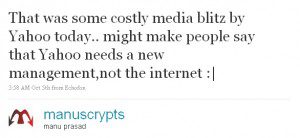
    Media Post reports that Yahoo’s latest campaign caused its perception among U.S. adults to fall steeply – apparently, YouGov’s BrandIndex, which tracks daily consumer perception of brands, found that Yahoo’s buzz score had tumbled from 35.4 on Sept. 22 to 25.5 as of Monday. Acknowledging India’s growing significance, the $100 million (global) “It’s Y!ou” campaign was rolled out in India too – y!ou couldn’t have missed the “disruptive” frontpage takeover of multiple mainstream dailies or the TVCs. My views on it were expressed in <140 characters

    Clipboard02

    Before you take me for some kind of Yahoo hater, I’m not. (Actually, I’m quite a fan of the Carol Bartz style of no-nonsense management – typified by the last few lines here) In fact my irritation with them stems from their relative disinterest towards a few tools that were original pathbreakers and that they’ve had for a long time – most importantly ‘delicious’, but I’ve written about that earlier, and some work on that service has happened since. So, anyway, Yahoo, this is not about you, you were simply a prolongued prologue, and a good example.

    A couple of weeks back, when writing about Wave, I’d wondered  “is brand equity an excuse/surrogate for thin value, and exist only in theory, or until the last good product?” This entire activity above somehow reminded me of that. Brand equity, and the lord knows there’s no shortage of definitions. (ignore the newspaper brand references)  So why did I think brand equity is now a surrogate/excuse for thin value?

    Every brand that enjoys good equity now must have provided ‘thick value’ at some point of time, to its audience. At some point though, did the ‘brand’ take over, and the focus become more on perception management, rather than as an aid to retaining/attracting customers. Is that the reason why brands in many industries cannot find a way past the disruption they’ve been facing – because they’ve been focused on creating brand equity basis communication and superficial value additions, and sticking way too close to the specifics, like competition, and not bothering about the generic fulfilment of a need?(classic example, newspapers and news delivery) Somewhere did brand and marketing communication start dominating the proceedings, at the cost of the basics – a product solving a need/a distribution that increases convenience/the factor that built the equity in the first place? And then did they shortchange consumers by putting a premium on the brand’s equity without delivering value? While trying to build the emotional connect and create a value perception beyond the commoditisation, did the means become the end?

    Take Yahoo for example. By an unfortunate coincidence, last week, GMail replaced Yahoo Mail as the most popular email service in India. I can imagine why. Like many others, I have multiple Gmail ids, and a Yahoo id too. While I open Yahoo because of a couple of e-groups, GMail is my primary communication centre. It has never been static, features and tools have been added to a point where I wonder how I worked without them. (try operating in basic HTML for a while) I checked Yahoo out again, with as fresh a perspective as i could, and didn’t find anything that could make me consider a shift. I still use Delicious a lot, and it still has a lot of equity (in my mind) going for it. Yahoo’s brand campaigns have nothing to do with it.

    Maybe the concept of brand equity had some merit when the audience didn’t talk to each other, but as WOM keeps getting bigger,  push brand communication is bound to become more meaningless. As consumption patterns change, needs change, distribution systems change, as real-time becomes the norm,  and exit barriers and costs for consumers come down, relying on a static and uni dimensional concept of brand equity is bound to be harmful. Also, with fragmenting media, fragmenting audiences, and an increasing importance for ‘my experience’, brand equity will be different things to different people at different times, and even the hazy setof objective measurements in vogue today, would be rendered ineffective. (Yes, it might have been the same before, but in an earlier era, consumers did not talk to each other, and it was easy to push the brand’s equity on to consumers). (Generalising, but) Take a look at the communication and taglines adopted by brands, their superficiality, the efforts that go into forcing the tagline’s emotion/value into the actual value provided, and thereby build/increase brand equity and you’ll see what I mean.

    Clipboard02

    Perhaps, product equity will be the only measure that matters, and brand equity will be earned and burned real time, as consumers share feedback and rely on their trusted sources for updates, and historic performances will decrease in significance. (when the Fail Whale comes out on Twitter, evangelists become bloodhounds, or whatever..you know what I mean) And so perhaps, from a brand perspective, its about time that meaningless communication took a back seat, and we went back to the basics of brand equity, that may mean redefining the roles and responsibilities of everyone associated with ‘brand’ as a function. Because if you’re good, they’ll talk about you, and if you’re bad, they’ll talk more about you 🙂

    But you know what, I had more fun when i thought about a parallel. Thought leaders. Replace ‘brand equity’ with ‘thought leaders’ (or personal brand equity) and tell me what you think. 🙂

    UPDATE: Yahoo hires a new agency, tells Ogilvy “It’s not Y!ou”.. Damn, that was fast!!

    UPDATE 2 Meanwhile, a homepage redesign gives them 9% more page views and 20% more time spent.

    until next time, equitable solutions..

    Bonus Reads:

    Braggarts take over the web

    Almost unrelated, but an excellent read – Jerry Yang’s Advice in Interesting Times (via @mukund)

  • What’s on TV? The Internet

    The confluence of web and TV has been a topic of discussion for quite sometime now. The initial version of Web TV- with a set top box and keyboard, didn’t work out well, but that hasn’t stopped the next generation from making attempts, and with all the components required for access built into the TV now, things are showing some promise.

    Yahoo’s TV widgets, with Flickr, news, finance etc integrated onscreen in Samsung TVs had created quite a stir at the CES 2009 event earlier this year. Yahoo and Intel have also co-developed a range of products that lets users access pages and tools while watching a program – around 20 widgets (scaled down versions) from the NYT to MySpace and Twitter. Yahoo will also release a toolkit for developers to make new content.Yahoo is not the only player here. Netflix has tied up with LG for a new line of broadband high-def TVs with Netflix built in to it. More on that here.  Verismo Networks has a PoD device – VuNow that can stream web content onto your TV without a PC or connections. (via Bangalore Inc) On another front, there are gaming consoles and DVD players etc with built in broadband access abilities.

    Meanwhile, the convergence is happening on the reverse direction too. With the net becoming a competition to TV channels as a source of entertainment, the reverse is also happening as a lot of television content is now finding its way into the net, legally. 🙂 Comcast, Time Warner Cable etc are now entering the fray with a two fold objective – to take more content online, and make the TV experience more web like. Closer to home, Star TV had tied up with nautanki.tv earlier this year to watch shows online. A couple of months back, the Times Audience Network added Big Adda as a video content partner. More about that here. Hmm, Bigflix + Big Adda?

    It is also interesting to see web based entities going beyond their current territories. Portals, like Sulekha creating Web TV. Internet video site Hulu getting into social networking. Will expand on that in a bit.

    Meanwhile, television content (shows) have started using social media to add a layer to their interactivity. MTV recently announced plans to launch a show that will also include real-time conversations taken from Facebook and Twitter, allowing users to interact with the show as it airs.  Users will be able to upload videos (their favourites and even self generated ones) through a RockYou application.(via TC) Mad Men’s tryst with Twitter, though fan generated is also a case study.

    An interesting concept I came across on TCDelivery Agent, which helps TV networks make use of their content by being an online marketplace for products and merchandise that are seen on television shows. It pays the network a royalty for this. According to the TC article, they have gone step further by checking the index of products scheduled to appear on the show, before the show airs, and then approach the brands concerned to buy an ad package. It seems like a win-win-win concept. With even a partially enabled web on TV, this concept could be easily integrated and made into real time purchases. Absolutely measurable for brands. Imagine saans – bahu saris, wedding costumes and even office and casual wear that can be bought online. The Jassi look, or the more recent Ballika Vadhu look, anyone? 😉

    TVLoop, which started out as a Facebook app that allowed users to have view TV show episodes on their profile , has now gotten itself a website of its own.If you comment on an episode of the show on TVLoop.com, TVLoop users on Facebook or any other social network can reply directly from their respective site. (via Mashable) The Hulu social network I mentioned earlier encourages Hulu users to connect with one another and share their video preferences. The new features are expected to help Hulu better track viewing preferences, which helps further target ads. It also helps monitor conversations around videos and therefore provides more data on viewer behaviour. In both cases, the key take out is collective feedback – on content, ads served etc. From tweaking storylines and characters to embedding products better, having conversations around them and making purchase decisions easier, there is tremendous potential.

    Web on TV, TV on web, web TV and social networking, TV and social networking, at the end of it, the point is about content on demand- across platforms, a rapid increase in interactivity, and the potential to increase the relevance of a product/service to consumers and encourage purchase almost instantly.  In an era when vanilla product placements are becoming increasingly unpopular with viewers, this content integration across platforms could be the kind of tonic that’s needed for a system that currently thrives on sponsored (and usually non related, random) advertising and  insipid product placements. From the other side, the web’s current major advertising mechanism – contextual advertising just got more content to play with, and this could spawn an entire new way of advertising.

    As for me, I’m waiting for the time when I can watch the YouTube videos, Flickr photos and Twitter updates and the TV news on the same screen, and then real time reality TV, when I use my Twitter handle to eliminate participants and generally decide their fate 😉

    until next time, users, from publishers on the web to broadcast producers