
Tag: William Dalrymple

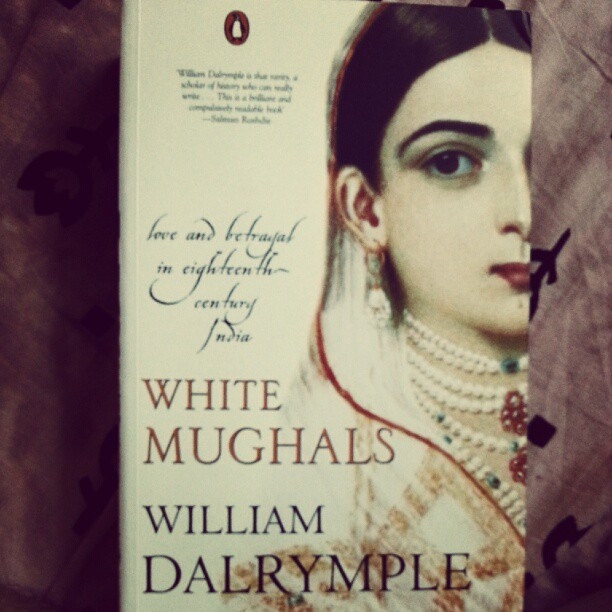
  • White Mughals: Love and Betrayal in Eighteenth-Century India

    William Dalrymple 

    In the eighteenth century, when the East India company was not yet the force it would one day be, there existed a few Englishmen (and other Europeans) who took up the ways of the fading Mughal culture. These were the White Mughals and among them was James Achilles Kirkpatrick, who arrived in India a soldier and soon rose to be the Resident of Hyderabad, mostly thanks to the influence of his older brother William.

    Friend of the Nizam, and an ardent lover of the Indian culture he came in contact with, he was willing to sacrifice everything to marry Khair un Nissa, a Hyderabadi noblewoman, who was already engaged to be married. Although the core of the book is their love story, and its aftermath, Dalrymple does take a while to get to it. He first gives us the prevalent scenario and glimpses of the other White Mughals like Hindoo Stuart, David Ochterlony etc to set the context. Even after James is fully in the picture, he focuses on the Nizam’s court, its players and its intrigues in which James is heavily involved, Hyderabad’s strained relationship with the Marathas and the charged political atmosphere which the Company was trying to profit from. But this also gives us an elaborate view of Hyderabad, its people, its art and culture and finally James’ relationship with Khair. In this broad canvas, we can also see the various Governor Generals and their varied stance on relationships with India and Indians. The images allow us to visualise the life and the times.

    <spoiler> After the death of James, the book follows the life of Khair as the story moves from Hyderabad to Calcutta to Masulipatnam (and tangentially Chennai) giving us tiny glimpses of the social milieu there, even as Khair pines for her children who have been taken away from her. Dalrymple provides a touching description of the very young children shedding their Muslim identity and donning a Christian one as they board the ship to England. In fact, the painting of the children with Sahib Begum’s (soon to be Kitty Kirkpatrick) teary face is extremely poignant.

    Khair’s only consolation is the presence of her mother, the correspondence with her grandmother and her (ultimately) tragic relationship with another Englishman. Except for the well being of Kitty Kirkpatrick, James’ and Khair’s daughter, the lives involved all have tragic endings, many of which cause lump-in-the-throat moments. Khair’s mother dies in penury and her son dies an invalid at a young age. Though Kitty corresponds with her grandmother, they never get to meet each other. As the author says, the death of Kitty in 1889 was the end of an era, of a world where cultures and people mixed freely without the biases and clashes that came later. A wonderful read for those interested in history.
    CIMG1673

  • The Last Mughal: The Fall of a Dynasty, Delhi, 1857

    William Dalrymple

    Once, during a trip to Delhi, seeing the way history seemed to come ‘alive’ in the old city at various corners, I asked my friend whether anyone had tracked what had happened to the descendants of the Mughals, and how they saw their legacy . In this book, William Dalrymple does shed some light on it, though a sad one. More than the last Mughal emperor, the book belongs to the First War of Indian Independence to which he was unwittingly bound. Bahadur Shah 2 or Bahadur Shah Zafar as we were taught in history classes, born in 1775, whose pen name meant ‘Victory’, and was depicted as the face of the revolution that almost threw out the British. A hapless man who was pulled by a desire to ensure that he did justice to his legacy, when all he wanted to do was write his poetry and live in the company of like-minded souls. A spiritual man who was even considered a sufi saint, and still is, at his grave in Rangoon.

    It is now history, but at some point it was the life lived by people like us. 1857 seems like tangible history, an era that can still be felt by its influence, even if minimal. Using records from all kinds of people – common men and chroniclers across Indian and British nationalities, the author creates a vivid portrait of Delhi, before, during, and after the uprising. Characters such as Ghalib sometimes add philosophical layers to this narration, and help us understand the cultural high point that was regained in Zafar’s court. It also shows Zafar as a normal human being of his era – with his own superstitions and insecurities, a subject of court intrigue courtesy his wife Zinat Mahal, his son Mirza Mughaal, Hakim Ahsanullah Khan, General Bakht Khan and others, despite being hailed as Padshah, the Lord of the World.

    The book also makes a point to showcase the relationship between religious communities before the event, and as the author reinforces many a time, Zafar deserves quite some credit in understanding the fabric that held his city together and maintaining the harmony there. He also points out that the real reason for the uprising was not political, but religious. What started as a fight between Hindu sepoys and the British ended as a fight between a rebel force that was made mostly of Muslim jehadis and British mercenaries made of Sikh, Muslim Punjabi, and Pathans. And it was a war that could have gone wither way.

    Late in the book, there is also a mention of a royal survivor – Zafar Sultan, Zafar’s brother’s son, who refused government pension, and made his living with a brick cart. Once, many years later, in his old age, he was abused and beaten up by a businessman. After quietly taking the first few blows, he hit the businessman hard enough to break his nose. He told the court that sixty years earlier, the man’s forefathers would have been his slaves and that he had not forgotten his lineage. Dressed in dirty suits, made to get up and salaam the British (when he used to consider it an insult for anyone to sit in his presence), and verbally abused regularly, Zafar himself was the recipient of several injustices at the hands of the British, who did not even give any consideration for his old age after they ‘captured’ him.

    What remains with me, and this is something I went back to, almost every time I picked up the book to continue, is the photo of Zafar, lying with his face to the camera – the face of a broken old man who through his life saw the dominion of his ancestors taken away from him until all he had was his city and an empty title, who had just been made to undergo a trial and many humiliations before it, eyes expressing melancholy, and resigned to his destiny.

  • Nine Lives: In Search of the Sacred in Modern India

    William Dalrymple

    In his introduction to the book, William Dalrymple explains how he has tried to invert the travel writing style of the eighties, highlighting the subject and relegating the narrator and his journey to the shadows. And that’s how this book manages to be a set of nine mini-biographies that are linked by the book’s tagline – ‘In Search of the Sacred in Modern India’. Each ‘story’ not only manages to show the protagonist, his/her belief systems, trade/artform in the context of a region that’s rapidly changing the way it looks at religion, spirituality and the world in general, but also manages to trace its (artform/trade) evolution across the centuries of its existence, and the inividual’s outlook towards his own journey. In that sense, it is also my favourite kind of travel writing – across time.

    From Kerala to Dharmasala and Tarapith to Sehwan, the characters flow, and though all of them are interesting in their own way, my favourites were the ‘The Singer of Epics’ – the story of a bhopa in Rajasthan, and “The Monk’s Tale”, the story of a Buddhist monk who takes up arms against the Chinese, is then forced to fight for the Bangladeshis against Pakistan and finally spends his last years in Dharmasala atoning for his acts by hand printing prayer flags.

    The narrative and the prose make the book very accessible, and the only concern I had was whether the author had let romanticism affect the truth of the stories a tiny bit. A great read.

  • Mythistory

    Centuries apart, but both in The Wonder Eras and Irascible, I had written about the documentation of incidents that we now call mythology and history. (respectively) In the former, I had mentioned the feeling when I saw the place where Sita had been temporarily imprisoned in Lanka, and in the latter, a fictionalised version of an event that happened in 1919. Both a bit intangible – the first only because of the centuries that have passed and it was still difficult to believe that myth was just history but more ancient, and the second because I am not sure if it actually happened.

    Sometime back, I read William Dalrymple’s ‘The Last Mughal’, that uses Bahadur Shah Zafar as a ‘device’ to write about the events of 1857. The book is based on actual documents. As I wrote in my review (will share soon) what remains with me long after I have read the book, and something I went back to, almost every time I picked up the book to continue, is the photo of Zafar, lying with his face to the camera – the face of a broken old man who through his life saw the dominion of his ancestors taken away from him until all he had was his city and an empty title, who had just been made to undergo a trial and many humiliations before it, eyes expressing melancholy, and resigned to his destiny.

    Suddenly, the images that I remember from history textbooks were transformed into a real person, and history was somehow tangible, as was his plight. It was almost as though that if I could take a few steps more, I could somehow feel the same about our myths.  Have you ever felt that when reading/seeing anything?

    Perhaps it is that way in every age, when some things that were history move into legend and then on to a myth status. I am still debating in my mind whether the layering that happens, adds or subtracts.

    until next time, history repeats?

  • Kerala Kerala, Quite Contrary

    This is an anthology of 26 works, edited by Shinie Antony, who also contributes a few as author, interviewer and chronicler. The title, IMHO, is a bit misleading since the works themselves, while touching upon various aspects of life in the state or offering perspectives on its history, culture or working as travelogues, do not attempt to bring out the contrary nature, in whatever form that’s meant. Different individuals’ point of view, does that make a collection ‘contrary’? I’m not so sure. To be fair, a couple of works do attempt to show the contrary nature of the state and its residents, but that’s in isolation, and anyway are not enough in number to justify the title.
    Having said that, there are quite a few which I immensely liked. Will mention those (in the order in which they appear in the book)
    Odd Morning by Susan Visvanathan. I’ve always been a fan of her work after I read ‘Something Barely Remembered’. There’s something that’s wistful and haunting about the way she writes, and this piece follows that style.
    William Dalrymple’s “The Strange Sisters of Mannarkad” is quite enlightening, and has a fascinating theme of religion and legend.
    Anita Nair’s “Orhan Pamuk, Nair and I” is a wonderful short story that explores the psyche of Kerala’s writers and critics.
    “The Argumentative Malayali” by D.Vijayamohan perhaps best justifies the book’s title, as it captures Kerala’s unique stance on global and national issues. As a malayali, I’d say that his observation and insights are spot on. Anti-communist? Probably, but I can’t blame him. For me, its one of the best works in the book.
    S S Lal’s “A medicine that cannot be prescribed” is the kind of short story I love. The perfect mix of food for thought and a mild twist in the tale, that makes a perfect ending.
    “Sitrep Seventies” by Hormis Tharakan is perhaps the strongest contender for the best work in the book. While I was mildly puzzled by the way the piece started, the way it swept across centuries and the lifestream nature of the work grew on me, and its amazing insights on law and human nature just raised it to a whole new level.
    Shreekumar Varma’s “Fort Lines” is a story anyone who has lived in the state, or visited on a ‘wrong day’ can absolutely identify with. I wish the kind of cosmic justice that appeared in the work happened in real life too!!
    “No Sex Please, We have cable” by Suresh Menon ended up as my favourite work. The humour is amazing, and I could easily identify the way a place changes or remains the same depending on what you’re looking for.
    Nimz Dean, all of 13 years old is the youngest contributor at “The Gift”, and the 2 page work definitely shows promise. 🙂
    Shashi Tharoor uses all of his skills to make a passionate case for Kerala and investments in the state in “Building Brand Kerala”. A well written piece but having lived there most of my life, and having worked there for some and having seen enough hartals in the recent past , I am not convinced.
    “Happy” by Omana (as told to Shinie Antony) is amazing food for thought material, and is a fine ending to the book.

    So that’s about 11 out of 26, which are really good works, and a few others could work for you depending on your interests. 🙂