
Tag: William Dalrymple

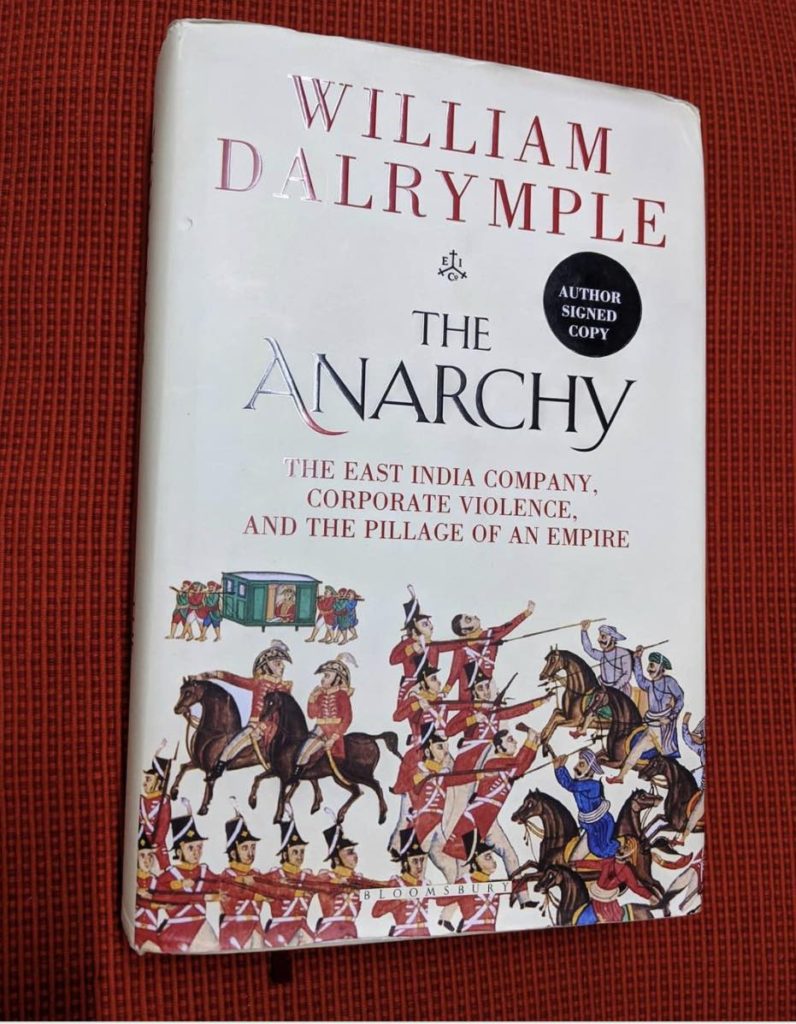
  • The Anarchy: The East India Company, Corporate Violence, and the Pillage of an Empire

    William Dalrymple

    There was so much money in India – that’s one of my biggest takeaways from this book! Every other page has a note at the bottom that shows the current value of the money that was paid to a local mercenary or the Company as protection money, or a deal as simple as crossing the river safely! I am exaggerating only a little bit. It reminded me of the inane charging for random things by modern airlines, and corporations in general trying to squeeze out every bit of revenue from the average user. And the story of the East India Company is exactly that – a corporation that arrived in India for trade, and ended up pillaging the country and finally giving it to the Crown on a platter.

    Dalrymple begins from where it all started – London, 1599, when the idea of the company was first discussed seriously by a diverse set of individuals. Though not an original idea, the joint stock process allowed the Company to raise resources efficiently in the beginning, and until things went south, provide handsome profits to its investors. The book traces the Company’s trailblazing journey in India, one that features not just its own principals like Clive, Hastings and Wellesley but the local rulers and power brokers as well – from the Mughal emperor (in name) Shah Alam, and Tipu Sultan to mercenaries like Benoît de Boigne who helped shape the Maratha army into one that matched the Company’s own fighting force, and interesting characters like Begum Samru, a feisty courtesan who became a mini-ruler in her own right! Some familiar from history, and others from the author’s own earlier works (like James Skinner from White Mughals). A word on Shah Alam – he is a far cry from his glorious predecessors, but in an age when living till 50 was a luxury, the man survived every tribulation that was thrown at him and lived into his late 70s even as his enemies perished around him.

    It is amazing how, from an inconspicuous office in far away England, with less than a hundred employees, a corporation controlled the destiny of a land as large and diverse as India. It was in 1600 that the Company received the charter from the Queen, and by the early 1800s, they had defeated the last credible threat – the Marathas. These two centuries are full of intrigue, and there are multiple occasions when a single different decision or event (e.g. if Nelson had not sunk Napoleon’s navy and the latter had been able to give Tipu an assist) might have resulted in an entirely different contemporary history. Politics – the English replicated the Roman divide et impera, and economics – many of their moves would have been impossible without local financing – went hand in hand in what was the first hostile takeover of a nation by a business entity. That’s not the only first – abuse of corporate power, lobbying, unfair trade practices, the Company pioneered all this. And finally, in another first, it had to be bailed out by the government because it was too big to fail!

    If you’re a history enthusiast, this is obviously a must-read, and even if you’re not, this is a fascinating piece of history that you’ll enjoy.
  • City of Djinns: A Year in Delhi

    William Dalrymple

    After finishing the book, I was surprised that it was only 339 pages, there is so much in it, and unsurprisingly so. The author mentions in the prologue that depending on whom you ask, the number of Delhis that have existed before the current one is anywhere between 7 and 21, and it is to his credit that he has probably brought out many, many of them. Not in the way of the structured and stratified thirty feet wall that represents 3000 years of continuous occupation to which Professor Lal points and says “The whole history of Delhi is there”, but through different journeys.

    There is clearly a preference for the ‘Twilight period’ – between the Mughal decline and the British ascendancy, but there are quite a few pages spent on the Mughal golden age, Tughlaq and other pre-Mughal Delhi rulers, right up till the Mahabharata’s Indraprastha and before, and the post Independence era. It must be mentioned that despite the seriousness with which the author has approached the content, his wit shines through! (more…)

  • The Age of Kali

    William Dalrymple

    I love doing this – reading a commentary long after the age has passed. It’s more than a decade and a half since the book was published and I’ve read four of the five books that the author has written since then. Both of these factors gave me quite a few perspectives on the book and the writing.

    I see this book divided into two on multiple counts – first in terms of geography, second in terms of narrative style, and third in terms of being true to the ‘script’ of the book. (more…)

  • Return of a King: The Battle for Afghanistan

    William Dalrymple 

    “Those who cannot remember the past are condemned to repeat it” This book brings that quote to life! More than the book itself, kudos to Dalrymple for choosing a subject that has so much of relevance in the contemporary era! In fact, I wish it were written a few years earlier. ‘Return of a King’ is the story of the British (East India Company) invasion of Khurasan (modern day Afghanistan) in 1839 in an effort to establish their man Shah Shuja ul-Mulk, (descendant of the Ahmad Shah Durrani, regarded to be the founder of the modern state of Afghanistan) on the Kabul throne in place of the incumbent Dost Mohammed. That was the easy part, but as one Afghan commented then, the British had gotten in, but how would they maintain this status quo, or even get out? In a couple of years, the Afghans, in an ever changing mixture of coalitions, rebelled against the British and massacred them on their way back to Hindustan. The British then created an Army of Retribution to avenge this, and ended up bringing things back to square one.

    What set off this chain of events is something I have read about in some Sherlock Holmes adventures and seen alluded to in other works like ‘Kim’. The Great Game, an international milieu of intrigue that pitched the mighty powers of the time – Russia and Britain – against one another. Afghanistan, as per British intelligence, was where Russia was poised to strike next, to control Central Asia. This was supposed to be achieved with Dost Mohammed’s help. The Russian plans were far less threatening than reported by the British and ended up creating a war that need not have been. There is some amazing parallel here with what the Russians (80s) and the Americans (now) tried to do in Afghanistan! (more…)

  • The legacy need

    The last two books I read had only a faint connection. One was historical fiction and the other was a memoir. The first – “A Spoke in the wheel” by Amita Kanekar – is a take on Buddha and his teachings by a monk three hundred years after the Buddha’s death when his teachings have begun their journey into religion, the emperor Asoka being the key catalyst. The second – “City of Djinns” By William Dalrymple is his discovery of Delhi – past and present – in a year that he spent in the city in the early 90s. The connection, as you might have guessed, is historical narrative.

    It is natural to think that there is a huge difference in a work of fiction and a more research and experience led memoir, but the point of the post is that with time, it is difficult to establish that. In the book on the Buddha, the monk chronicling his life and teachings is irritated by the supernatural abilities being attributed to him. But we do know that many people believe in it now and even consider him as one among the avatars of Vishnu. On a related note, William Dalrymple delivered a body blow to my notions of the Mahabharata era when his conversation with an archaeologist constituted a distinct possibility that the war was fought with sticks and stones and probably a bit of metal! (the proof being excavations around what is considered one of the earliest versions of Delhi – Indraprastha) I am a huge fan of Hindu mythology and it has fascinated me from as long as I can remember. I truly believed that they had happened in some form, but the archaeologist is clear that most descriptions in the epic would fall under ‘poetic license’!

    It made me wonder if there would be any difference between the two books say, a hundred years from now. It is possible they might exchange roles. It is also possible that they both are treated as fiction, or as factual pieces of work. I think all scenarios are possible because at the time of chronicling something, we believe that its factuality would be transmitted across time. And yet, we could debate the Mahabharata’s historical authenticity and Buddha’s superpowers both ways! So think about it, the same thing could happen to the information we store now as well. Thanks to digitisation, more data is being created in this world than ever before and (arguably) every point made has a counterpoint. There are no objective annotations because even the original construction is a product of biases, interpretations, perspectives and so on.

    That brings me to legacy, something a lot of us care about. From children to business empires to art to helping others, there are many avenues. However, I think that unless there is documentation, the chances of a legacy lasting beyond a few generations is questionable. For example, Dalrymple finds the last line of direct Mughal descendants and their knowledge of their ancestors is limited to a few generations before them. The futurist in me does fantasise about a global neural network and consciousness that connects all of humanity and has sufficient storage to instantly collect, catalog and annotate all ‘memories’  in as objective a state as possible for later generations to study them.

    But meanwhile, even as I dissect my baggage of the past, I am now forced to consider my need for leaving a legacy – something behind that will represent me when I’m gone.  After all of the above, how relevant is that need? Isn’t it just a demand made by the ego, a story we create for ourselves? Something to continue the narrative of our lives? We do talk a lot about letting go of the baggage of the past, but isn’t legacy also a baggage? A baggage of our future? If we let go of that, how different would our thoughts and deeds be? Understanding that is probably the key to living in the moment. I could easily twist my favourite cricketer-gentleman’s words for this context- He’s not concerned about his legacy, he’s concerned about what actually makes him come alive in the first place, which is that love of life, the desire to live completely.

    recite-15416-48543400-hiy6v5

    until next time, present participant