Tag: value

  • If it makes me happy…

    In a workshop I attended recently, the trainer made an interesting point that being a little selfish and taking care of our own needs first will actually enable us to help others better. Around the same time, I also read this very interesting post on the conversational gambit. Extremely helpful for those of us who aren’t good at going from zero to conversations quickly. Put simply, ask a question. The one that stuck with me was “When were you happiest?” I directed the question inwards and got some answers. Then I upped it to “What will make me happy?” That was complex, but something I heard recently gave me some direction.

    People say that what we’re all seeking is a meaning for life. … I think that what we’re seeking is an experience of being alive, so that our life experiences on the purely physical plane will have resonances with our own innermost being and reality, so that we actually feel the rapture of being alive.

    Joseph Campbell
    (more…)
  • Platform Principles

    Though not by design thus far, I have actually been expanding on the 4P (planning to add one more) framework I wrote about in Agile @ Scale. The attempt is to help me navigate the concept of brand in a rapidly changing landscape. The Change Imperative tried to showcase some of the possibilities of these dynamic shifts, and Revisiting Brand Purpose dwelt upon purpose in the framework. This post is on platforms. Though media platforms have been around for a while and have been utilised by brands, and the internet, mobile and different OS can also be treated as platforms, I’m choosing to focus on the brand/ organisation as a platform.

    Thus far, the organisation as a platform has been built to leverage scale for competitive advantage. But technology and open platforms are easily on their way to make scale matter much less. As this post  succinctly states, connections weigh more than efficiency now. So how can the organisation move towards connections?

    My thought process on this was probably started in Social’s Second Chance. Social tools and platforms have brought the brand into full contact with the user and have caused paradigm shifts in not just marketing but across the organisation. This deck makes an insightful point that traditional marketing structures are dialectic in nature while social platforms are dialogic. That explains why brands are using social mostly as media and trying to frack it, despite there being better ways to approach it, even in the context of marketing. Experience > exposure is a lesson yet to be learnt.

    Among other reasons, one of the big factors that are contributing to a resistance in truly embracing social in entirety is a fear – loss of control. This is a great read on designing for the loss of control and my biggest takeout from it is where it quotes from ‘The Power of Pull‘ – “shaping strategies” on the individual, institutional, and societal level.

    I think there’s tremendous scope in rethinking the brand/organisation as a platform. In the bid for competitive advantage through scale and efficiency @ scale, it is possible that the organisation/brand has chosen to see value very myopically – as a transaction. What if the organisation transformed itself around connections – connecting employees to a sense of purpose, partners to the kind of work they’d want to associate with and its own narratives with that of the consumer’s? Of course there’d be transactions involved too, but how about engaging each in a way that understands and works with the unique value in every interaction within the context of a shared purpose?

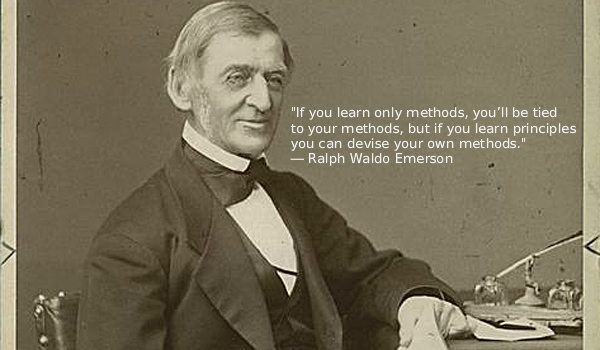
    (Arguable) I think efficiency lays more stress on methods, but engagement has the potential to focus on principles. Profitability at any cost vs value creation as a means to profitability. The choice might actually make the difference between survival and irrelevance.

    Emerson

  • That’s the plan for now

    This ‘what could have been’ post on FB Platform and the broader theme of ‘move fast, break things’ made me think about planning – brand as well as business, how technology is reshaping it, and the fine balance that is required to ensure business growth goes hand in hand with retaining the trust of the ecosystem.

    Brand planning has always been an interest area, and I’ve had the good fortune of knowing a few brilliant planners, and learning what I could from them. Still continue to. A simple search would throw up a number of planning frameworks, and many of the fundamentals would still hold.  However, technology is throwing open more options in terms of manifestation/output. I found some good perspectives in this article which is about that CMOs can learn from technologists. The fundamental theme is dynamism. But such are the challenges that they remind me of We are trapped in our inadequate mental models ~ John Edwarrd Huth (via)

    I’d think that brand narratives are (also) shaped by the story telling devices at their disposal. As Mitch Joel points out here, the nuances of marketing vs advertising need to be understood as brands struggle to transition from the mass advertising era. One-way media allowed a linear flow, but current platforms demand flexibility, and customised rendition across contexts and platforms. If consumers are the new media, the stories should be ones that they can identify with, fit into their personal narratives, and therefore inclined to share.

    Many of the familiar narrative devices have focused on getting attention, but that is increasingly difficult. It’s not that ‘awareness’ can be ignored, but not only is it not enough, but attention for the sake of itself cannot work. I really liked this post (again by Paul Isakson) where he encapsulates the thought in the title itself Adding Value > Getting Attention. The > works not just as ‘greater than’ but also as ‘leads to’. Or, in other words, Be the Company Customers can’t Live Without.

    In a highly fragmented media and consumption scenario, how does a brand/business know what to focus on and when to shift from it?A wonderful blog I have discovered recently is that of Paul Isakson. This post, for instance, throws light on the need for the brand to stay true to its own story, and therefore focus on specific audiences. Another of my favourite posts focuses on something that I have always believed in and liked – the back story, and its relevance for brands. What we are today comes from our thoughts of yesterday, and our present thoughts build our life of tomorrow ~ Buddha

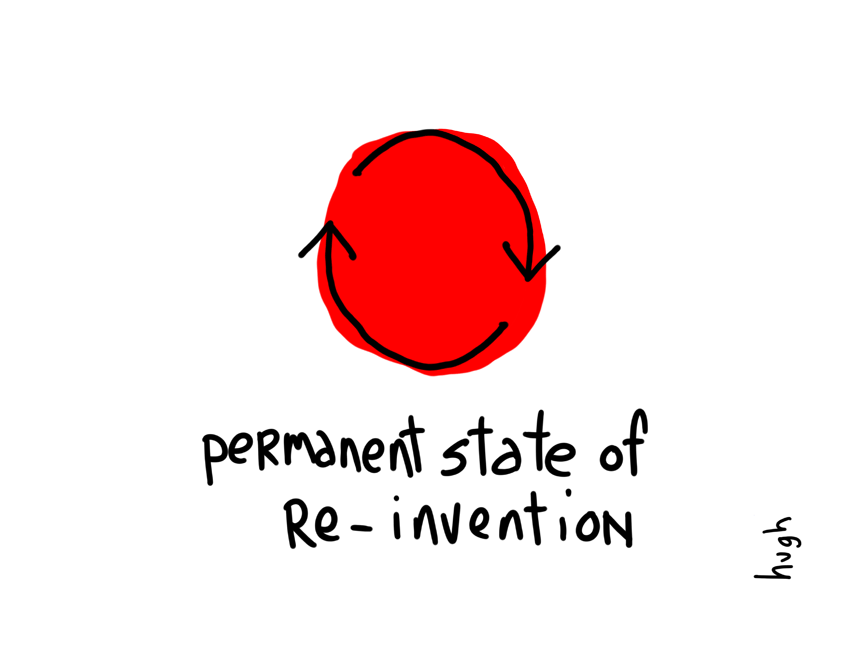
    To get there involves a cultural change, and tectonic shifts. I also think that this will force brands to think about scale. In a mass media world, a brand could get ‘reach’ by throwing money. That can still be done, even on social platforms, but when attention is not the only thing that matters, the challenge is to build relevancy and scale it – across time. That requires new planning frameworks, and possibly means a

    permanent_state

    (via)

    We started with FB, so let’s go full circle. Even as late as last year, there was massive skepticism around Facebook’s ability to adapt and thrive in the mobile space. In the last earnings call, they reported that mobile had contributed 41% to revenue. (read) It would seem that Facebook knew its story, what to focus on,  and stuck to it.

    until next time, refresh

  • Jump with a crowd

    ‘Jumping the shark’ is a phrase that has been jumping on to my face regularly, but something that got lost in the rigours of speed reading and processing. Thanks to Tom Fishburne’s excellent post on the subject in the context of brands, products and organisations, I got to think about it a little more. The quick definition would be (from the post), “the moment of downturn for a previously successful enterprise.” The problem with it? “The risk of jumping the shark isn’t getting eaten by the shark. It’s leaving your loyalists behind.”

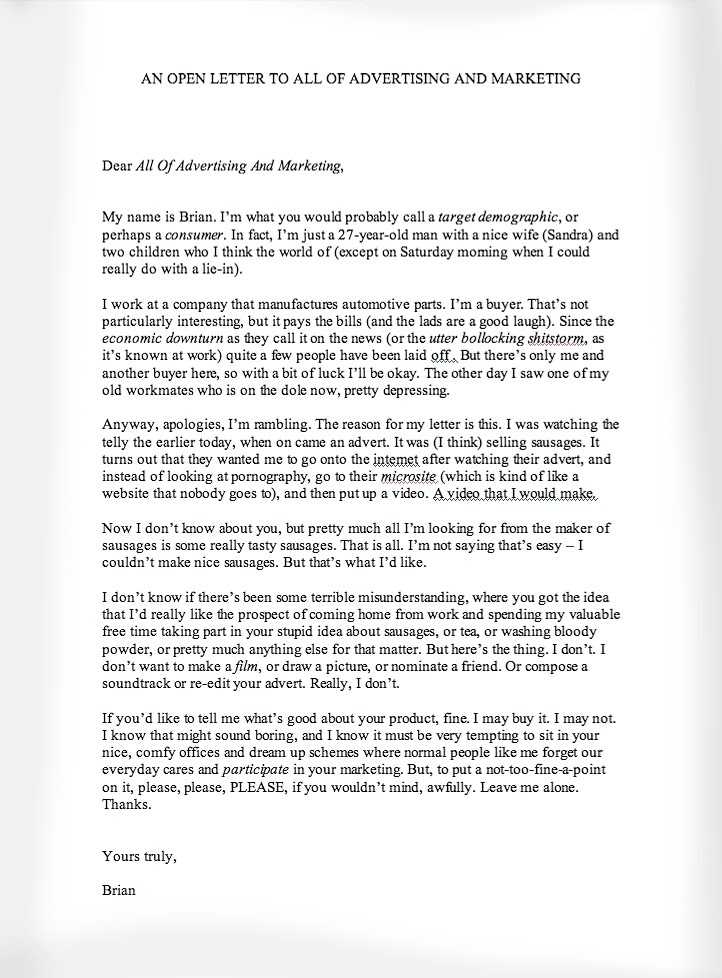
    I thought about it a bit, not in the context of brands or businesses, but more in terms of brand communication as a field, advertising specifically, and brands’ usage of the social web. Consumption patterns, media platforms available etc had pretty much created templates for creative agencies over a period of time. But the arrival of the web, social platforms and the democratization of media have managed to disrupt the ways of the one-way communication age. This post is a good one to read in that context, and talks about the change digital has made to campaigns, and the ‘role of the consumer’. But desperation, hype and the eagerness to get on board makes everyone concerned ‘jump the shark’. And unfortunately, the way I’ve seen many agencies and clients execute it (purely as a consumer), I’m quite inclined to agree with the author of this hilarious letter. (via PSFK)

    Clipboard01

    (click to enlarge)

    The job of the brand manager/creative agency is obviously a more difficult one now, and is made even more so thanks to the approach – of tool strategy. Like this (old but) excellent post states, ‘the technology that underpins social media is changing fast’, but its ephemerality ‘is a feature, not a bug’. It made me wonder whether brand communication/advertising, as a process (the way we see it now) had ‘jumped the shark’, mostly because the thinking process still sees  social platforms in the same light as traditional media and has not changed to be in tune with the former’s dynamics. In other words mistaking social media marketing for social media.

    Maybe they have to dig deeper, figure out the value that people are willing to pay for, and then find their ‘purpose idea + social object‘, and consistently. But that would mean a sea change in the way brands and creative agencies operate. Is adaption possible, or is complete disruption inevitable?

    I juxtaposed this thought with something that Seth Godin wrote recently, about the ‘red zone‘ – the joyless part of the learning curve. His graph also has a green dot, which represents ‘someone on the other side.. rooting us on, or telling us stories of how great it is on the other side’. Perhaps if brands can find from the existing consumer crowd a few who believe enough to play the ‘green dots’, they can adopt a more holistic approach to social platforms and carry the loyalists without it seeming like ‘jumping the shark’?

    until next time, safe jumping.

  • Coincide

    A friend of mine, Soubhagya, is an avid photographer, who, despite my best efforts, still shies away from running his own photoblog. So when he asked me to take part in a writing experiment, I thought it would be a relatively painless way of introducing him to blogging, and hopefully, he’ll like it enough to do it on his own. The idea’s pretty simple – he’s given me a couple of pictures he has shot recently, and wants me to write a few words on each. Here goes

    the face of money‘The face of money’ is what Soubhagya calls it.

    What’s my value? To a politician, I’m a vote that will help him in his quest for power. To my employer, I am a worker who gets paid for the job I do. To the places I eat out in, to the shops I buy things from, I am a source of revenue. To the people who care for me as an individual, these are perhaps not the parameters of calculating their value for me. It’s a different currency. So the question is complete only if I ask “What’s my value to …. ?”  Now, what if I were to pose the question to myself? Do I measure myself by my financial status, or the lack of it? Is it the ‘Likes’ on Facebook or the followers on Twitter? Or is it by the number of lives I have touched, in one way or another? Is it a combination? Is it what I deem as my potential? How much is that dependent on externalities? And doesn’t that change with time? Which brings me to..

    Burnt out ‘Burnt Out’

    Purpose. I have always been interested in the purpose of our lives. All life forms in general, and of course, specifically us, humans. Generally, at different stages in life, we get stuck with different routines, sometimes by choice, sometimes not – school, college, work and so on. There is a short term purpose to it all, so we rarely look for something beyond. By my definition, ‘purpose’ gives a meaning to what we do, something beyond the money that it brings in, something that really makes us happy just by doing it, as though we are destined to do it. One could rationalise and say that the money then becomes a tool to ‘buy’ the things that give happiness, but that’s arguable.. We prioritise according to our baggage, some are okay with trading an amazing weekend and regular holidays for mind numbing work, some wouldn’t be able to manage it at all, and there are tons of options in between. The candle reminds me of the passion that we bring into what we do, and I believe that depends on our approach to ‘purpose’. Burn brightly or be a shallow flame? In both cases, there is a finite lifetime in which it has to be done. For me, even the task of finding a purpose is a tough one. Whichever way one sees it, there is always the possibility of a burnout. Such is life. So burn you must, and light up the place as much as you can. 🙂

    until next time, wax eloquent 😉

    PS: Now split ‘coin-cide’ and you might figure out a new possibility