Tag: Uber

  • Brand with a world view

    In Feels & Fields in Marketing, I had written about my view that the sustainable advantage in data driven marketing over the long term might be lesser than an approach where the brand is marketed as a worldview – reflected in thought and deed. A couple of nuances I’d like to point out here. One, the reason I feel so is because from the evolution of digital media thus far, the end game of new platforms/technologies arguably seem to be a version of a “cost per” arms race, and that end game is reached rather fast. Two, I don’t strictly see data and story telling as an either/or. It’s just that I don’t see a lot of justice being done to the latter thanks to the focus on the former, and I also see the dumbing down/tempering of messaging to access a larger mass.

    However, I’ll admit that putting down ‘brand with a worldview’ into a generic framework is a rather challenging. But I have seen quite a few examples – personal experiences as well as larger campaigns – that highlight various aspects of this approach. The new POTUS has in fact, provided quite some fodder for this. Hardly surprising, since his usage of extreme stances contributed majorly to his victory.  (more…)

  • Algorithms, the institution of the future!

    Tom Goodwin’s precise summing up of the shifting business environment is now legend – Uber, the world’s largest taxi company, owns no vehicles. Facebook, the world’s most popular media owner, creates no content. Alibaba, the most valuable retailer, has no inventory. And Airbnb, the world’s largest accommodation provider, owns no real estate. Something interesting is happening. 

    Institutional realignment is now on an accelerated path. In this superb, nuanced post titled ‘Uber and AirBnB make the rules now – but to whose benefit?“, Vili Lehdonvirta brings up very interesting perspectives. (To paraphrase)

    – If buyers switch to a new market, sometimes sellers have no choice but to follow, irrespective of whether it brings them gains or losses (eg. if there is very little business outside of Uber to be had)

    – Even if everyone participates with interests intact, the collective effects on society may not always be positive (eg. AirBnB rooms causing nuisance to neighbours)

    – These conflicting interests are usually reconciled by political institutions, but they face the challenge of siding with incumbents or upstarts.

    And towards the end of the article, this very important thought – these new platforms appear to provide access to those who have been denied it by the institutions and processes thus far, but is it that simple? In this context, the new jobs being created are quite different from the typical ‘job’ description. That brings me to a key institution – the traditional workplace.

    (more…)

  • Wallet Wars

    Recently, thanks to Uber having to comply with RBI regulations, I was forced to introduce myself to Paytm. The entire signing up episode reminded me of a post I had written in early 2014 – “The overhaul of currency“, though that dwelt more on the broad changes and implications rather than the functional aspects. Mobile payment systems have been on a fast evolutionary path for a while now. (a bit dated, but I found this infographic to be a good primer)

    I also remembered a Seth Godin post from 2009 that called Twitter a protocol. On the web, the subsequent discussion then was that just as we were transferring links and messages on the platform, we would soon be transferring money too. That took a while coming though – it was only in late 2014 that Twitter released a payment service.  A week before that, a hacked screenshot had begun rumours of Facebook’s Messenger having the wherewithal for money transfer. But they were both late entrants in a market that was already crowded with the likes of Paypal, Google, banks, credit card companies and so on. Apple Pay would join later. (more…)

  • Change Strategies

    It was mid last year when I wrote The Change Imperative, which was as much a note on massively changing business dynamics as it was a note to self. I thought the new year was a perfect time to revisit and explore how brands and business can use change as an opportunity. The new year sees a glut of predictions, trends, insights etc, but the one I look forward to is the JWT Future 100. This year too, it impressed me with unique insights and potentially far reaching consequences. But in the change’ context, I found slides 33 and 52 most interesting. Both of these were related to brand strategy – 33 (Third Way Commerce) was about how millennials were looking for brands with clear values, and 52 (The Long Near Game) was on brands taking a dualist approach to balance short and long term goals.

    In my mind, they are related, as brands are making efforts to maintain/create business models that are buffered from current and future shocks and can remain relevant now and later. I found an intersection of the two thoughts in a couple of places. The first was in this post by David Card on new models of  disruption. The first model brought up in this is “Adjacency Platforms”, which is about platforms migrating into new markets or industries. Apple’s iOS moving to payment is the example given here. This thought is also echoed in slides 24-28 of this trends presentation – the phrase used was Startups going ‘Full Stack’. I particularly liked this framing of the thought – It’s not like a brand like Virgin diversifying to follow an audience, it’s diversifying to follow an expertise. Both fantastic approaches, I must say, because they’re based on consumers who believe in the brand’s values. [I believe that Uber is a brand with much potential in this respect – check this]

    (more…)

  • Brand Agility

    One of the movements that I’d mentioned in the drivers for brand/marketing in 2014 and beyond is agile marketing. In my mind, there are various factors that are contributing to this eventuality like fragmentation of media platforms and the phenomenal amount of data being created and consumed to begin with.

    Simulations, testing, analysing data, and quickly adapting are the basics of this approach to marketing. In terms of ‘ingredients’ to play with, I’d still go with the traditional 4Ps of the marketing mix- Product, (includes packaging) Price, Place (I include the internet with Platform) and Promotion, with Purpose being an umbrella addition. The input and the output, I have categorised into business dynamics, using the other favourite marketing letter – C. These are consumer, competition, channel, content and context, and the cohesive narrative that is created. I’m trying to evolve a framework from these, while watching brands actually practice it – with or without a theoretical structure to the approach.

    One of the brands I’ve noticed doing a good job using many of these ingredients and the I/O is Uber. That’s despite the recent surge pricing bad press. In fact, I’d see this as an example of their ability and willingness to adapt. In the US, they’ve been honing their craft for a while – free rides for students during the Boston school bus driver strike was the first occurrence I noticed, and then soon after, the delightful hat tip to pop culture on National Cat Day in a tie up with Cheezburger.

    They launched in India recently, and true to form, wasted no time in launching the UberSLEIGH during Christmas in Delhi, Bangalore and Hyderabad –  a tie up with Goonj. From a critical agile marketing evaluation perspective, it would be easy to argue that Christmas is a recurring annual event that brands plan for. But auto-rickshaw strikes are relatively less predictable. A fortnight later, on January 6th, Uber slashed rates by 75% in Bangalore in response to a strike. What is easy to see is the anatomy of an agile strategy. To me, it seems that they are well on their way to developing a flexible marketing framework that helps them take advantage of any variations in the ‘input-output’ factors I’d mentioned earlier – in this case, pricing product and place in response to consumer and context.

    Newer brands might have an advantage in developing these frameworks because of minimal ‘baggage’ in their brand philosophy. But then again, the advantage for existing brands might be their existing role in a consumer’s life. Traditionally, brands have attempted to build a unique/distinguishable/identifiable ‘idea’ of itself in the mind of the consumer, with different forms of the promise+identity+attributes+personality framework and (relatively) limited broadcast media options. Iterations cycles were lengthy and included brand tracks and insights which resulted in large campaigns. Several things have changed now. Consumers have shorter attention spans and are increasingly fragmented in their consumption habits. Social platforms have caused brands to cede control over the conversations – any consumer’s experience can potentially create the perception for millions of potential customers. Platforms for reaching the consumer are exploding, and each have their protocols. The potential amount of data from all of this is huge! The challenge for brands is to stay relevant across contexts and create a cohesive narrative, and this requires an evolution in marketing processes. Like I’ve written before, if technology is invading marketing, then perhaps agile – which is a popular approach among that kind – is the way to go!
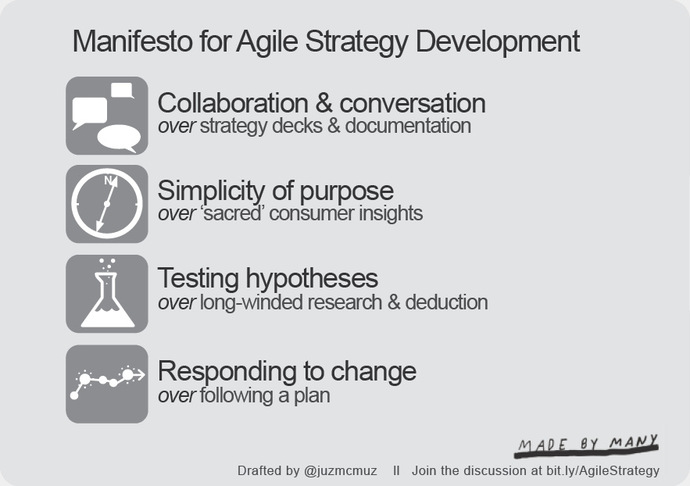
    manifesto_agile_strategy_development_3_content

    until next time, sprints and marathons
