
Tag: twitter

  • Of trending on twitter and media fragmentation…

    A couple of weeks back, I’d written about the increasing broadcast tendencies on social platforms. Some events last week reminded me of something I’d tweeted a while back –

    It is, for better or worse, an item in the social marketer’s checklist. So unless it’s a day on which we’re outraging on multiple issues, you can easily see ‘branded’ trending topics. At Myntra.com, we’ve been playing with hashtags for quite a while now – #bachpanstyle was one such experiment. As we practiced more, the patterns started becoming more evident. Late last month, we started the #hotindecember hashtag in response to a business objective – creating more awareness about the similarly titled promotion at Myntra.com – and had constructed it around the promo TVC. It resulted in the hashtag trending on twitter. Just to check the lessons learned, we ran a #hotin2012 hashtag on 31st Dec, and ended the year as the #1 trending topic in India.
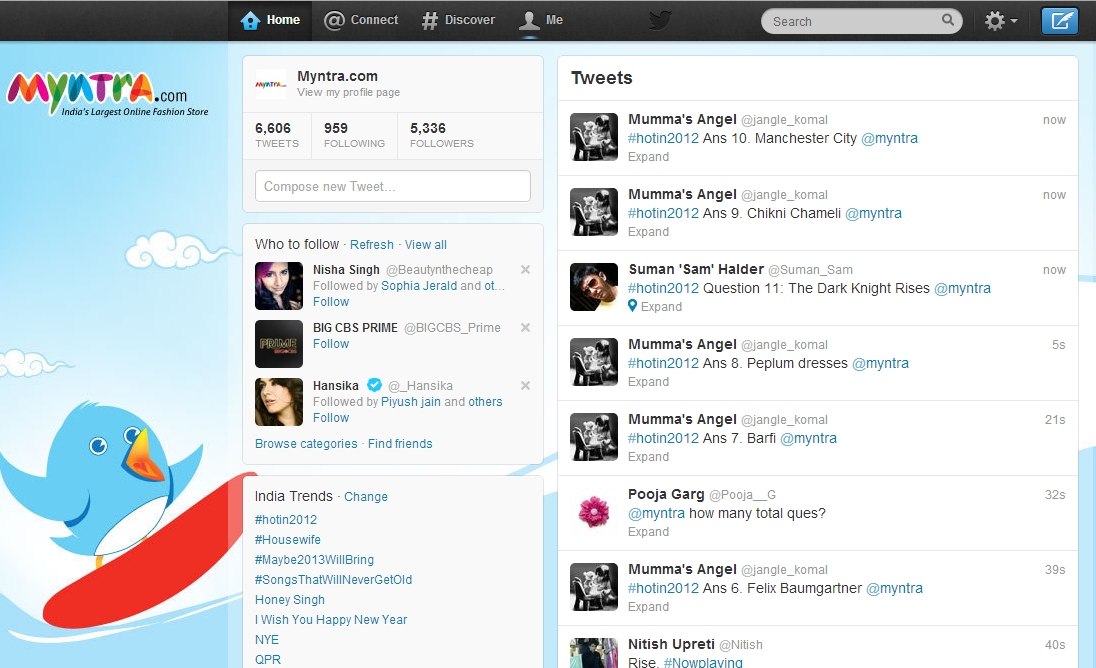
    Considering that there was a much more serious issue taking up everyone’s attention, this should be surprising, but it’s not, and that’s what we have learned of Twitter’s trending algorithm.

    That was about a brand using social as media. Like I mentioned earlier, the first hashtag was based on the TVC, something that had gotten us positive feedback on Twitter. After the Delhi incident however, the ad was considered by a few as ‘projecting women in poor light’. (worthwhile mentioning that Lisa Haydon, who starred in the TVC, had tweeted about the TVC being a lot of fun) Users, who also utilise social as media, are bound to have their opinions and will air them. The interesting part was that all this (hashtags and criticism) was happening in the same timeframe – 27-31st December.

    Why do I find it interesting? Let’s take a step back. It was only when TV stations started competing with the rabbit population that we started contemplating the fragmentation of media as we then knew it. Add to that the increasing web (+mobile) penetration and things became more complicated as time progressed. Brands (in general) still haven’t figured how to handle this, so fragmentation within a social media channel and its impact is small fry, except this is probably an indication of the future.

    This time, we chose not to react to the criticism – given the circumstances, it would have probably led to a nasty debate. Thankfully it died down. But what if a few twitter heavyweights had gotten into the act and made it trend for all the wrong reasons? We’d not have had the luxury. We’d have to refer to Crisis Management 101. In a worst-case scenario, we’d probably have to consider taking the TVC off air.

    In essence, when an interactive medium is added to the mix, fragmentation takes on a completely different meaning. It no longer means isolated compartments which don’t talk to each other, the events on one affect another. As a media buyer, a brand can choose not to be present on some media, but when a channel talks back, the brand’s choices suddenly dwindle. I think this will manifest itself much more in 2013, the learning curve is going to be very steep!

    until next time, user generated brand virals!

    Disclaimer: The perspectives above are personal, and does not reflect the thoughts or actions of the organisation mentioned. 

  • Broadcast 2.0 then?

    Facebook is planning a new video-ad product that will offer video advertisers the chance to target video ads to large numbers of Facebook users in their news feeds across devices. It is also becoming more public about its Publishing Garage, that aims to put into place a set of measurements to demonstrate how well campaigns are working. Twitter has partnered with Nielsen for the the “Nielsen Twitter TV Rating” – an industry standard metric for measuring the conversation that TV shows spur on Twitter.

    The commonality I see is the shift from social to media, though to be fair, the Twitter-Nielsen partnership also talks of sentiment being measured in the future, in addition to tracking the volumes generated. I am using the term ‘social’ for two of the biggest platforms around now – FB and Twitter, but considering they have been the trendsetters, it is likely that the others will follow suit. Yes, there would be exceptions, I’m sure, but let me generalise a bit. While time will dictate whether this shift is smart or not, I’d think this shift is massively underplaying the true potential that social has thus displayed as a disruptive force. Social is now walking the measurement rules laid for a thoroughly different kind of media. (I liked this post at GigaOm because it throws light on, and questions why every social network is trying to turn into a broadcast platform) Doesn’t this put them on the same path of vulnerability that traditional media is facing now? Is this inevitable or is this sheer laziness and/or conforming? Also, from a user perspective, isn’t this a fundamentally different direction from the original premise/reason for existence of these platforms?

    Meanwhile, it is interesting to note that this is happening at the same time as users (increasingly) are treating social as broadcast – from the shoot-from-the-hip opinions on everything to the careful posturing. Not so suddenly, it’s more about numbers than actual conversations. Now what does that remind me of? 🙂 I don’t know how much of it is unconscious and how much of it is subtle nudging (read) by the networks and their features. But whatever the reasons, imagine a future where everyone behaves the way media behaves today – loud, pompous, full of themselves, ignorant to their own faults, violent towards any criticism, and generally abhorred. What happens then?

    So in the current direction I see the networks (and users) taking, the future media mashup will show more characteristics of traditional broadcast platforms than the social traits displayed by the social networks in the early days. My concern in such a scenario is because of what Godin has stated in another context – “Media doesn’t just change what we focus on, it changes the culture it is part of.” That’s when I wish social/we would be more ridiculous.

    until next time, growing pains

  • The story of #bachpanstyle

    Myntra’s twitter accounthit a couple of milestones last week. For starters, it overtook me in terms of number of followers – not that I am way up on the charts or hugely active on twitter these days, but it’s good to handle a brand that has more followers than I do, especially when it has more than quadrupled in the last year. 🙂 Growing a personal brand is fun, but as a professional in the domain, growing a brand on social media is more fun because of the increased number of challenges and constraints.

    We have focused mostly on getting the basic stuff right – Customer Care, (utilising GetSatisfaction to a fair degree) promoting interesting content relevant to our domain – created and curated, presence on the website, and when we were confident of taking it to the next level experimenting with various contest formats. Not the “let’s make it trend” kind, but ones that have some meaning for us as a brand/business and that’s fun for our followers on twitter as well.

    And that’s what gave us our second milestone. Long before brands arrived on the scene, Ashu Mittal, (to begin with.. thanks Surekha for the correction) Surekha, Roshni, The Comic Project, b50, Aalaap had made Children’s Day a fun event on Twitter by getting people to change their DPs – to a childhood photo – for a day. I have participated too, at least for a couple of years. Though I didn’t inform them (because I am still unsure on how I should deal with personal relationships in a work scenario) this was also a hat tip to them. All users had to do was share a childhood pic of theirs with a description of it and use #bachpanstyle. We used our larger FB crowd for publicity, ran the contest on Twitter, and made a Pinterest board specially for it. It was a lot of fun, and also got us our second milestone – a little bit of coverage (courtesy Lighthouse Insights) for the activity. That was a first for us. 🙂

    The cake had some icing too! The next day, my Twitter daily digest showed me a tweet from Surekha about #bachpan and changing DPs. Since the contest was over and done with, I sent her the board we’d made. And got this

    Being appreciated is always a great thing, and more so when it comes from my twitter-childhood friends. 🙂

    until next time, childlike glee 🙂

  • HireRabbit

    HireRabbit helps companies boost their existing recruitment strategy with social-media. In conversation with co-founder Prafull Sharma

    [scribd id=113574291 key=key-16y50vfjlos6nxyvesnc mode=scroll]

  • Social grows up to be media

    On the first page of BG Verghese’ “First Draft”, he talks of The Times front page on the day he was born -21 June 1927. The paper was priced at one anna and “only carried advertisements on its cover page as was the general practice.” This was how traditional media companies had always worked. They had probably begun as journals, and later had sponsored information. (ads) In an era of information scarcity, this was probably required and appreciated. Even if they were not, the complaints would spread only as WOM. More importantly, while they took money from readers, their real survival (generalising) depended on advertisers. In the case of radio and television, it is even more evident. Then came the internet, and a story that has oft been repeated. We’re not going there.

    Though from email to BBS to Geocities to Friendster and beyond, everything can be considered social media, it began for me in the form of blogs (in 2003) became social networking via Orkut and really took flight with Twitter (May) and Facebook (July) in 2007. By this time, ads had begun to be ‘noise’ as media platforms proliferated. Twitter as well as FB served different purposes. As the cliche goes, “On Facebook, you connected with people you went to school with, and on Twitter, with people who you wished you went to school with.” In fact, such was my affection for Twitter that I even walked the talk. 🙂

    Why this long winded narration now? Because what I’d considered social is now very clearly becoming media that happens to have a social past. Facebook’s Promoted Posts will now reach people who have not Liked the brands as well, and it is working on measurement systems that resemble GRPs. From its options – a real time cloud API company and a media company, Twitter has clearly chosen. It has now started throttling the third party apps that made it the rockstar it now is. In their chosen line, this is an inevitable step to protect the ‘value’ it sells. Promoted tweets can now be targeted on the basis of interest.

    The disappointment, even if I reconcile myself to the fact that social is media, is the extent of evolution, or rather, the lack of it. Of the two, I have better hopes for Facebook now. Mark Zuck, despite the IPO, still controls it and from whatever he has spoken thus far, it seems this is not just a business for him, and though the ‘Promoted’ stuff on Facebook has now taken centre stage, the potential of the Open Graph remains and if it does evolve (as mentioned in an earlier post – last paragraph) it will continue to be interesting. Twitter? Oh well, Google’s AdWords is a megabucks one-trick, and it has Android. In the Google-like path it has chosen for itself, I can only hope that Twitter has a vision beyond being “sponsored”. If there is anything that media history has taught us, it is that irrelevance is just one service away.

    until next time, growing pains