
Tag: twitter

  • De-privacy

    The Twitter discussion last week with Surekha and Karthik, was mostly about attribution, but it had another facet to it – privacy. Last week, a childhood photo of mine was shared on Facebook, I promptly untagged. Thankfully Facebook still allows that, though I wonder for how long. But it made me think. Does the photo belong to the person clicking it or the person who has been clicked?

    Surekha, for example, mentioned that she was okay if her tweet was reproduced, so long as it was attributed to her. I am ambivalent about my stance since I have at least a couple of problems, one practical, one theoretical (for now) – first, the context of it, where will it be used and in what context? I even stretched the thought to whether I can choose who gets to RT me and which tweets. Second, what if someone has a revenue model out of aggregating tweets, and that’s not just MSM I’m talking about, its online publications, blogs and blog aggregators too.

    The first one is about privacy. When I share a status/tweet on FB/Twitter, I do it on the assumption that its shared in a relatively closed network, and in a context. It would be ironic if the content creators of new media to say they’ve been mistweeted. With Facebook’s  changes in policy at the end of last year, the definition of privacy is actually up in the air. No, actually Facebook is deciding what is privacy and that it is over. And to think that privacy was the cited reason for the non-portability of the data on the network!! There are two wonderful posts on the subject which you really should read – one by danah boyd and the other by nicholas carr. On a tangent, this post onThe Inquisitr about how (in the context of customer service), in spite of the web making every person a media outlet, the concerned corporations would choose to listen to only a few. The fear being whether rules of personal privacy would also be decided by a select few. Are we talking the Schmidt language here – “If you have something that you don’t want anyone to know, maybe you shouldn’t be doing it in the first place”. Oh, did I take that out of context? Heh.

    The second one (about the revenue model) made me think about media and brands and intrigued me because it is linked to privacy, and more so, because I sensed a paradox – between the individual’s notion of privacy and how we expect a media outlet/brand to be dictated by us on how and where its content is used. Yes, they are not individuals. But even if news per se is not owned by anyone, isn’t the particular form in which it is carried owned? The brand, is owned. The way the web is evolving, do they have a choice about where they are seen and who talks about them? This is not a debate on whether it makes sense for them to be private/public, but my point is about choice. When we start thinking about ‘linking’ as a right, just because the web economy is supposedly supported by it, I get the feeling I mentioned earlier – will a (new) powerful few dictate how it plays out? Privacy and control – they cross paths a lot. What really are we creating?

    until next time, protocols
  • Beyond the web…

    What makes the evolution of the web more interesting is that in whatever small ways, we all are drivers of the changes that are happening. Seth Godin wrote a thought provoking post sometime back on the evolution of a medium, in which he points out the end result of banality.

    On Twitter recently, Surekha, Karthik and I had a good discussion on attribution and payment models, triggered by Karthik’s post.  again got me thinking on digital collectivism. I’ve always wondered about the conflicts of digital collectivism and mediocrity, and recently read a good post in the WSJ, that not only made a case of the former working against innovation, but also the need for a better system for intellectual property rights.

    Digital collectivism, content creation, Intellectual Property Rights are all issues that would have to be simultaneously grappled with. Right now, separate industries are battling it out in their own turf, what would happen when individuals like you and me are faced with these? Systems are evolving faster than standards can. With more people, including celebrities getting on board Twitter, and the web in general, there is going to be more content abundance and the need for trust based networks. I, for one, believe that proper standards of attribution would have to be a part of the trust based economy.

    Meanwhile, because of the subjective/personal nature of the social web and the relative ease in creating content/products/services, it is safe to expect that niche models and economies would happen. We would perhaps move beyond what we call social media now, as it becomes a standard, because as Rex Hammock correctly states, the web is bigger than social media.

    But then I had a strange notion. As habits change, new consumption patterns emerge and technology evolves to such an extent that geographical constraints become even more irrelevant, will we see a different kind/system of human aggregation? Will we see virtual gated communities with different protocols, that will tie back into reality and help build sustainable economies different from what we can fathom now? Going back to that WSJ article I linked to earlier, has the net already accumulated baggage, in terms of the way things work? What if the web has already evolved to such an extent that these new systems would find operating within it, a constraint?

    Would we then see the emergence of a new medium? Think about it, the timeframe between emergence of new media  are getting crunched. And there were days when nobody thought there would be something that would make newspapers almost redundant. Does that mean the net will? Perhaps not, but it just won’t be the super hero it is now.

    until next time, internext

    Good Read in context:  “In Networks we trust, but privacy is another matter

  • Time Off

    In an earlier post – “Brood Mode“, I’d written about expectations, and how sometimes, they cannot be met. In the context of that post, Austere had commented thus “Is it the instant-ness demanded of the response that puts one’s brain to a side?” I messaged her on Twitter, that ‘the time construct’ was something I’d planned to write on next.

    Our response time has been shrinking on a continuous basis, twitter, FB etc are a manifestation of that – real time, but the changes have been happening much before that, probably with every advancement we made, not just in communication, but even things like transportation. So, the thought is, if we had more time on our hands, would we be behaving differently with people?

    When I was chatting with Meeta recently, we started discussing this, in the context of relationships with people. It started with me saying that the traffic during the daily commute to work, made me forget all the rules I make for myself, because with all the lane cutting and parking woes, its easily a scenario in which you’re either aggressive or you end up on the road, literally. So I wondered if it would be different if there were no time constraints.

    Despite only a superficial similarity, I was reminded of another construct – money. What started out as a tool of convenience has enslaved many and managed to dictate their actions. Much like the things we create to crunch time. The similarity ended there. Time is not money. Quite obviously, time exists with or without us, though the latter can force one to ask “Who does it exist for then? So let me put it this way, it is a construct that’s still not fully understood, whereas we made the money construct. But for the fun of it, imagine what you would’ve done if your life wasn’t dictated by time. What if you had all the time in the world. Would you be a different person? Would you behave differently with people?

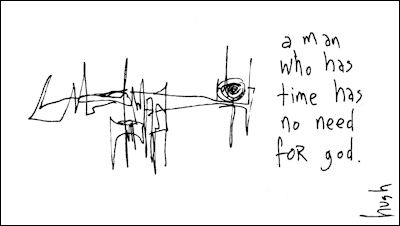
    As it regularly happens these days with me- by sheer coincidence, the day after I had this discussion with Meeta, I came across this work from Hugh MacLeod, which puts it so well

    time

    until next time, timed out for a fortnight 🙂

  • Blocking Crowds

    Even if you’re not really a 140 type character, you’d have heard about the CBI – Chetan Bhagat Incident, that is. But if you haven’t, not to worry much, we have a link, starring our very own celebrity blogger Nikhil Narayanan, who created the hashtag that led to the deluge. Considering Nikhil’s proximity to another author (turned politician) we’re also probing into other possible links with the external affairs ministry. But that’s for later. :p

    In essence, what started as a debate on piracy – books, not Somalian warships and blockades- led to Chetan Bhagat blocking a couple of twitterers, and the phase that launched at least a few hundred tweets, each a warship using variations of the word ‘block’. Samples can be found here, and my contributions here. My friend Vimoh (as usual) wrote a very objective post on the entire episode, capturing life on Twitter and the presence of celebrities on Twitter very well. Chetan Bhagat can take solace in the fact that his desired aim of uniting India (as stated in 2 States) did happen on Twitter, with very few exceptions. My stated aim of Chasten Bhagat also happened. I think he now understands how the ‘2.0 state’ works, since a couple of days later, we found him very sportingly, making a dig at the incident – “wife screamed at me this morning for no reason. felt like blocking her.” Now that’s cool. 🙂

    Some perspectives.I’ve blocked people on Twitter too (I still feel bad about those nice girls who sent me what they must’ve thought were useful links), but not after warnings in the public stream. Like I commented on twitter, The Comic Project said it best here, ” If you want to block, block; don’t talk” . In the same article, Surekha also pointed out that though it began as fun, it quickly spiraled into a mob. Something that Nithin, who proved to be a very good voice of reason, had pointed out just when the spiraling started. The ironic part is that I’d have missed out on all of this if Surekha hadn’t popped up on a chat window and told me something was brewing. (Fault attribution check :p)  And though I usually avoid hashtags, a window of wordplay opportunity I couldn’t miss. So i dived right in, ignoring the standard operating procedure of checking out origins. Big mistake, no pun intended. 😐

    I hate mobs, and on the other blog, it is a subject that keeps appearing every now and then. So it sucks to have been part of one. In a post from long ago – 5 years back, titled “Communities and echo chambers“, Dave Winer commented “Your “friends” are an angry controlling abusive mob. …… If friendship is just that, people being friendly and supportive, great. But if it’s really defining who it’s okay to attack, then it’s not friendship.” I perhaps cannot define the relationships on twitter (always) as ‘friendship’, but as I become part of communities on various kinds of social networks on the web, it becomes all the more important to keep a check on the ‘belonging’ craving. Its a lesson learnt.

    until next time, mob bile…

    PS. But all that doesn’t stop me from an occasional dig – like yesterday, when I suggested a brand ambassador for Haagen Dazs, after their franchisee in Delhi did a unique preview – for those with international passports only. To an extent, the mob was in action yesterday too 🙂