
Tag: twitter

  • Hairsay

    So, the Old Spice man  increased the sales of the product. Now we can renew the debate on the efficacy of social media on the bottom line. We obviously won’t ask for correlation data. 🙂 The other side effect is that every brand manager will now want to replicate it – especially the viral and the ROI. Quite like a poster child (in India) of an era gone by – Sunsilk’s GangofGirls, which at that point had made many a  brand manager experimenting with digital media tell their agency “I want one too”. Damn virals work at meta levels!!

    I recently read Kapil Ohri’s article on afaqs, on the site’s makeover – the shift from blogs and gangs to trends and forums and the ‘mandatory’ buttons – Facebook and Twitter. Its early days, so it’d be unfair to make a comment on the numbers, even if they were to be considered a parameter of success/ failure. But while, on buttons, I think YouTube videos would’ve been a help. More on that in a bit. A revamped GoG, and the Pantene vs Dove war for hairspace being fought offline and on blogs (Karthik, L Bhat) gives me enough food for thought.. and opinion.

    Sunsilk Gang of Girls: GoG could have (like an industry person commented on the afaqs post) integrated Facebook in a much better way. Check out what Levi’s has done at their online store. Instead of separate registrations and profile, Facebook’s plugins could make life easier for the user and automatically bring in the ‘gangs’. It could get them to pull their own photos from Facebook for the ‘Makeover Machine’, suggest it to friends, and so on. Or build a Twitter app that uses the display picture. It could have perhaps thought bigger and had their ambassador (Priyanka Chopra?) interact with the users through her own identities on these platforms. Or used a location based tool like Foursquare (or FB Pages or later Google Places) to start building a resource for salons and tips at each place (think of a Burrp! for salons), maybe in sync with a YouTube channel for tips.

    Pantene: Good Morning! They obviously missed a little thing when they didn’t pay attention to the pwnage of DNA at the hands of the Times Group during the former’s launch campaign in Mumbai back in 2005 (?), or the more recent Airtel- Reliance DTH fun. Not to mention the cliche that after a certain point, the only person who gets teased is the brand manager. Ok, I won’t overstate, but c’mon this is a real-time era AND they did walk into a Dovetailed ambush. Since the internet already has made them un-mysterious (thanks for that info, Karthik), maybe Pantene should have just added those FB page and Twitter links to their mass media communication, and solved the mystery immediately online. Mind you, thanks to our dismal internet penetration, they could still demystify it again on mass media, later, after perhaps, adding the content from their online and offline activities. (think non market research agency 80%) That way, there would’ve been at least some buffer against a Dove’s sneak attack. Arguable, but possible.

    Dove: All of us should take the time and remember the controversy over the ‘campaign for real beauty’. But hey, they saw an opportunity and used it. Effects on long term goals are again arguable.

    A little note on ‘low involvement’. I wrote about brands, content and new media platforms in the last post, in the context of the Old Spice campaign, and also mentioned the importance of ‘intent’ and setting objectives. Once the ‘why’ is done, the relevant crowd can be identified, along with the platforms and activation strategies – ‘(to) who’, where and what. (Read Rohit Awasthi’s comment on Karthik’s first post) When the ‘right’ content is pitched to the ‘right’ people at the ‘right’ time (and the ‘right’ platform too), very few categories are low involvement.  (read Naina’s comment on that post) And that’s the beauty of the web in general, and the tools that social media have provided marketers. Old Spice could be seen as low involvement too, until they did this campaign.

    But having mostly seen communication as advertising (except arguably PR), creating content for social platforms is in itself quite a challenge for brand managers. Even if they were to  view ‘social’ as ‘media’, it requires a complete realignment of how media and content strategy is done, mostly because the mechanics of distribution are completely different. At a fundamental level, brands are dependent on users of platforms to create a buzz, and money doesn’t always work. At this point, tools can help with the ‘time’ (including location and other contexts) and ‘people’ (interest), and the way it works, if the ‘content’ is done right, people will get other people.

    Therefore brand managers need to make a more diligent effort. The fragmentation of traditional media does not seem to have made much of an impact on the costs involved in using them as distribution channels. So when ‘social media’  presents ‘free’ channels, brand managers see a value proposition and jump right in with a TVC and or/other weapons of mass mediocrity. Brands, I believe, need to invest a bit more on who they’re trying to reach, and then invest some more on building content and designing networks and constructs (irrespective of platform) that will drive the crowd to interact with the content and share it more. Content and people that will drive more connections, and help meet everyone’s objectives.

    But yes, until Augmented Reality allows me to scan a shampoo and tell me how many of my friends liked it, and think I should use it, (though my hair won’t last that long 😐 ) lets keep playing all the shampoo games we can play. 🙂 And while on using social platforms purely with a sales objective, I’m reminded of how Grandma uses her laptop. (vid below) Can it be used for those purposes? Of course! But is that its best case use? We can argue 😉

    httpv://www.youtube.com/watch?v=Vg6emajJmEo

    until next time, sometimes brand strategies can be real poo!!
  • Square Routes

    Despite my niggle with location based services (specifically Foursquare) – that the game part is taking away from the social/utility part of it, I still believe that they’re an excellent step towards bringing reality and the virtual social networks closer. And hence, I do pay attention to the developments in the domain – from how they stack up against each other in terms of features (and an excellent infographic) to futuristic scenarios and thoughts, which give some good pointers on where these are headed, and the features being added in specific LBS players and the omnipresent trio – Google, Facebook and Twitter.

    Foursquare is the only one I use, and hence I’m a bit biased. But it really has been setting a scorching pace in terms of creating opportunities that widen its scope. Badge fatigue is definitely something I’d been wondering about basis my usage, and I read that they’re now looking at adding more real value to badges, beyond the regular ‘mayor specials’ kind of deals. For example, “users who check-in at an Internet Week venue will unlock a special badge. That badge — when presented to bouncers — will guarantee users priority entrance into some Internet Week parties and events.” (via Mashable) The association with WSJ for the ‘Add to Foursquare’ button- to add venues with a single click when they are mentioned in articles – is quite a good move, both in terms of publicity, as well as utility. (because WSJ also adds a tip, with a link, so they get traffic later)

    Scoble has an excellent post with suggestions on what Foursquare should be doing, going forward. I think all of them are essential – especially badges as a platform so companies/establishments can use it too (read recently that they’re doing it, but can’t find a link), giving more importance to tips (I don’t even get points for them), adding multimedia content (Brightkite has started this already), and the checking out feature. I’d also like to add to the wishlist – the ability to (direct) message (not shout) other users, (actually buy Meet Gatsby)  a way for select users to preview my (say) weekend plan, a way to ‘like’ existing tips so future users can have some kind of mechanism to judge,  tie ups with the group buying players (see The Dealmap), and please, an app for Nokia (especially valid for India). Oh yes, these real badges and other merchandise, how about adding some Augmented Reality/Stickybits to it? That goes for the stickers that are coming out soon too.

    Meanwhile, Google has rolled out Tags – an advertising feature for local businesses that allow them to post additional information (eg. deals), Twitter is going ‘Places‘ which will allow users to tag tweets with places – its already integrated with Foursquare and Gowalla and automatically goes to a page associated with the place, and as SearchEngineLand notes, could in time, provide some good competition to Google Places. Ok, Yahoo’s trying too, remember, it bought the Indonesian service Koprol last month.  In addition there are new players set to arrive on the scene too, like Placebook!! (via) That reminds me, the Facebook ‘location’ buzz has been happening for long enough now, and I’d say that once the privacy talks have been sufficiently muted, there would be an announcement. For the record, Facebook ain’t the only ones with privacy issues. The aggregators have also arrived on the scene – Fourwhere.

    RWW has a classification of three different webs – data, people and services, all of which are the basis of mashups – current and near future. The web of people has thrown up the issue of privacy and the amount of personal data users want to share. Location based services stretch this even further. (Do read ‘Publicy and the erosion of privacy‘) As we live in the stream and move towards new social and data arrangements, what I find interesting is that without the data we share, mashups might find it difficult to throw up personalised recommendations. Users, services as well as brands will need to walk a fine line on this. Services, I think, have to do the balancing act most. They have to keep users comfortable in terms of privacy and what they receive for sharing the data. Placebook sounds good in this context. They also have to help brands deliver value to the user.  But as of now, the business models are still evolving. A recent study showed that only 10% of businesses would be willing to pay for Foursquare.  But as users evolve, consumption, social behaviour and data sharing comfort levels change and intersect, and services gear up to accommodate all this, we will surely see a rapidly changing landscape.

    until next time, location based relationships next?

  • Higher Stakes

    The ‘cow slaughter ban’ bill that got passed in the Karnataka assembly sometime back, got a lot of people’s erm, goat, especially Mallus, for many of whom, paradoxically, its a ‘holy cow’ issue. But the phenomenal prospects of wordplay is not what got me thinking. Its the idea of something getting banned and the protests that follow.

    Take smoking, for example. I’m sure all the smokers would have been fuming at the bans that came out on various aspects of the product and its usage, but a lot of us feel that its a good thing for different reasons. Me, mostly because those lousy forwards with the much abused ‘kick the butt’ subject line, and horrible pictures, have stopped. I find that the majority of people I know support this ban, citing health reasons etc. But the beef ban, which (at least in a way) prevents killing of a life form, finds lesser supporters. Personally, I love beef, but as time passes, my feelings of guilt have also been strengthening, and its the case of a subjective like over ruling a ‘better for the cosmos’ thought. A sad rendition of  the “way to a man’s heart…. ” too. But I do wonder about a future when the majority would say that the beef ban is a good thing. A higher state of awareness?

    A few days back, I read Seth Godin’s post titled “Fear of Philanthropy“, where though his context is mostly to do with ’cause marketing’, he writes about knowing how much (of giving) is enough.  He paraphrases a question (attributed to Peter Singer) “Would you save a drowning girl even if it means ruining a pair of Italian shoes? If the answer is yes, why not use that money to save 20 kids starving to death at the other end of town/world?” Isn’t it the same? (I need to read up more on Singer, Practical Ethics, and the idea of “the greatest good of the greatest number”).  Godin points to proximity, attention and intent as factors that weigh in in our decision to ‘give’.

    Proximity and attention. I remember wondering in a post sometime back whether all this connectivity, instant communication and micro popularity would make us less compassionate and more inconsiderate. But then again, does this connectivity increase our proximity to issues and would it be negated by the lack of attention? Heh. Will it make us more conscious or will it cause to go even deeper into our own comfortable bubble?

    Intent. I saw Will Smith’s ‘Seven Pounds’ when it played on TV recently. The idea of a man donating different organs/parts of his body, after ensuring that the receiver is indeed worthy – ‘a good man/woman’ (“You’re a good man even when no one’s looking”). Commenting on the intent would spoil the viewing for you, but the point here is the time and patience taken to identify and verify the ‘goodness’. I’d have liked to do that too, but I’m afraid of what all it would entail. I convince myself that I don’t have the time. However, I can’t help but wonder optimistically whether one day, the collective consciousness would help take my awareness so high that my intent is made all the more stronger and then, everything else will cease to be a factor. But then I look in the mirror and say that I’m better off looking within myself, for its difficult to refute an oft asked question “I didn’t make it this way, why should I contribute to making it a better place, when I can buy my happiness in other ways?” As Godin says, its effective enough, sadly so.

    until next time, streamlined thoughts 🙂

    PS. meanwhile, if you’ve been reading this blog for a while, and have liked it, do officially ‘like’ it here 🙂

  • Early Bird Rewards

    At least two major virtual happenings, one that has massive implications on the future of the web, and the other, slightly more subdued, but not lacking in potential. The latter – Twitter Annotations, announced at Chirp, allowing developers to “add any arbitrary metadata to any tweet in the system.” You can take a look at the various possibilities here, here and here. The former – Facebook’s  Open Graph, unveiled at the f8 conference, and aimed at making itself the centre of everything that happens on the www. A  combination of  plugins, developer tools, new markups which can make the user experience on any site that plays along increasingly personal, social, semantic, from plain hyperlinks to layered information. Already, one small manifestation can  be seen at the bottom of this post – a Facebook ‘Like’ button, which will carry your liking of this post into your activity stream on Facebook. More and more data, not just what you do on FB, but outside as well, across the web. From what I read, smells like Google, perhaps worse, because the flow of information seems possible only through the Facebook conduit. A good round up of implications here.

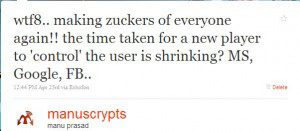
    When I returned from he break, and read up on these developments, my first thought, which i also tweeted was

    1

    And that’s the point of the post. During the break, the only network I was hooked on to was Foursquare. One of the things that happened, thanks to long waiting times in the Kolkata airport was that I became mayor of the neat CCD outlet just outside the airport complex.

    CCD has completed the re-branding at this outlet (unlike the one inside the airport) and has done a decent job at establishing ‘conversations’ as the prime focus area, in terms of in-store design. The feedback posters, ‘snippets’ at each table and the ‘quotes’ design on the roof were nice touches. When I got back, I found a CCD account following me on Twitter. Seemed like a more synergistic effort after the earlier snafu.

    It made me think once again about how alert brands need to be in such a dynamic scenario. If CCD were an early adopter, would they have braved the earlier storm better? What if they become active on Foursquare now, experiment with the new services being built on top of it – friendticker, snacksquare etc, still in their nascent stages. Or at least acknowledge their outlets on Foursquare and engaging the users. “@xyz congrats on becoming the mayor of our abc outlet”, and then build on top of that relationship. Won’t that help them gain some crucial evangelists in a new medium? If not evangelists, at least someone who will listen to their side of the story when something nasty happens? Wouldn’t they get a headstart on ‘authority’ by being an early bird?

    Even the era of quick responses being a reasonable expectation seems to be blurring by fast. Perhaps brands are now required to have an advance scout mechanism, to test out new services, features, changes, understand the implications and see whether/how business and objectives needs to be realigned. Page Rank, Social Platforms at consumer and enterprise level, Social CRM, Location based services, tools and platforms keep shifting. Early adoption and balancing objectives with diverse ways and platforms of engagement may become an imperative. Multiple options, two way communication manifestos, its all changing real time. Hold on tight.

    until next time, service level disagreements

  • Endurance Models

    I’d ended last week’s post wondering about the role of durability in the design of communication and organisational structures. Dina has continued the discussion on her blog, adding on some very pertinent questions. Do visit and add on to this very interesting thought flow.

    I got myself three threads of thought in her post. One, the dependency (of one product on another’s durability) factor, highlighted by the classic example of Twitter, where app developers have been flummoxed by recent events. (Twitter buying out Atebits and making Tweetie a free app for iPhone). Two, brands needing to create enduring, sustainable relationships, and being agile and flexible, because neither consumers nor their relationships are ‘static’. And therefore, three, durability is morphing.

    Before we dig into all of them, a small point of view. While one one hand, Twitter buying out services/competing with them could be seen as very Google like, and something that kills innovation in my book, I do have faith in Twitter and believe it won’t go the way Google has. (Simplistically) Unlike Google, which practically kills (eg. Dodgeball, jaiku), Twitter has just removed one entry barrier (paying for the service) for Tweetie’s adoption. As for Fred Wilson’s post, i can only remind you (again) of Godin’s description of Twitter – a protocol, and that’s why I completely buy the argument in the post on creating something entirely new on top of Twitter. (a contra view on Twitter being a protocol, informative read)

    This, you would notice, is a thought that continues from Dina’s point on dependency. But there’s a link to the second point as well – creating enduring, sustaining relationships and being flexible. The services which (to quote Fred Wilson) were ‘filling holes’ were (IMO) way too dependent on twitter. They were only providing a value, which Twitter had not deemed as a priority at a particular point in time. Not sustainable.

    Now, social gaming is one of the opportunities that Fred Wilson notes. So, look at Zynga. Their creations acquired massive adoption because of Facebook. They keep making more games, running them on Facebook, but simultaneously, also made farmville.com, with integrated FB Connect, and offers them more flexibility to provide more value. More importantly, the genre is perhaps not something FB is likely to get its hands dirty in anytime soon. Slightly more sustainable. Look at Foursquare. Standalone, but with Twitter and Facebook integrated very well. A level higher on sustainability. So the point is, the durability would be a function of how these platforms are used, dependency is proportional to the value provided.

    Morphing. Though the usage of social media by organisations is a subject that is discussed often (including on this blog), I thought this post by Tac Anderson articulated it extremely well. He discusses three strategies used by the enterprise – the one off approach that isn’t integrated with any existing system/process; optimising social media for business – with clear resources, roles and responsibilities; optimising business for social media. The first and second areas are where most companies operate. The third is a business organisation optimised for social media (technology and culture). He points out that Netflix, Google, Amazon have built businesses optimised for the web, and doesn’t see a business that has successfully implemented it wrt social media. He does say that it may not make sense for a company to throw out an existing strategy and build another around social media, but the ones with the third approach will be the next Google/Amazon. Another good read on the subject is Tom Fishburne’s ‘The new product waterfall‘.

    It is debatable whether an organisation can move from approach 2 towards 3.  But I do think that the morphed versions of durability will emerge from business structures that are built to be comfortable with and are therefore in a position to take advantage of the tools and platforms of social media. That is most likely the way to create enduring, sustainable relationships in a scenario of changing consumer and communication dynamics.

    until next time, the durability of this thread on the blog ends here 🙂

    PS: Won’t have to endure a post next week. Back in a fortnight 😉