
Tag: twitter

  • Social evolution, at least?

    Judging by the number of responses to his article in ‘The New Yorker’, Malcolm Gladwell seems to have ruffled quite a few feathers, especially in the Twitter loving community. Not surprising, since he has torn apart at least a couple of Twitter’s poster children revolutions – Iran and Moldova. His grouse seems to be that we have forgotten what activism is, and are perhaps doing the word disrespect by using it for activities that happen basis the ‘weak ties’ of social media. The benchmark he sets for activism are indeed high – the Civil Rights Movement, which happened before and without the internet.

    I could give you quite a few links that offer rebuttals to this argument or try to put in context – Evgeny Morozov’s post in NYT, Maria Popova’s vehement retort, Gaurav’s 6 point reasoning of why Gladwell is wrong, Anil Dash’s more nuanced approach, and even cite say, a Pink Chaddi campaign (in a country which has a single digit internet penetration) to attempt a contra view. But there’s no denying that armchair activism/slacktivism exists.

    However, as Maria explains in her post, different generations face different societal challenges. They also have a different set of tools that enable them to achieve changes in the status quo. And that’s probably why I think its unfair to dismiss the influence of social platforms in combating the issues of our time. The issues can be across domains – from water crises (check Mashable’s post on Blog Action Day 2010 – Water) to changing the ‘unhealthy’ business models of several traditional media outlets. It is challenging individuals to create and collaborate and break out of  work/life mindsets. I am able to be part of say, a micro finance venture and spread the word on social channels. Such changes can’t be deemed worthless. In any case we’re perhaps too early to postulate what these tools would achieve. Precisely being in the middle of this would take away our objectivity.

    Despite this hilarious Maslow’s hierarchy of internet needs, I’d like to think that we are moving through a hierarchy as web technologies evolve. From a general source of information, the web has moved on to being able to connect us in context. It has allowed the rapid amplification of signals. We have only started with location as a context of networking. There would be a tremendous difference when we start addressing civic issues, using social tools as a means to aggregate locality based communities.  In essence, tools are just that, and we have to define contexts to make them more useful. And we have to evolve to that level.

    Maybe there will never be massive revolutions, just small uprisings across time and place that subvert what could’ve been a great crisis if it was allowed to grow without checks.

    until next time, rebelution it is 🙂
  • Mirror Images

    I came across this passage while reading Kiran Desai’s “The Inheritance of Loss”. The context is of a young girl, who, because of a new found romance suddenly becomes conscious of herself.

    “But how did she appear? She searched in the stainless-steel pots, in the polished gompa butter lamps, in the merchants’ vessels in the bazaar, in the images proffered by the spoons and knives on the dining table, in the green surface of the pond. Round and fat she was in the spoons, long and thin in the knives, pocked by insects and tiddlers in the pond; golden in one light, ashen in another; back then to the mirror; but the mirror, fickle as ever, showed one thing, then another and left her, as usual, without an answer.”

    I found that I could also identify with it in the context of our encounters with the social platforms around – Orkut, Twitter, Facebook, LinkedIn.. and how slowly the ‘Like’ and RTs seem to be defining the interactions and affecting even perceptions and understanding of the self. Its not as though people and comments never existed before, but the sheer mass of people we come into contact with, thanks to the social platforms is unprecedented. Through the conversations and responses, we see a bit of ourselves, a self colored by the other person’s perceptions. As the voices around us continue to increase, at some point, is there a danger of losing touch with what we really are? Yes, you could ignore or be selective, but then we’d just get back to an objectivity argument.

    “The biggest danger, that of losing oneself, can pass off as quietly as if it were nothing; every other loss, an arm, a leg, five dollars, a wife, etc. is bound to be noticed.”

    I read that, thanks to @aanteadda‘s share on Twitter – an excellent take on the Ramayana,(do read it) and in a completely different context – that of dharma, it happened to arrive around the same place. Rama, having lived his entire life by what he considered his dharma, is distressed by what he must do with Sita after the end of the war with Ravana, irrespective of what he personally wants. The author thinks that this is Rama’s tragedy, and that of every person who lives by ‘impartial and abstract principles’, which don’t take into account ‘individuals as persons,’ and can’t see the difference between a situation and a personal situation’, and it can only lead to the destruction of the self.

    And so I wondered, whether its people, or a moral code that one follows, whatever dictates what we do, is there really a difference – between the reflections from others and ourselves? Is there one right answer for what should define us and the way we live. I think not.

    We must prioritise, I guess, based on what we think will give us happiness, and just like this neat article on addiction (the internet in particular) ends, “we will increasingly be defined by what we say no to”, all thanks to an abundance of choices, from within and without.

    until next time, you always have a choice, but do you always want a choice?

  • Group Pwn

    I’ve never gotten around to trying group buying/deal sites until once recently, though I always thought that they were fulfilling a need for businesses and consumers. But when I read this ‘peculiar’ story titled Groupon’s Success Disaster, I found myself identifying with it (from a consumer perspective, we’ll get to that in a bit) and since the number of group buying sites in India is only a few numbers lesser than the number of social media consultants, I thought it made sense to spare a few thoughts on it.

    The (linked above) story is of a small business owner, who, after 3 months of using Groupon, discovered that the deals were hurting the business financially and then had to take $8000 out of savings to cover payroll. Considering that, I thought the Groupon reply has quite a cruel title – ‘Too much of a good thing‘, but it is well drafted.

    The win-win for business-consumer in this is because it gives the former a chance to spread the word on the service and probably get some feedback on it and the latter mostly gets a good deal. Like I mentioned, I used a site recently for what seemed like a good deal. Though the deal process was painless, I ended up spending more money than what I normally would, thanks to a mis-communication (and some carelessness on my part). It means that I won’t be a repeat customer. It ends up as a lose-lose. Now this is probably the exception to how it usually happens, but…

    It did make me think whether the business owners get into deals with a strategy in place. Not just in terms of finance, but also in terms of their expectations of buzz, their delivery capability as well as how they’d manage to make the customer return. When it is kept in mind that social platforms and deal sites are mostly interwoven, I think it’d make sense for the business to use their service delivery (assumed good) and connect it to their social presence. A “We hope you liked it. Here’s an x% discount for your next visit and we would really appreciate it if you could leave your comments on FB/Twitter” approach. Facebook would especially help the business to spread the word beyond the usual early adopter set. While on retail, its difficult not to mention Foursquare. Though I’d love it if Foursquare aggregated the deals themselves, the businesses definitely can get active on Foursquare and push their deals to users nearby.

    With the (limited) examples I’ve seen, I doubt whether this is being done. So it reminds me of a lot of advertising,  and most social media efforts. The former because the message and the product/service are rarely (generalising) in sync, and the latter because of the lack of strategy and the herd mentality.

    until next time, regroup!

  • ‘Like’ Minded People

    I read an interesting post by Dare Obasanjo titled “There will be many social graphs“. It took me back to the context of my post on Google’s social plans, where I’d mentioned the possibility of creating networks around different contexts – with not all connections being ‘friends’- a Twitter kind of asymmetric relationship, and how Facebook and Google both have an opportunity at that level. The form and kinds of data that we share – blog posts and thoughts, status updates, photos, videos, answers, people and the contexts we share them in, are many, and sometimes I wonder if one service can actually aggregate all this, while still providing user friendly privacy options.

    When i read (and saw) that Facebook is replacing ‘boxes’ with tabs, and also saw that my ‘Like’s (Interests and Likes seem to be undifferentiated now!) were now displayed prominently on my profile, I wondered if Facebook could really aggregate everything. Imagine, if those Likes+ interests were differentiated – i.e. Interest was ‘Music’ and ‘Greenday’ was a Like. Now, the way I’d like it is, if I had Interests displayed on my Profile page (or a tab, if you prefer) – there could be options of ‘how many’, ‘most active’, ‘most recent’ etc, with the existing ‘who can see’ privacy option, but more finely grained for each interest. For each interest, I should be able to build a page – with third party content included – subscription to blogs on the subject (either through FB Notes or say, Networked Blogs), Facebook Questions  and Quora, it could be Facebook groups, Pages that I have liked (so the interest ‘Music’ could have every artist/band/music media brand/ label I’ve liked), Friends who share the interest, people I ‘follow’ in that interest category (will explain in a minute) and when FB plays location, include that too, and sync Events. Goes without saying that I should have micro-level privacy setting options for sharing with others. I should be able to ‘Like+follow’ an interest of a person even if I’m not his friend (assuming he’s kept his interest public),  and even recommend to my friends.  A sort of ‘Twitter list’ for each interest. Yes, of course I need to be able to import Twitter lists too. There would also be a universal ‘Interest’ page that collates data from all the Interest Pages created by individual users, and also gives suggestions on ‘Whom to Follow’ for that interest – an algorithm based not just on mass ‘Like’s, but also basis contexts like Location, sub-genres, and my previous activity. To scale even further, use (mass and personal) data from services where I’ve used some form of Facebook Connect. Of course, Facebook would then have ginormous data on me, but they have it anyway, so I’ll be optimistic and hope that they use it to ‘personalise the internet – like Hunch, than for anything evil. Of course I’m assuming I get data portability too. Then maybe the different Facebook Search options can also really have fun. The entities who want to ‘engage’ users would also find this useful. I realise that I might be being simplistic about this, but what about the direction?

    And though most people are skeptical about Google’s social efforts, perhaps justifiably so (read this at GigaOm and Stowe Boyd’s “Can Google go Social“), and the Wave crash doesn’t really help perception, I don’t want to rule out  the possibility  (like I said in the earlier post) of Google getting over their privacy agony, and surprising us – imagine the ‘Interests’ as a separate service/ something around or integrated with iGoogle/Profiles/Buzz (brrr)/Chrome (browser or OS)/ Search itself.

    While on interests, suggestions and discovery, Twitter’s ‘Who To Follow’ hasn’t excited me much in terms of the people it has suggested. It says that the algorithm is based on people you follow and those they follow, but for now everyone’s busy trashing it, using its own acronym – WTF. So, how about using interests (Why To Follow – work harder on the existing Interests structure?) – either ask me when when i register, you can ask me now too, the lists that include me, keywords from tweets and bio, hashtags and hopefully ‘learn’ my preferences over a period of time. Popularity by itself is really not that great a parameter – if they’re popular, chances are I already know, and there’s a reason I don’t follow, even if its ego 😉

    Its not as though these are the only guys who can build a more nuanced social platforms – perhaps its possible for someone like Quora to start with questions and build more – eg. relevant posts from say Networked Blogs, and more people from Twitter Lists? Foursquare, or any of the LBS could scale too – from places to activities and consumption that happen at those places.

    Meanwhile, interests, context, relevance, building authority and influence, all of these are established on identities,  but there’s a debate on whether an old friend merits a return – anonymity. 🙂 More on that later. 🙂

    until next time, interesting?

  • Back to eternity

    Despite being a Star Trek fan, I happen to think that Time is the final frontier, at least in the horizon that I can see. I find it quite intriguing that, though it might be looked on as a tool for tracking, I can perhaps not account for most of my lifetime. I don’t mean the large picture, I haven’t lost it totally yet, but specific minutes. Take for example, the last hour and account for all the thoughts that rushed in. I would find it difficult.

    If you close your eyes, and allow your breath to be the only meter, the perspective of time undergoes a shift. Meditate a bit, and its easy to see. Easy to see that even the measurement of time – years to seconds and beyond is our  construct. But it is so ubiquitous and enmeshed in our lives that it seems as though it is a constant and only we change. It requires dramatic events for us to pause and note the passage of time. Kahlil Gibran has said, ‘Perhaps time’s definition of coal is the diamond”

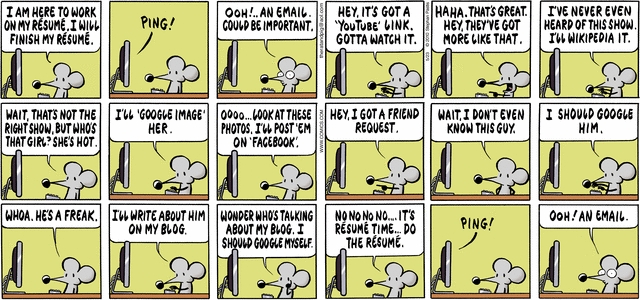
    Meanwhile, I wonder if all the information about those unaccounted for minutes is stored somewhere in my brain, and is just not deemed enough to be of any priority for me, and hence seems inaccessible. The tools that consume me these days – most specifically Twitter, and more recently, Foursquare, also help me keep track of what I’ve been up to, and when it works the same way for everyone is when there is an information deluge, and that seems to be something we find difficult to handle. Something that we have discussed before. There is a toon I found (here) that correctly describes the way a lot of us seem to be functioning now

    Clipboard01

    And in another example of how man is shaping his own evolution, I read about companies like Lifenaut, which  ultimately aim to create humanoid robots powered by a backup of the original human’s brain. (via @pkaroshi) The first step is to create a digitised version – an avatar, and give it enough data for it to mimic the original human. It makes me wonder whether we will be able to create ‘consciousness’.

    And that makes me think a bit more – by the time, we are technologically advanced to create it, will we have forgotten what consciousness is? Which also begs the question whether we have ever understood it at all, when we are not even mindful of the minutes of our lives? How does one define it? So many reactions which seem pre-programmed when one thinks of it, actions and reactions more out of habit than any conscious choice being exercised.

    So yes, with all of the work happening at a rapid pace, (do read) I think its more ‘when’ than ‘if’ – that we will become immortal, and time, from a future point of view, will become immaterial, because the future will be infinite. But we still may not be able to undo what we did a minute back. Where does that leave us? To quote Pico Iyer (from Abandon) “God has to be understood in the context of everything that is not Him”. But that is a different discussion, I guess. Its only that with every advancement that humanity makes, and in that process also usurps things once attributed to divinity, I begin to wonder where that leaves our versions of God?

    until next time, time.ly links 🙂

    PS. I tweeted sometime back, even if you never read an Asimov work, or never plan to, this is one that you should read. The Last Question.