
Tag: trust

  • Until the customer is king..

    Instagram just released v3.0. One of the biggest changes in this version is the introduction of Photo Maps, which quite obviously, plots your photos on a map. The default is opt-in, not opt-out, though they’ve done their bit to give the user control over data.  I updated despite reading this Wired article on the privacy implications and the bug that briefly exposed private photos!

    I’d written my first post that referred to Big Data recently, and the day after that, I read this very interesting post that talked about various applications including an algorithm that can identify cities based on their unique architectural elements and other distinguising characteristics. But a few weeks earlier, WSJ had an interesting post that talked of how large corporations see big data as a means to get personal with customers using information gathered by placing tracking files in people’s browsers and smartphone apps without their knowledge—so they can be stalked wherever they go, with their “experiences” on commercial websites “personalized” for them. The post describes not just its real world analogies but practices as well, and predicts a future where the user will declare your own policies, preferences and terms of engagement—and do it in ways that can be automated both for you and the companies you engage. An entire ecosystem across apps and corporations built in a consumer centric fashion.

    But as the post itself admits, the move toward individual empowerment is a long, gradual revolution. Until then, we need to define our own limits of sharing, fully understanding that it is a give and take. Not just what and where, but whom too – since all it takes a RT or a ‘Share – Public’ for something shared in a close circle to go public. How much of privacy would I give up to open myself to opportunities, or get an experience that is tailored to my needs and convenience. On the other side, a modern corporation needs to understand the choice the consumer is making and use the information to not just provide genuine value, but also make it easier for both entities to adapt to the rapidly changing landscape.

    until next time, kingmakers
  • The price of influence

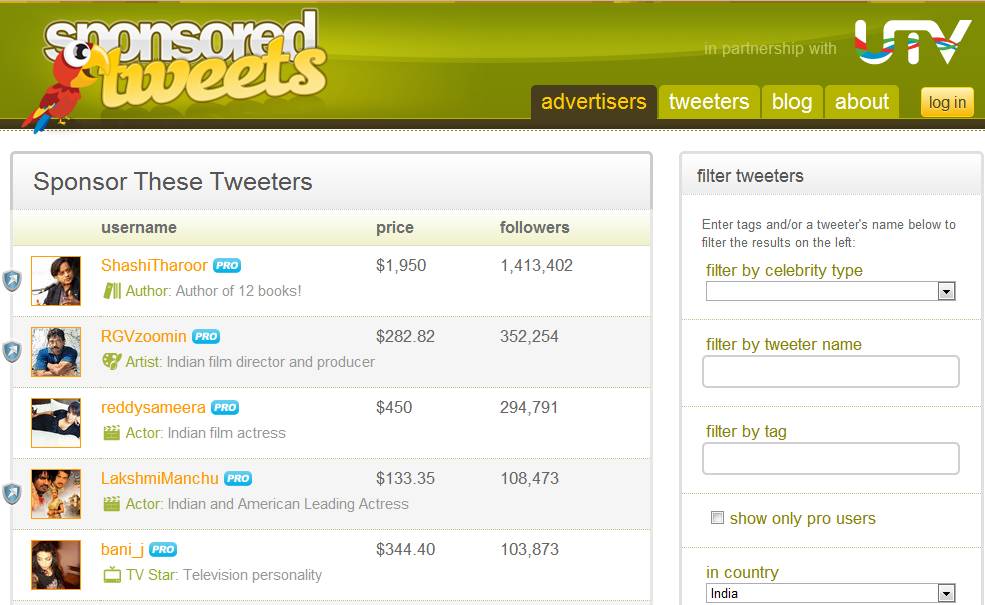
    Speaking of trust, between a corporation and consumers, one of the earliest controlled version of ‘outsourcing’ it was celebrity endorsements. I use ‘controlled’ because organic WOM is not really in the corporation’s control. Though it is still in vogue, the credibility is possibly dented thanks to abuse by the endorser, the endorsed and a media that creates more ways to make an a$$ of the end consumer. eg. passing off ads as content.

    In the era of social networks and lightweight interactions, the beneficiaries of this decline would be micro celebrities (MC from now) who have created their own circles of influence in specific domains. I remember writing about that – over 3 years back, and following it up later with influence cycles and the tool based influence calculations being used by brands for promotions. The platforms used by these celebrities could be any – twitter, blogs, Pinterest etc and it does allow the brand to customise their interactions basis the medium itself and with help from the MC, use the strengths of the medium to the hilt.

    I was hoping that it would evolve such that brands would identify MCs who would be connected to their own category and therefore would wield their influence among people interested in that category. But judging by the directions the platforms are taking, the equations seem to be becoming closer to the earlier forms of media, and ignoring the social aspect. When Vijay shared this and pinky-swore that he wasn’t playing an April Fool prank, I was even more convinced of the direction. Full circle. Hopefully the lessons will be fast, and the new cycle will begin soon. 🙂

    until next time, influenced?

  • In trust we trust

    Karthik recently wrote a post on a subject I’ve been thinking about for a while now – “How should brands use public information you share on social media“, on British Airways’ “Know Me” scheme to personalise their service by providing iPads to their staff and “giving them instant access to customer data, including passengers’ travel history, meal requests and details of any previous complaints. They will also use Google Images to search for pictures to link with passenger profiles, helping staff to identify them next time they fly” (via) It has already been met with disapproval from some, but Karthik believes there is value if there is intelligent use of context to delight a consumer. I’d tend to agree.

    Any user of Rapportive would be familiar with the thrills it offers thanks to rich profiles provided as you read/write a mail from/to a contact. 🙂 At an enterprise level, any social media practitioner would also agree that it’s sometimes useful to butt into conversations where an @ has not been used, if you can provide value to a consumer. A Capgemini infographic, based on 16000 interviews in 16 countries, shows that 61% of digital shoppers want the store to remember their personal details, 54% want to receive persoanlised offers, and 41% actually want to be identified through digital devices when they enter a physical store! But when Orbitz starts showing Mac users different and costlier options as compared to Windows users,  I’d really wonder if the business is providing value to consumers in personalised offers!

    At paidContent, I read “Big data and the changing economics of privacy“, which discusses how easy it is to get info on people, and debates a ‘Do Not Collect’ law, especially in the context of new technologies like face recognition. Another suggestion I read at AdAge is to let consumers build their own tracking profiles – What consumers might prefer, if one were to actually ask them, is the ability to build, manage and get useful things from their own profile and data. Let consumers remain entirely anonymous and in control.

    As this Econsultancy report succinctly points out, personalisation is ultimately a trade off, and businesses need to learn to provide tangible value to consumers who share their data. But before that, they also need to make the consumer comfortable by using even freely available data intelligently in a way that shows their intent, asking consent when applicable, building trust and allowing users to retain control.

    I personally believe that if you’re putting any information out on the web, you should take responsibility for it – that includes what you share and who you share it with. From experience, it can give you great lessons in trust, and I think that applies to the relationship between people and businesses too.

    until next time, trust worthy

  • Consumer Tracks

    I heard a very interesting quote recently, attributed to Rishad Tobaccowala

    When consumers hear about a product today, their first reaction is ‘Let me search online for it.’ And so they go on a journey of discovery: about a product, a service, an issue, an opportunity. Today you are not behind your competition. You are not behind the technology. You are behind your consumer.

    That reminded of the title of a post last month from Mitch Joel – “The Ever-Evolving Consumer Evolves (Again)“, in which he talks about how consumers are now more advanced than marketers in terms of technology and how they communicate. Quite agree in general, though it varies with geography, kind of demographic and so on.

    Simplistically put, word of mouth with a technology assist. You'd say that every 'social media' presentation has a version of it, and I'd have to agree. But the interesting part is how brands react. For the purpose of this post, let me give you a contemporary tool based example.

    Within a few days of the launch of Google +, a few brands jumped on to the wagon. They weren't just content sites, but regular brands. Only to be told by Google to lay off until they were officially allowed to. Were the brands behind the con

    sumers in this case? Or technology tool? Not. But even if they were allowed to operate in Plus, would that guarantee a success story? Not necessarily. That's probably because many a time, when brands (and brand managers) get to know about technology, they choose the easy way out. Order the agency to create a page/handle/group and get x number of fans/friends/followers, post some content to 'tick' engagement and then wait for the next shiny object. The harder way is to understand why people are active on the social platforms and the networks that are created within. In this context, relationship and trust. Something that brands lost when they made full use of the fact that traditional media didn't allow consumers to talk back.

    Mitch Joel is right when he says that brands finally found an answer to the first coming of the web. They answered the 'why' reasonably well – information, and built websites. But with an explosion in platforms and interactivity, the answers this time around aren't that simple. Having a touch point at every new internet nation state is a great thing, but if brands look at the new shiny technology/service through the prism of why users are flocking to it, and go through the data – information – knowledge – wisdom path to figure out if/how they can use the technology/service to anticipate and meet consumer needs, they might be evolving a better and scalable strategy for the days ahead.

    until next time, to corrupt a cricket line, platform is temporary, class is permanent 😉

    zp8497586rq
  • Influence, Decision Making & Data

    It’s been just over a year since my last post on influence, but a couple of very interesting articles, and a few advances and observations makes this a good time to visit the subject. I am in touch with both the custodians of my influence these days – Klout and PeerIndex, and like to experiment with them. (the rise in Klout a few days back is the result of one such 🙂 ) They are obviously in early stages, which is probably why I think they can be gamed, despite their stout denials, and also why Klout considers me ‘influential’ on the topic of lottery. (thankfully Pakistan has been removed now)

    What I did find a bit disconcerting was the usage of these scores in brand strategy/promotions. (relevant link at the end of the post) The basic thought here is to identify ‘influencers’ and engage them for various purposes – from product design to communication, advocacy etc. Not a bad thought in itself, but I wonder if it is way too early in the evolution stage to try this out, because there are way too many variables, including trust, involved and many of them have probably not even been acknowledged, let alone tracked and measured.

    The consumer decision making process is itself undergoing massive shifts thanks to an ever increasing slew of communication platforms and services, which allow consumers to speak to brands, and other consumers, and has mechanisms for rapid and wide spread. For example, I saw an interesting perspective, which replaced the traditional funnel with a ‘consumer decision journey’ and discussed the need for changes in the brand’s approach so that different functions can be better aligned.

    For a different perspective, take a look at this presentation (via Vijay Sankaran)

    It makes a good case of why algorithms and ready made dashboards may not be the best solution possible to even finding the ‘right’ ‘influencers’. The way I see it, the current social platforms are only portion of the data, and there are going to be many more layers and sources. (earlier post ‘Data beyond Social‘)

    But even though many, including myself, would agree to the observations in the presentation, the ways to scale it are still blurred because I’d say the human component still has a major role. But that might be something that will change in the longer term. In the short-medium term, considering the $ spent on many a media blitz, a better allocation of $ resources – into collecting and then converting the data deluge to actionable information – is what is warranted.

    until next time, influence shell

    The promised link: Involver is a platform that has partnered with Klout to allow brands to “interact with and reward fans on Facebook based on their Klout score” (via)

    Bonus Reads: Resolving the Trust Paradox, and Prem’s post on ‘social’ in the buying process.

    zp8497586rq