
Tag: Travel

  • More on the Uncertainty Principles

    Ok, so it’s not long back that I wrote about uncertainty, but in this real time world, I can’t blame myself for thinking of it on a regular basis. I wonder if it also has to do with the macro environment I grew up in – the typical 80s kid in India, whose ‘options’ across the board – from movie heroes to restaurants to soaps and television channels usually boiled down to one. (remember?)

    From my own experiences, I know it is possible even now, but it’s a choice and a very difficult one at that, and one that might be difficult to reverse later. An extended trip to Kerala sometime back- home, made me realise that there are those who have made that choice, or rather, have for some reason remained in a lifestyle with minimum choices. Belonging to an earlier generation, but who have refused to let the ever changing world rock their boat. It isn’t that the boat isn’t rocked regularly in their ‘small’ world, but the rocking seems to happen within a framework – as though there is some tacit understanding with the cosmos, a reward for not adding to the cosmos’ complications.

    Uncertainty has a permanent live-in arrangement with most of us, and now dictates the relationship so much that we take it as a given. I am not a comfortable partner, but for various reasons, can’t do much about it. I wondered what the future would hold. As is becoming a practice with me, I found interesting perspectives in the book I was reading – ‘The Mammoth Book of Short Science Fiction Novels’.

    Asimov’s “Profession” had a world where a person’s station in life, and life itself is dictated by certain tests he undergoes at 2-3 points in life – Reading Day, Education Day and every individual is slotted basis the result of these tests. (not exams, mental examinations which figure out the natural aptitude of the individual’s brain) John Jakes’ “The Sellers of the Dream” has a world where companies sell a ‘fashion’ for a season, which includes physical and mental changes done to an individual and changes his/her personality. But in Larry Niven’s “Flash Crowd”, one of my favourites, I sensed the best summation of our current status “For each human being, there is an optimum ratio between change and stasis. Too little change, he grows bored. Too little stability, he panics and loses his ability to adapt.”

    I wonder if this is timeless, and am not too certain that the last sentence on losing the ability to adapt is very encouraging.

    until next time, certain tees I can’t live without
  • A clocked up life

    Time has always been one of the most important constructs for me. In most of my actions, it is probably the first parameter kept in mind. The debate on whether it’s a human construct or a dimension that exists anyway is still not resolved in my head. But I still swing more towards a construct because in the words of one Julian Barbour, “Change merely creates an illusion of time, with each individual moment existing in its own right, complete and whole.” He calls these moments ‘nows’ and further postulates that “Time is simply the measure of the space between two separate and unrelated ‘nows.’” Unfortunately, this seems to take us further away from any possibility of navigating that distance beyond the linear flow we experience.

    I was reminded of this because of an article I read in TOI and from my own recent experiences. The article was about an Amazonian tribe called Amondawa that had no concept of time. They live in a world of events and had no words for ‘next week’, ‘last year’ etc. Also, no one had an age. Instead, when their position in life changed, they took on a new name!!

    For a fortnight in May-June, I was in Kerala, spending most of my time in a hospital waiting room. My entire routine had been changed. Nothing can be more disruptive for a creature of habit, but it did gave me a chance to observe time and my relationship with it. I noticed that time played an intrinsic part in my life because of associations – from mundane things like when I had to take a bath/ go online to things like when I would see D next. The associations make memories and our visions for the future, and those make up our navigation mechanism. If the associations did not exist, time’s importance could be reduced to a minimum, if not completely.

    On those starlit nights, it was easy to remember Dr.Manhattan’s  line from Watchmen, though in another context ” I am looking at the stars. They are so far away. And their light takes so long to reach us. All we see of stars are their old photographs.” But for us, it’s a now. So which really is the now -the stars’ now or my now or both? But then again, if not time, what would be my main narrative?

    until next time, anti-clock-wise 🙂

  • Insignificance

    I remember writing this post about 4 years back, with an insight on why I didn’t particularly like to travel. Things have changed since then, and I do travel as much as possible these days. The odd discomfort of viewing masses of humanity still persists, but the reasons are more nuanced.

    What reminded of that post was this article that beautifully expressed the discomfort with the title “The Sad, Beautiful Fact that We’re All Going to Miss Almost Everything“. The article uses this in the context of books, films, music, television and art. But I relate it more to places and people. I still remember that the saddest part of leaving Leh was that it was perhaps my only visit to the place and I had not seen everything that had to be seen. In the case of people, the rise of the statusphere (Facebook and Twitter) has only added to the feeling that one is constantly missing something significant.

    It is probably going to get worse, unless of course, we manage to do the Matrix-USB type thing of instant information absorption. Even then, it would probably go the way things are headed to these days anyway- consuming without experiencing. The real time challenge of being updated about people would still exist. And perhaps it will end up the way the line goes, “we will increasingly be defined by what we say no to”. But, as the author of the article I linked to, above, notes,

    It’s sad, but it’s also … great, really. Imagine if you’d seen everything good, or if you knew about everything good………That would imply that all the cultural value the world has managed to produce since a glob of primordial ooze first picked up a violin is so tiny and insignificant that a single human being can gobble all of it in one lifetime. That would make us failures, I think.

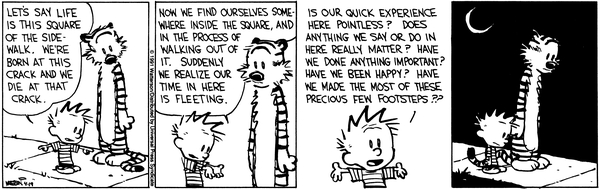
    If I had to adapt that to places and people, I could say that the creator might feel insignificant if we could discover all of it in a lifetime. However, the collective advance of humanity is not a complete solace when it comes to the individual’s existential angst. As one of my fave Calvin strips go

    until next time, insignificant choices too?

  • Armchair travel plans

    If I discount Pico Iyer, the travelogues of Pankaj Mishra, and Mishi Saran’s Chasing the Monk’s Shadow, I hardly read travel books. But I picked up Rahul Jacob’s ‘Right of Passage’ on a whim (influenced by Pico Iyer’s comment on the jacket) and quite liked it, mostly because its really not just a travelogue. Shall publish a more detailed post on that later.

    I was hooked on early enough thanks to the last lines of the preface

    Still, there is this final paradox of travel: time and again, these memories come back unbidden with the clarity of something that happened yesterday, long after we have returned to the rhythm of our lives

    Later in the book, he compares flight travels with train journeys – that he can remember his first flight journey but the rest are a blur. In contrast, however, he remembers most of his train journeys. Though I’m not really the most frequent of fliers, I can relate to that.

    I wonder if its to do with memories of childhood, in which train journeys played a very important part (for me), and that affinity meant that later journeys would also be cataloged better by the brain. Or is it the entire set of experiences – from ‘uniform’ airports to passengers consciously avoiding each other even if it means staring resolutely at the seat in front compared to colorful railway stations that seem to be oozing character to seats facing each other and almost forcing conversations?

    I juxtaposed this with cities and their culture too. Recently, when I went to Cochin, and dropped in at its most ‘happening’ mall, I wondered how much of homogeneity was being created by malls. The same brands, almost the same store experiences, familiar multiplex chains that somehow give you an air of familiarity even in an unknown town (not Cochin for me, but otherwise). How much of a city’s original hangouts and culture will survive this  onslaught? In fact, I even told D that I could already see landmarks of my days in Cochin  (local shops famous for some particular item) disappearing and the new ones (like a Nilgiris store) being unfamiliar to me. Would most people prefer familiarity over serendipity? Or would a middle ground be found – carefully packaged serendipity?

    Going beyond the things to be seen in a place, every travel experience is also about the  discovery of the character of the place you visit. Will we end up creating a homogeneous world, in our constant quest for convenience, and change travel from the train journeys they should be (opinion) to controlled fancy flights?

    Fortunately for this generation, this is perhaps not a reality we’ll live to see, and even in the sunset years we will have our memories and photographs and be thankful that not all journeys need travel.

    until next time, planed travel

  • Destination Nowhere

    My reading habits are quite predictable, and as with most of my habits, they become more concrete over a period of time. I pessimistically call it building my own prison walls, and the statement works across contexts. 🙂

    But sometimes I rebel against this. In the case of reading, one of the things I do while shopping is to consciously choose a book that I wouldn’t normally read, or better still, I let D choose a few books. But a better disruption happens during Kerala trips. At D’s parents’ home, I pick up a random book which I normally wouldn’t go anywhere near, and finish it. This time it happened to be Randy Pausch‘s ‘The Last Lecture‘. To give you a quick perspective, the book is based on the last lecture given by Randy Pausch at Carnegie Mellon, and adding to the University’s aim of “what wisdom would you share with the world if it was your last chance?”, he also makes it a message to his young children, since he has been diagnosed with a terminal illness.

    In many ways, though personal, it’s the typical inspirational book, but several parts interested me. At one level, the author’s penchant for following childhood dreams struck a chord with me, for I have always entertained a notion that our childhood aspirations are instinctive and free of the baggage of later life. In that sense, it’s perhaps closest to what we’re really meant to do. Debatable, but it’s a belief nevertheless. 🙂 The professor also gives perspectives on following dreams, and the roadblocks one might encounter. He believes that ‘brick walls’ are there for a reason – to see if you really want something bad enough.

    Later in the trip, we visited Cochin’s contribution to the country’s ever growing mall list – Oberon Mall, to catch a movie at Cinemax – Mammootty’s ‘Best Actor’. The story of a man who while working as a Hindi teacher to fulfill his familial responsibilities, believes that he is destined to be an actor, despite his age and the mocking attitude of several around him. (slight spoiler) In a desperate last ditch attempt, he takes the unintentional advice of a film crew (how Vivek Oberoi landed a role in Company) and becomes part of a street gang to ‘learn’ his role the real way. As is his wont these days, Mammootty excels in a role and the script gives him enough ammunition. Ranjith, playing himself, advises Mammootty’s character, and tells him that if he has decided to become an actor, then actor he will be.

    I’m a sucker for cosmic message theories and two random works seemed to be giving me the same message. My problem though, is a step behind. I am yet to find what I really want from life – the one thing that will drive me, the thing I am born to do. Almost everything I do these days is an attempt to crack that question. I am also constantly seeking out Dutch uncles (another term learned from the book) to give me perspectives on brick walls and a kind of laziness I blame myself for.

    Funnily, I also received contradictory messages – a random link shared by someone – Osho’s talk on anger and not desiring (so) intensely and later (via Surekha, who now believes that irrespective of destiny, my destination is the Himalayas 😀 ) Chinmayananda’s talk on the journey being the goal.

    As always, this Kerala journey too gave me much food for thought. But Randy Pausch’s poignant line reminds me “Time is all you have. And you may find one day that you have less than you think”

    until next time, time tableau