Tag: tom fishburne

  • Social Induction

    ‘Disparate’ perhaps wouldn’t describe it best, but definitely 3 different posts in terms of scope and point of focus, but which I thought were in their own way, circling one of this blog’s favourite topics – how organisations can fundamentally become more social – not just from a usage of tools across its ‘silos’ but more from an ‘adding meaning to the individual and society’ perspective.

    Stowe Boyd’s post titled ‘Are you ready for social software‘ not only gave me perspectives on the subject of the post, and title – social software, but also gave me a way to connect these three posts. He starts of with challenging the belief that Sherlock Holmes used deduction to solve the mysteries.

    It turns out he (or better, Arthur Conan Doyle) was using induction, which is, according to Webster’s, “the act or process of reasoning from a part to a whole, from particulars to generals, or from the individual to the universal.” In working from a paltry collection of clues to a full understanding of the actions and motives of the butler and his victim, Holmes/Doyle was, basically, developing a picture of the universe surrounding the crime from a few hints.

    He goes on to distinguish social software from software built for several purposes taken to mean ‘social’.

    Social software is based on supporting the desire of individuals to affiliate, their desire to be pulled into groups to achieve their personal goals. Contrast that with the groupware approach to things where people are placed into groups defined organizationally or functionally…..Traditional groupware puts the group, the organization or the project first, and individuals second….. Social software reflects the “juice” that arises from people’s personal interactions. It’s not about control, it’s about co-evolution: people in personal contact, interacting towards their own ends, influencing each other.

    Its a fascinating read and he quotes Kenneth Boulding, the economist, humanist and social scientist,“We make our tools, and then they shape us.” I thought that was an amazing way to look at it, and if you think for a moment on how tools have changed the way you behave, interact, consume, I’m sure you’ll appreciate it too.

    Amazingly, even without getting into software or technology, I saw an application of this thought process in Tom Fishburne’s Wiki Wall, a symbol of organisational creativity that could prove more useful than the traditional ‘brainstorm’. The wiki wall (a real whiteboard/surface)  allows ideas to be shared, collaborated on, and evolve over a period of time beyond the silos that the organisation might have. Shared belief systems and thoughts around which people could group together.

    Which then brings us to the ‘larger purpose’ that an organisation exists for. This purpose is something that has popped up here many times in the recent past, the last being ‘A Social Culture‘. I found it expressed extremely well in Umair Haque’s post on the way ‘social’ needs to evolve.

    Social is significance. The real promise of social tools is societal, not just relational; is significance, not just attention. You’ve got to get the first right before you tackle the second — and that means not just investing in “gamification,” a Twitter account, or a Facebook group. It means thinking more carefully how to utilize those tools to get a tiny bit (or a heckuva lot) more significant, and starting to mean something in enduring terms.

    For now, most organisations are looking at social tools (including software) to meet their business ends, and not looking to make the business’ ‘reason for existence’ itself something people – both employees and consumers- would associate with. Hopefully, by the time they deduct the importance of this, it won’t be too late.

    until next time, elementary? 🙂
  • A social culture?

    Even as I write this, Titan is looming on the horizon – not Saturn’s moon, but Facebook’s purported mail service, which can (potentially) stake claim on another front that Google has made much advances in, though its still only #3. And so the thoughts from last week’s post continue – on whether culture is the key differentiator that sets apart the dominant player in an era and everything else from superior technology to better marketing evolves from it.

    The two posts I had linked to last time remain relevant in a Google vs Facebook  discussion – “Google’s real problem – GTD” at GigaOm and “Facebook and Google” at Piaw’s blog. Meanwhile, Robert Scoble wrote an excellent post last week titled ‘Why Google can’t build Instagram‘, which brought out a whole lot of other perspectives on what prevents Google from innovating at a rapid pace (also probably the reason why Facebook is stealing its thunder regularly) – organisational size (something we keep discussing here), controlling the scope of products/services, an infrastructure that’s not built for a smaller social scale, the necessity to support all platforms (because they’re Google, that’s expected of them, thought this holds true for FB too), the inability to use a competitor’s graph (in this case, Facebook), the need to ship a product/service that’s near perfect (because they’re Google!) and so on. Scoble also throws in a few pointers on how Google could still innovate, and I thought some of Android’s success could be attributed to one of those – sending it out and allowing developers to build on top of it. You can get another interesting perspective on Google and scale here. (via Mahendra)

    The other understanding I developed was that with scale, even the organisation’s vision could change, (though the reverse is what we see regularly) and that would affect everything from competitor landscape to culture. So the challenge is to keep people hooked on – employees and users.

    I’ve come across excellent posts on both these. The organisational aspect is the core theme of Gautam’s blog, and so its not surprising that I’ve seen two posts in the recent past that tackle this subject – Inspiring People, and Making Work Meaningful. The other must read in this context is the 2010 Shift Index, specifically the ‘Passion and Performance’ part. From a consumer perspective, few people can articulate it better (especially since a toon is usually more popular than a 1000 words) than Tom Fishburne, and again, two relevant posts – App  of dreams (as a devout Angry Birds player, I identify completely) and The Antisocial Network.

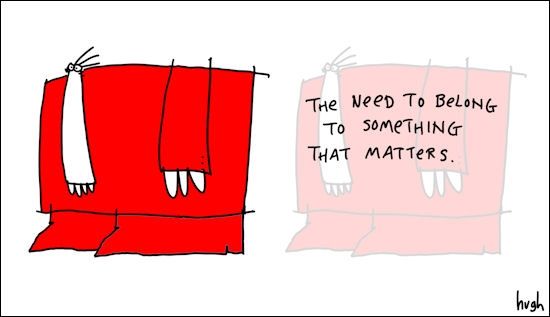
    Despite approaching it from two different sets of stakeholders, the common thread is easy to spot – that brands/organisations need to figure out a reason for existence that goes beyond their business mission and balance sheets. This would then help them identify the ‘something’ that people – both employees and consumers  can identify with and would want to belong to. Coincidentally, this is the drawing I got on my Gaping Void subscription today. 🙂

    (Hugh credits Mark Earls for first voicing this thought)

    Not very long ago, Google spearheaded a revolution of sorts, by creating an algorithm that connected a web user with the information he sought. The only thing that topped it was the business model they built on it. Many have attempted it before and after them, but there was only one Google. The world changing mojo seems to have been transferred to Facebook these days, and even to Twitter to a certain extent, as, in different ways, they connect us to people we know/want to know in various contexts. Information sharing then becomes one of the applications of this connection. This phenomenon is called (by) many names, including social media. 😀

    Perhaps brands and organisations fail to understand the philosophy of social platforms/interaction and get lost in the applications. A bit like wanting to build a social layer on top of everything you have created so far and meanwhile, firing an employee for telling the world he got a bonus and raise 😉

    until next time, titanic shifts 🙂

    Bonus read: The Heart of Innovation via Dina

  • Jump with a crowd

    ‘Jumping the shark’ is a phrase that has been jumping on to my face regularly, but something that got lost in the rigours of speed reading and processing. Thanks to Tom Fishburne’s excellent post on the subject in the context of brands, products and organisations, I got to think about it a little more. The quick definition would be (from the post), “the moment of downturn for a previously successful enterprise.” The problem with it? “The risk of jumping the shark isn’t getting eaten by the shark. It’s leaving your loyalists behind.”

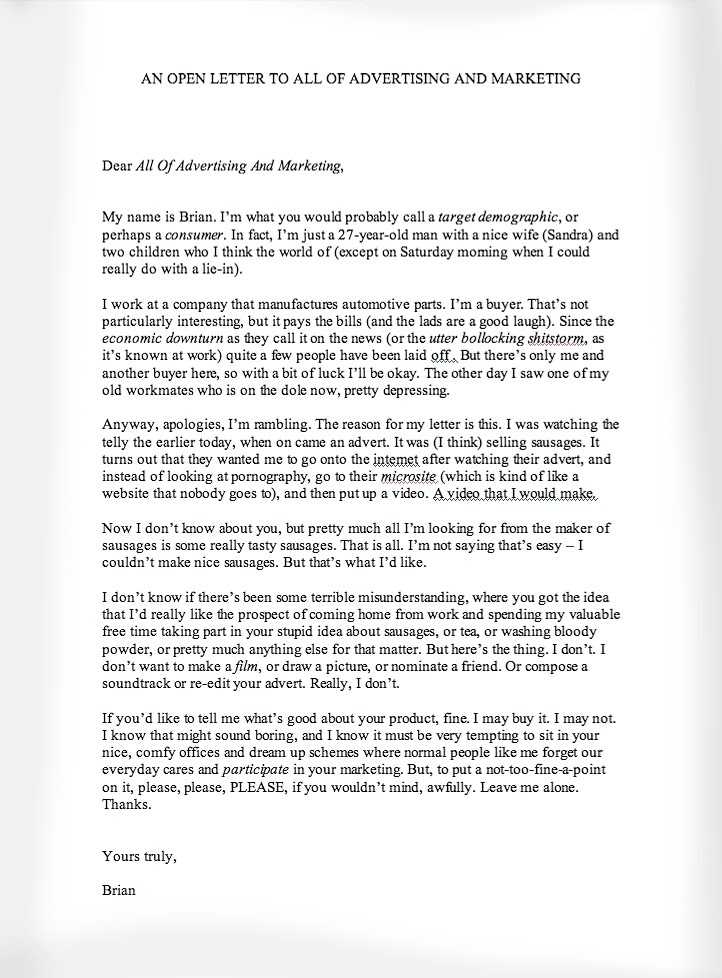
    I thought about it a bit, not in the context of brands or businesses, but more in terms of brand communication as a field, advertising specifically, and brands’ usage of the social web. Consumption patterns, media platforms available etc had pretty much created templates for creative agencies over a period of time. But the arrival of the web, social platforms and the democratization of media have managed to disrupt the ways of the one-way communication age. This post is a good one to read in that context, and talks about the change digital has made to campaigns, and the ‘role of the consumer’. But desperation, hype and the eagerness to get on board makes everyone concerned ‘jump the shark’. And unfortunately, the way I’ve seen many agencies and clients execute it (purely as a consumer), I’m quite inclined to agree with the author of this hilarious letter. (via PSFK)

    Clipboard01

    (click to enlarge)

    The job of the brand manager/creative agency is obviously a more difficult one now, and is made even more so thanks to the approach – of tool strategy. Like this (old but) excellent post states, ‘the technology that underpins social media is changing fast’, but its ephemerality ‘is a feature, not a bug’. It made me wonder whether brand communication/advertising, as a process (the way we see it now) had ‘jumped the shark’, mostly because the thinking process still sees  social platforms in the same light as traditional media and has not changed to be in tune with the former’s dynamics. In other words mistaking social media marketing for social media.

    Maybe they have to dig deeper, figure out the value that people are willing to pay for, and then find their ‘purpose idea + social object‘, and consistently. But that would mean a sea change in the way brands and creative agencies operate. Is adaption possible, or is complete disruption inevitable?

    I juxtaposed this thought with something that Seth Godin wrote recently, about the ‘red zone‘ – the joyless part of the learning curve. His graph also has a green dot, which represents ‘someone on the other side.. rooting us on, or telling us stories of how great it is on the other side’. Perhaps if brands can find from the existing consumer crowd a few who believe enough to play the ‘green dots’, they can adopt a more holistic approach to social platforms and carry the loyalists without it seeming like ‘jumping the shark’?

    until next time, safe jumping.