Tag: Time

  • The Uncertainty Principles

    Not the quantum theory kind. Sometime back I read this interesting post on HBR on uncertainty, which made me think about my relationship with the concept. I must admit that I have more than a little affection for certainty. That is exhibited in most of everything I do – from my routine to travel itineraries to life planning. It also manifests in relationships – not just with people, but even services like Twitter. ๐Ÿ™‚ It is probably a bit about control, and a bit about not having to waste what I consider premium currency – time.

    In the post, Tony Schwartz states that

    It feels good to know things for sure. It makes us feel safer, at least in the short term. But certainty has its limitations. Very rarely, I’ve discovered, is certainty the outgrowth of careful consideration and deep understanding. Far more often, it’s a primitive instinct โ€” a way we defend against uncertainty, which understandably feels unsettling and even dangerous.

    I really can’t disagree with that, though I think that sometimes it’s an individual’s conscious choice. The sad part is that the automaton inside us usually makes this choice for us. Further in the article, he also adds a neurological perspective on why we are pulled to certainty, and then “Above all, certainty kills curiosity, learning, and growth.” And that’s the part that I am ironically, unsure of. My take is that if I am certain about a set of things, I am able to focus on, and do better in another set of things.

    Devdutt Pattanaik’s ‘The Pregnant King’ was an excellent read, and though it was the story of Yuvanshva, the king gives birth to a son after drinking a magic potion meant for his wives, it is also about the nature of the world and the fluidity of dharma among other things. There are a few interesting statements in it, if I consider it from the uncertainty context.

    In an argument with Pisachas, Yuvanshva states that “every civilisation needs its delusion” and we don’t take kindly to things that “threaten the facade of order”. I think that would hold for individuals who prefer certainty too. In another conversation between Yuvanshva and the Angirasa, there is a meaning given to the existence of this world,

    When all is understood and accepted, the world will lose its purpose and cease to be. The world exists only to make us wise. Ignorance fuels pain and from pain comes our search for wisdom.

    But my favourite is in the form of two diametrically opposite approaches to the purpose of life that comes earlier in the book – Yaja and Upayaja, two Siddhas who never agreed on anything, yet ended up taking the same decisions.

    Yaja sat under a banyan tree and sought truth in stillness. Upayaja always sat before a waterfall and sought truth in movement. Yaja said, “By observing the flow of rasa, one can train the mind to accept destiny. This is the purpose of life. Upayaja argued, “By manipulating the flow of rasa, one can change the world and fructify all desires. That’s the true purpose of life.”

    Though Upayajya’s argument might seem in favour of certainty, I’d say that both are versions of the same story – embracing uncertainty. And thus, another lesson from the book springs to mind “The truth is not poison. It is our inability to handle it that makes it poisonous” The same goes for uncertainty too… I guess ๐Ÿ™‚

    until next time,

  • Comics and moral signs

    Though many claim that most comic book – movie adaptations completely spoil the original work, I still find them fascinating, simply because of discovery. Many a time, I have realised that comics are an amazing representation of culture, whether it’s popular, alternate, counter or even imaginary (eg. different renditions of myths, accommodating the changing ethos), either overtly or through subtext. So they work like a time portal for me, giving me a vicarious experience of a different era. (just like some books, music, cooking, smells etc)

    I’d never have known about Watchmen if not for the movie. Since I don’t want to miss out on references and subtext, I always try to read up on the characters and original work before watching the movie. And that’s how I came across the concept of moral absolutism, while reading about Rorschach, an amazing character, made more so by a class performance by Jackie Earle Haley. Wikipedia defines moral absolutism as the ethical view that certain actions are absolutely right or wrong, regardless of other contexts such as their consequences or the intentions behind them.

    I’ve wondered many a time about the concept, without knowing about the existence of a term, so it’s good to find it and read up more. With morality in a constant state of flux, who would be objective enough to give an absolute perspective, and would it matter at all? I guess not. So maybe, in some later rendition of Rorschach, his moral absolutism might shift to consequentialism, (holds that the morality of an act depends on the consequences or the context of the act) and a future reader would get a sense of how the times have changed.

    Late night. Red Signal. No vehicle or human in sight. Stop or Proceed? ๐Ÿ™‚

    until next time, moral abdication

  • Destination Nowhere

    My reading habits are quite predictable, and as with most of my habits, they become more concrete over a period of time. I pessimistically call it building my own prison walls, and the statement works across contexts. ๐Ÿ™‚

    But sometimes I rebel against this. In the case of reading, one of the things I do while shopping is to consciously choose a book that I wouldn’t normally read, or better still, I let D choose a few books. But a better disruption happens during Kerala trips. At D’s parents’ home, I pick up a random book which I normally wouldn’t go anywhere near, and finish it. This time it happened to be Randy Pausch‘s ‘The Last Lecture‘. To give you a quick perspective, the book is based on the last lecture given by Randy Pausch at Carnegie Mellon, and adding to the University’s aim of “what wisdom would you share with the world if it was your last chance?”, he also makes it a message to his young children, since he has been diagnosed with a terminal illness.

    In many ways, though personal, it’s the typical inspirational book, but several parts interested me. At one level, the author’s penchant for following childhood dreams struck a chord with me, for I have always entertained a notion that our childhood aspirations are instinctive and free of the baggage of later life. In that sense, it’s perhaps closest to what we’re really meant to do. Debatable, but it’s a belief nevertheless. ๐Ÿ™‚ The professor also gives perspectives on following dreams, and the roadblocks one might encounter. He believes that ‘brick walls’ are there for a reason – to see if you really want something bad enough.

    Later in the trip, we visited Cochin’s contribution to the country’s ever growing mall list – Oberon Mall, to catch a movie at Cinemax – Mammootty’s ‘Best Actor’. The story of a man who while working as a Hindi teacher to fulfill his familial responsibilities, believes that he is destined to be an actor, despite his age and the mocking attitude of several around him. (slight spoiler) In a desperate last ditch attempt, he takes the unintentional advice of a film crew (how Vivek Oberoi landed a role in Company) and becomes part of a street gang to ‘learn’ his role the real way. As is his wont these days, Mammootty excels in a role and the script gives him enough ammunition. Ranjith, playing himself, advises Mammootty’s character, and tells him that if he has decided to become an actor, then actor he will be.

    I’m a sucker for cosmic message theories and two random works seemed to be giving me the same message. My problem though, is a step behind. I am yet to find what I really want from life – the one thing that will drive me, the thing I am born to do. Almost everything I do these days is an attempt to crack that question. I am also constantly seeking out Dutch uncles (another term learned from the book) to give me perspectives on brick walls and a kind of laziness I blame myself for.

    Funnily, I also received contradictory messages – a random link shared by someone – Osho’s talk on anger and not desiring (so) intensely and later (via Surekha, who now believes that irrespective of destiny, my destination is the Himalayas ๐Ÿ˜€ ) Chinmayananda’s talk on the journey being the goal.

    As always, this Kerala journey too gave me much food for thought. But Randy Pausch’s poignant line reminds me “Time is all you have. And you may find one day that you have less than you think”

    until next time, time tableau

  • But what do I know?

    Unlike in my other blog, Seth Godin is rarely referenced here. But when I read this post (rant, he says) from him titled “Deliberately uninformed, relentlessly so“, I sensed some vague connection with something I’d written a while back.

    Unlike other posts of Godin, whose blog I religiously follow for its ‘food for thought’, I found a smugness to this post – perhaps the rant provides the liberty. But as always, he manages to make a point. However, for a second, I wondered about the irony of this post coming from someone who does not allow comments on his blog. And thus this post.

    It is to be noted that he did not switch off comments just like that, he has valid reasons. Even if one just looks at the scale (1858 people retweeted and 2373 ‘Like’s) and considersย  only a certain % commenting, it would tend towards chaotic. But whatever the reasons, he has chosen not to use comments as a channel.

    Ok, lets move on to me now. ๐Ÿ™‚ I don’t read business books, however I follow several blogs in my line of work and otherwise. I rely on my Twitter, Reader and (occasionally) Facebook connections to point me to interesting reads. I also use Wikipedia extensively, despite the accusation that crowdsourced content can only be so trustworthy. From all this consumption, I have ‘superficial’ information on a lot of subjects, which make good conversation. This is also because I have way too many interests, and I’m forever in awe of things I don’t easily understand. My interest sometimes wears off after I’m able to bring a subject to my horizons of understanding. Sometimes, a more knowledgeable person corrects me/points me to things he/she thinks might interest me further and whenever I need/want to know more about a subject, I try and use the web’s sources to the fullest.

    But here’s the thing. Once upon a time, I could remember websites in context and add to discussions (offline), but increasingly I rely on delicious, among other things. I’m forced to prioritise my memory thanks to the ton of information out there that I process daily. Ok, that, and age.ย  ๐Ÿ™‚ And this is not a problem that will end soon, and its something I keep bringing up here. (Read)

    Time is the new currency, and I increasingly feel that people now react mercilessly to an “I don’t know”. Is that an excuse for people to claim knowledge of things they know nothing about? Maybe not, but perhaps like many other things, it is one of the ways for them to feel accepted and have a sense of belonging. So yes, it might be easy to label it as being deliberately uninformed, but in judging people so, without context and more understanding, we might be falling into the same trap ourselves – about people this time, as opposed to subjects.

    until next time, judge mental capabilities?

  • Back to eternity

    Despite being a Star Trek fan, I happen to think that Time is the final frontier, at least in the horizon that I can see. I find it quite intriguing that, though it might be looked on as a tool for tracking, I can perhaps not account for most of my lifetime. I don’t mean the large picture, I haven’t lost it totally yet, but specific minutes. Take for example, the last hour and account for all the thoughts that rushed in. I would find it difficult.

    If you close your eyes, and allow your breath to be the only meter, the perspective of time undergoes a shift. Meditate a bit, and its easy to see. Easy to see that even the measurement of time – years to seconds and beyond is ourย  construct. But it is so ubiquitous and enmeshed in our lives that it seems as though it is a constant and only we change. It requires dramatic events for us to pause and note the passage of time. Kahlil Gibran has said, ‘Perhaps time’s definition of coal is the diamond”

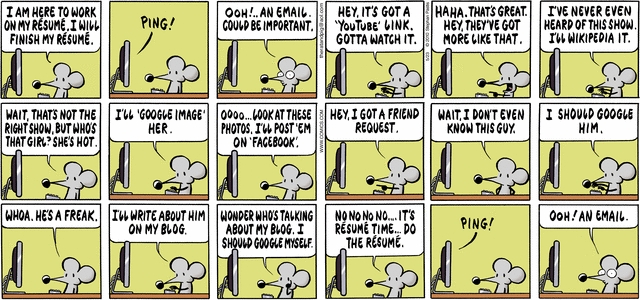
    Meanwhile, I wonder if all the information about those unaccounted for minutes is stored somewhere in my brain, and is just not deemed enough to be of any priority for me, and hence seems inaccessible. The tools that consume me these days – most specifically Twitter, and more recently, Foursquare, also help me keep track of what I’ve been up to, and when it works the same way for everyone is when there is an information deluge, and that seems to be something we find difficult to handle. Something that we have discussed before. There is a toon I found (here) that correctly describes the way a lot of us seem to be functioning now

    Clipboard01

    And in another example of how man is shaping his own evolution, I read about companies like Lifenaut, whichย  ultimately aim to create humanoid robots powered by a backup of the original human’s brain. (via @pkaroshi) The first step is to create a digitised version – an avatar, and give it enough data for it to mimic the original human. It makes me wonder whether we will be able to create ‘consciousness’.

    And that makes me think a bit more – by the time, we are technologically advanced to create it, will we have forgotten what consciousness is? Which also begs the question whether we have ever understood it at all, when we are not even mindful of the minutes of our lives? How does one define it? So many reactions which seem pre-programmed when one thinks of it, actions and reactions more out of habit than any conscious choice being exercised.

    So yes, with all of the work happening at a rapid pace, (do read) I think its more ‘when’ than ‘if’ – that we will become immortal, and time, from a future point of view, will become immaterial, because the future will be infinite. But we still may not be able to undo what we did a minute back. Where does that leave us? To quote Pico Iyer (from Abandon) “God has to be understood in the context of everything that is not Him”. But that is a different discussion, I guess. Its only that with every advancement that humanity makes, and in that process also usurps things once attributed to divinity, I begin to wonder where that leaves our versions of God?

    until next time, time.ly links ๐Ÿ™‚

    PS. I tweeted sometime back, even if you never read an Asimov work, or never plan to, this is one that you should read. The Last Question.