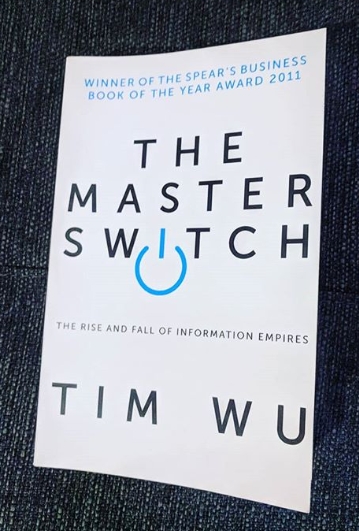
Tim Wu
Wow!
Two of my favourite books in the recent past have been The Moral Animal and The Sovereign Individual. I liked them because they brought out the fundamental patterns that underlie the evolution and behaviour of humans and the system of the world respectively. The Master Switch does the same with communication and information empires.
His premise is this – history has shown that communication/information technologies follow a predictable path : it starts as an idea in a mind/group of minds typically in a small room, is then brought to life in the most rudimentary manner, and keeps itself open to improvements and changes until it becomes a solid proposition. It then shifts to industrial scale, predictable outputs, and controlled by a corporation which then decides to make it a closed system. He calls this the Cycle.
The author’s contention is that all information businesses go through the cycle. The question he seeks to answer is “which is mightier : the radicalism of the Internet or the inevitability of the Cycle?” He gets there by taking us through the history of information empires.
The story begins in the 1870s, when Alexander Graham Bell’s small telephone company goes up against the ruler of the times – Western Union. A classic underdog story that resulted in the continuing empire that is called AT&T. Is At&T still the hero? Will get to that in a bit. Similar stories with its own heroes and villains then play across radio (AM & FM), television, movies and now, the internet.
It is not just the magnificent scope that makes the book interesting. The author retells history in the mould of a thriller! There are anecdotes and (not so) trivia that make the book really engaging. Multiple inventors of the same technology (and uncredited firsts), towering personalities from JP Morgan to Steve Jobs who left a firm imprint, fascinating origin stories of movie studios like Universal and Warner that are now household names and how movie making is now less to do with the movie and more to do with the business of the franchise (a movie is a 2 hour advertisement of an intellectual property which makes money through a franchise that sells everything from tshirts to DVDs to theme parks), companies that rise again like phoenixes in revenge arcs that span a century (GE buying Universal)!
The author obviously does not give a definitive answer to whether the Internet will beat the Cycle. He suggests a constitutional approach (not regulatory) and a “Separations Principle” to make sure that the ownership of information creation, distribution (networks, infrastructure) and access control remains with different parties to prevent it from corporate or governmental misuse. The nuance he highlights is that the monopoly actually begins and even continues with noble intentions and utopian values, but loses the plot subsequently. Almost like “you either die a hero or live long enough to see yourself become the villain.” (Remember the question earlier about AT&T)
He also points out (and this is where it meets The Sovereign Individual) that the user has the power to control how this plays out – “Habits shape markets far more powerfully than laws”.
A fantastic read on multiple counts!