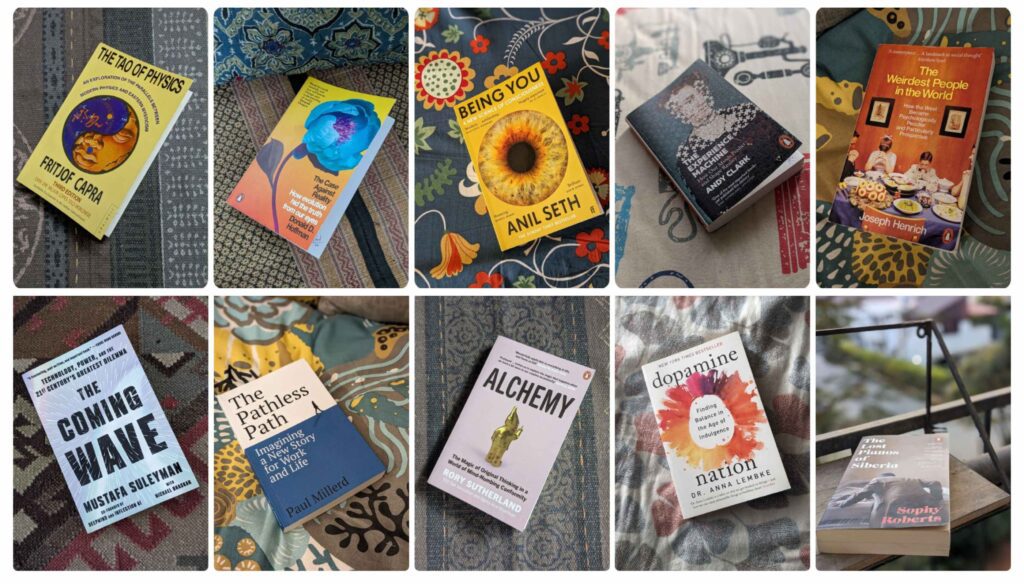
The Tao of Physics was first published in 1975, and I’d say that it’s even more relevant now in the context of science and the direction of human advancement in general. As the subtitle of the book states, the idea is to explore the parallels between modern physics and eastern mysticism.
Both science and religion/philosophy are trying to get to the reality that lies beyond our senses. One approaches it predominantly through rational means, the other through a non-intellectual experience by quieting the mind with meditation and fine tuning intuition. Broadly, it turns out that many Eastern philosophies/religions – Hinduism, Buddhism, Tao, Zen – had already reached the understanding that modern (in the 80s) science later discovered.
The Tao of Physics is divided into three elegant sections – the way of physics, the way of eastern mysticism, and the parallels. Capra begins by summing up the evolution of physics from the time of the Greeks to its modern formulation in the form of Descartes’ philosophy – the separation of mind and matter, which influenced not just the development of modern physics but also the general Western way of thinking – a mechanistic world. On the other hand Eastern philosophies have emphasised the unity of not just mind and matter but the individual and the universe at large.
A theme has been emerging, even more stronger since I wrote “Living a life of Intentionality“. Pithily summarised as “At this age, I prefer an identity that provides the least friction and regrets in the life I want to lead.” How do I get there? A key factor I identified for myself is acknowledging the difference between my wants and likes, and deeply questioning my wants. Where does that get me? From that post, Intentionality helps you have your needs and considered likes as anchors. When that happens, a whole lot of clarity emerges – what you spend time and money on, people whom you will go overboard for, how you plan your days, weeks and months, and what can get you out of those lil twinges of envy and seemingly deep pools of a mid-life crisis.
But while I was trying to get there, I encountered a strong opponent – myself, or rather, my identity. I first brought it up in Marshmellowing. The key point in the first was how in my approach to getting what I needed/wanted, my larger desire for ‘freedom’ led me to optimising for optionality – a huge bias for scenario planning. I think the identity I created thanks to this is aptly called the Marshmallow mind (by Frederik Gieschen), and its best expression is a poem I read in Poor Charlie’s Almanack: The Wit and Wisdom of Charles T. Munger, attributed to A.E. Housman
The thoughts of others
Were light and fleeting,
Of lovers’ meeting
Or luck or fame.
Mine were of trouble,
And mine were steady;
So I was ready
When trouble came.
In Marshmellowing – The Prequel, I wrote about my path to this identity/self image from childhood. A great description of it appears in Robert M. Sapolsky’s Why Zebras Don’t Get Ulcers. In the personality section, Sapolsky practically described my (former) Type A personality down to a behavioural “time-pressuredness” (research by Meyer Friedman and colleagues), default hostility, and a persistent sense of insecurity, the last being a predictor of cardiovascular problems. Add to it disciplined, discomfort with ambiguity, and (formerly) repressive in terms of emotional expression, and you have my profile! Damn!
My self image, and increasingly my identity was the kind of person who thought in a certain way and behaved in a certain way. While its origins was my ‘responsible child’ identity that possibly repressed my freedom of emotional expression in favour of (parental) attachment, in adulthood, it transformed into a “responsible adult” self image that ironically optimised for freedom and optionality, and underplayed the need for attachment. It became an identity, and many of my decisions were biased in that direction.
It is only in the very recent past – through reading and reflection, that I have begun to be at least a little fine with unplanned-ness. As I wrote on LinkedIn, the universe’s tendency is randomness! An excellent read in a different context was The Tao of Physics. I realised that In both quantum field theory and eastern philosophies, physical phenomena (including us) are mere transient occurrences in an underlying entity. How humbling that is!
I think I have made progress by moving from fixed goals through fixed strategies to fixed goals through flexible strategies. I hope, after we are confident of financial freedom, that I can move to flexible goals and flexible strategies. Meanwhile, the biggest task in all this is the mindset. Mindset made the identity, and now it has to dismantle it. Erich Fromm wrote this a long time ago – “Life, in its mental and spiritual aspects, is by necessity insecure and uncertain…The psychic task which a person can and must set for himself, is not to feel secure, but to be able to tolerate insecurity without panic and undue fear“. Decades later, we have a pithier version.
In 2024, the mind seemed to be obsessed with the mind and the reality it perceives, and that’s a good thing because I was able to take a shot at some synthesis on why I am the way I am. When you see the books, you’ll know why/how. And so, as per tradition – from 2019, 2020, 2021, 2022 and 2023 – we have this year’s list of ten (plus a few extras 🙈). From the 63 books I read in 2024…