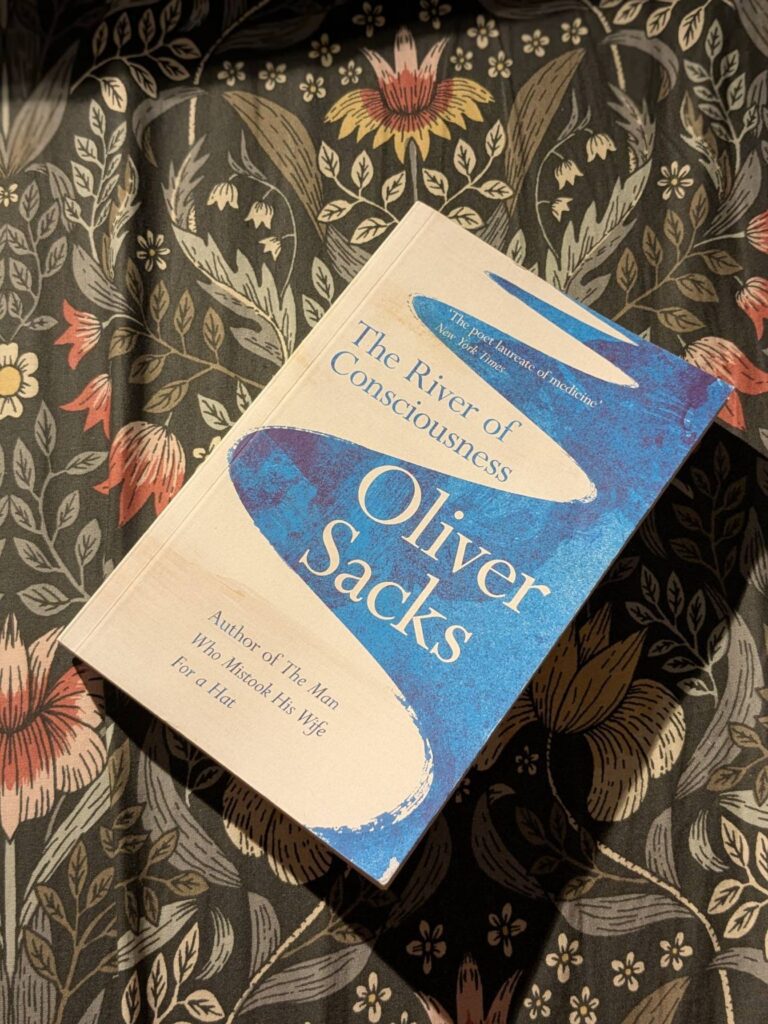
Oliver Sacks
The River of Consciousness is the final collection that Oliver Sacks oversaw, assembled just two weeks before his death in 2015. Ten essays across diverse subjects such as botany, chemistry, evolution, medicine, neuroscience, and even the arts. They are connected by the title – an exploration of how the river of consciousness has moved through evolution, and how it continues to manifest itself in ways beyond what we normally look at.
While a large part of the book is objective, there are a few sections where the author’s own experiences and maladies become a trigger for investigations. I liked the former more, but the explorations across memory, time, creativity are all fascinating anyway.
He opens the ‘river’ with “Darwin and the Meaning of Flowers”, exploring Darwin’s relatively lesser-known botanical experiments, but showcasing his abundant curiosity – lying in grass pollinating flowers by hand, and celebrating plants as living entities imbued with purpose and beauty.
Darwin intuitively hypothesised that the tip of the plant’s root – radicle – behaves like a brain for lower animals, receiving sensory impressions and directing several movements. Criticised at that point, it was proven right fifty years later, and plant hormones like auxins were discovered.
The next essay, “Speed”, is about how our brains distort time, whether slowed by Parkinson’s or quickened by Tourette’s and drugs. He takes the example of how athletes require intense conscious effort and years of dedicated practice and training to learn nuances of techniques and timing.
But at some point, the basic skills and their neural representations are so ingrained in the nervous system that they become second nature, and time works differently. I have heard how in cricket, how a batsman in form sees the cricket ball ‘as big as a football’ and is able to ‘suspend time’. Ditto for war pilots. An interesting point he brings up is how in Parkinson’s, dopamine is brought down to less than 15% of normal levels. (something I need to chew on)
In “The Other Road: Freud as a Neurologist”, he reminds readers that Freud, in his original avatar/ road not taken, mapped jellyfish neurons. A callback to an era when neurology and psychiatry were joined at the hip. He eventually pivoted to psychoanalysis.
This reclamation of early neuroscientific legacies is also brought up later in the final chapter – “Scotoma: Forgetting and Neglect in Science”, a lamentation on blind spots in scientific history. Two of the most fascinating ones there – Archimedes cracked calculus, two thousand years before Newton and Leibniz. Aristarchus had a helio-centric theory of the world in the third century BCE. It was Ptolemy who reversed it centuries later.
Memory, and its frailty, is the subject of both “The Fallibility of Memory” and “Mishearings”. Both of them examine how our minds play tricks, mistaking imagination for fact and transforming misheard phrases into personal artefacts. I was fascinated by cryptomnesia – accidental plagiarism. It’s when a person cannot remember when a specific event occurred/ are unable to distinguish if an event was a dream or reality/ forgets the source of information – whether an idea originated from themselves or someone else. The book provides many examples of this. A great perspective on false memories, and how we construct flawed personal narratives.
In “The Creative Self”, my favourite takeaway was the nuanced differences between mimicry, imitation, and mimesis, attributed to Merlin Donald. “Mimicry is literal, an attempt to render as exact a duplicate as possible. Thus, exact reproduction of a facial expression, or exact duplication of the sound of another bird by a parrot, would constitute mimicry. Imitation is not so literal as mimicry, the offspring copying its parent’s behaviour imitates, but does not mimic, the parent’s way of doing things. Mimesis adds a representational dimension to imitation. It usually incorporates both mimicry and imitation to a higher end, that of reenacting and representing an event or relationship. Mimicry occurs in many animals, imitation in monkeys and apes, mimesis only in humans” (all three can overlap in us, even in a single ‘performance’) I am seeing this as the meeting point of nature and culture.
His penultimate title essay, “The River of Consciousness”, digs into the nature of subjective experience. Is consciousness discrete ‘frames’ or a seamless, flowing stream? This was theoretically interesting, but I couldn’t engage in it completely.
The River of Consciousness is a delicate balance of meandering and narrative, but as I said, held together by the idea of consciousness, even as it flows across disciplines. In an era of super-specialisation, I don’t know how many people have the knowledge or intent to do that last bit anymore. This book is a great example of why that is a sad thing to happen for humanity.
In my Bibliofiles 2025 longlist
Notes and Quotes from The River of Consciousness
1. Though Darwin is often held responsible for banishing ‘meaning’ (divine purpose), courtesy natural selection, it is more a redefinition of purpose – by knowing the granular evolutionary purpose, we are able to piece together a more coherent picture connecting the past, present, and potential future
2. Hughlings Jackson proposed a hierarchic view of the nervous system, picturing how it might have evolved from the most primitive reflex levels, up through a series of higher levels, to those of consciousness and voluntary action. Freud continued that thought in what he described as stratification of the psychic mechanism, a rearrangement in accordance with fresh circumstances. Further, for Edelman, this was every perception being a creation, and every memory a re-creation or recategorisation.This is where the paths of natural science and human meaning meet.
3. “Nothing is more central to the formation of identity than the power of memory”