
Tag: The Master and His Emissary: The Divided Brain and the Making of the Western World

  • An entropic guide to history

    In the last year, I have read four ( + one) books that I thought summed up the why-what-how of humanity’s evolution very well. Respectively, The Case Against Reality: How Evolution Hid the Truth from Our Eyes (Donald D. Hoffman), and Being You: A New Science of Consciousness (Anil Seth) (my favourite this year), The Master and His Emissary: The Divided Brain and the Making of the Western World (Ian McGilchrist) (first among my favourites last year), The WEIRDest People in the World: How the West Became Psychologically Peculiar and Particularly Prosperous (Joseph Henrich) (don’t worry, it is inclusive enough in this context), and finally the + one The Cosmic Game: Explorations of the Frontiers of Human Consciousness (Stanislav Grof) because while it is fringe science and despite the qualitative proof, I wasn’t convinced on the existence of divinity, I think our experiences in our non-ordinary states of consciousness has a connection with the ‘why’.

    The theme that unites them is entropy and ‘order’. Haha, school stuff, I know. So here’s a quick refresher. Simplistically, entropy is the measure of the degree of disorder in a system. The second law of thermodynamics states that in any isolated system, the total entropy tends to increase or remain constant over time. Our universe is an isolated system because, as far as we know, there is nothing else other than our universe; there is no external environment that our universe can exchange matter or energy with.

    Let’s begin with Hoffman. He points out how natural selection is the only process we know that ‘fights’ entropy. It pushes organisms to higher degrees of functional order to try and delay entropy if not offset it completely. Across a vast amount of time, it has tweaked living systems to not just be fit for survival, but also reduce disorder. But there is a trade-off. We don’t see reality as it is. He posits that “some form of reality may exist, but may be completely different from the reality our brains model and perceive.Maya, anyone? He compares this to icons on our screens that are a way of interacting with the system but don’t look/feel/behave like the system underneath. They are a user interface that spares you tiresome details on software, transistors, magnetic fields, logic gates etc. And everything we perceive around us through our sensory organs and mind is just like that – icons that help us navigate. Our perceptions don’t even have the right language to understand/describe reality. Think of it like the UI or formats we have evolved for navigating the world, and there are different ‘languages’ for different species.

    The non-ordinary experiences – courtesy psychedelics etc – that Grof writes about , I suspect, opens up our brain to a different language and thus a different interpretation of the world. A perception of reality in a different language.

    Anil Seth also touches upon how our brain is wired for survival and the functional order that natural selection is driving towards. Reality is an interpretation, and the entire process is not optimised for accuracy, it is designed for utility. ‘We perceive the world not as it is, but as it is useful to us.’ A mechanism of making it seem real so we respond to it. Additionally, perception is a ‘controlled hallucination’ (phrase by Chris Frith), an active construction as opposed to a passive registering of an external reality. The brain constantly makes predictions about the causes of its sensory signals through a Bayesian process in which the sensory signals (also) continuously rein in the brain’s various hypotheses. Perception is thus a continual process of prediction error minimisation (reducing the difference between what the brain expects and what the signal provides) because lesser error, more order, lesser entropy.

    McGilchrist ‘s work goes deeper into the functioning. The right is present and pays attention to the world outside, the left re-presents. The differences between them are less about what they do and more about how they approach something. A fascinating perspective on how the two halves of our brain have quite different worldviews – the “left hemisphere is detail-oriented, prefers mechanisms to living things, and is inclined to self-interest, where the right hemisphere has greater breadth, flexibility, and generosity.” Relatively, mechanisms offer more control (order) and predictability than living things. Thanks to its ability to break things down into simple answers and better articulation, the left hemisphere has been able to grab control at an accelerated pace since the Industrial Revolution, and create a world where it prizes precisely these capabilities in individuals, institutions, and culture at large.

    And finally, Henrich, overlapping with McGilchrist, shows how cultural learning adaptively rewires our brains and biology to calibrate them for navigating our culturally constructed worlds. “Unlike other animals, we have evolved genetically to rely on learning from others to acquire an immense amount of behavioural information, including motivations, heuristics, and beliefs that are central to our survival and reproduction.” From kinship altruism and pair bonding to our own motor patterns to projectile technology and food processing to grammar and social norms. When you look around, the dominant narrative is the WEIRD (Western, Educated, Industrialised, Rich, Democratic) one. Broadly, individualism and personal motivation (self focus, guilt over shame, dispositional thinking – based on intent not context, low conformity, self regulation and control and patience, time thrift, value of labour, desire for control and choice), impersonal pro-sociality (impartial principles, trust, honesty and cooperation with strangers and impersonal institutions, emphasising mental states in moral judgment, not revengeful but willing to punish third parties for not sticking to principles, reduced in-group favouritism, free will, belief in moral truths like physics principles, linear time), and perceptual and cognitive abilities and biases (analytical over holistic thinking, attention to foreground and not surroundings, endowment effect, overconfidence on own abilities) are all features of this, and the correlation with higher functional order is evident.

    If I look around the metro crowd in India and across the world, the optimisation for WEIRD is rising. As I wrote in Kaumpromise, we can still see an alternate way in patches. It’s interesting how with the rise of AI, we are at once creating even more order in many ways but at the same time ceding control to blackboxes. That requires some thought, and another post!

    P.S. There is a nice time dimension to this as well, brought out in monochronic and polychronic cultures. Read more here.
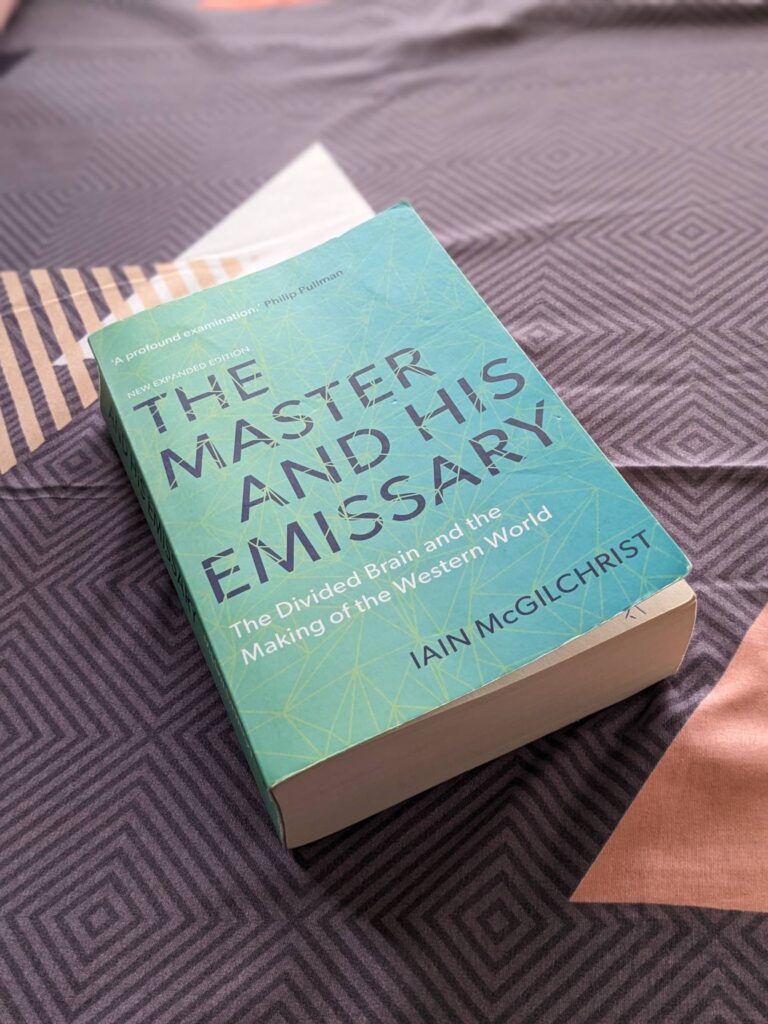
  • The Master and His Emissary: The Divided Brain and the Making of the Western World

    Iain McGilchrist

    As is the case most of the time these days, I discovered The Master and His Emissary thanks to a podcast. Iain McGilchrist’s concepts seemed extremely intriguing, and now I have to admit (as he mentions early in the book) maybe intuitively consistent with my lived experience, and I had to read the book soon. Turns out that it goes directly to my all-time favourites, and was in my Bibliofiles 2023 list.

    As the subtitle suggests, the book is divided into two parts – the divided brain, and the making of the Western World, each with half a dozen chapters. The first part deals with the brain itself – the asymmetry of the right and left hemispheres, their collective and individual roles, how their functioning actually leads to different perspectives, how this affected the evolution of music and then language (which can be seen as a key component in the progression of the species), the primacy of the right hemisphere, and how its emissary – the left hemisphere – has now usurped control.

    The heuristic ways of looking at the hemispheres, e.g. left analytical, right creative etc, is replaced by a nuanced view. The differences between them are less about what they do and more about how they approach something. The left’s utilitarian ability to ‘grasp’ (look at how the metaphor applies to thoughts), its ability to provide simple answers and articulate them well, have all enabled it to grab control at an accelerated pace since the Industrial Revolution, and create a world where it prizes precisely these capabilities in individuals, institutions, and culture at large.

    This is in many ways opposed to the right, which takes more holistic views, understands ideas and metaphors, perceives emotions better, specialises in non-verbal communication, and is humble about what it knows. The right deals with whatever is implicit, the left is tied to more explicit and more conscious processing. The right is present and pays attention to the world outside, the left re-presents. We need both hemispheres, and the right knows it, but the left thinks it knows everything. The left creates a world, and when it stops communications with the right, will not even accept reality if it counters the ‘truth’ of the world it has created. Its role was to provide a map of reality, it now thinks the map is reality, and if not, it will remake reality to fit the map.

    The second part then digs into how this has manifested in the world around. It begins with the concept of mimesis (my favourite part) and how it was the crux of our leap into what we now call culture. The meta-skill that enables all other skills – imitation – possibly explains the rapid expansion of the brain in early hominids. Through the next five chapters, Iain takes us through history – from the early Greeks to the post-modern world, and how, though history has seen a see-saw in terms of the dominance of the hemispheres – Renaissance, Reformation, Enlightenment, Romanticism, and the Industrial Revolution – the impact of the last one was such that we are now in a world where a swing towards the right seems near impossible. Much like an addict, who is not even conscious that his next dose is not just another dose. ‘There is a vicious cycle between feelings of boredom, emptiness and restlessness, on the one hand, and gross stimulation and sensationalism on the other’.

    The research is deep, in both sections, as evidenced by over a hundred pages of notes and bibliography. I especially appreciated the decision of not having same-page notes – it really does help the flow of reading. Iain has painstakingly tried to make a large number of diverse topics as accessible as possible. The first half is based on conclusions from scientific research and experiments across history, and various domains. The second half is itself an accordion of topics across centuries – arts, music, politics, language, and everything we call culture.

    I think my bias for this book and its argument is based on my own experience. As a person and a professional who has to balance both hemispheres, I have been pulled to the left for the longest while. And in many workshops, the recommendation to me has been to let my right side ‘play’. It is only very recently that I have been able to start doing that, and I have to say that I am much happier. The Master and His Emissaryis a book I hugely recommend. It is not the easiest of reads, and I deliberately slowed down my reading speed so as to not gloss over it (though I still did in some of the arts discussions!) but it will open up how you think – the narrative you have made about yourself, and the world around you.

    Quotes and ideas from The Master and His Emissary
    There are four main pathways to truth – science, reason, intuition, and imagination
    “The question is not what you look at, but what you see” ~ Henry Thoreau
    Attention changes what kind of thing comes into being for us : in that way it changes the world. Whether they are humans (say, employer vs friend) or things – a mountain is landmark to a navigator, a source of wealth to the prospector, and a dwelling place of gods for another. There is no ‘real’ mountain which can be distinguished from these, no one way of thinking which reveals the true mountain.
    Manipulospatial abilities may have provided the basis for primitive language. Function gestures become manipulative, syntax developed to form language, expression of our will. (p 111) Even in left handers, grasping actions controlled by left hemisphere, thus right hand.
    Language’s origin in music. Language originates as an embodied expression of emotion, that is communicated by one individual ‘inhabiting’ the emotional world of the other. A process that could have been derived from music. Grooming – music – language, all picked up by imitation. (p 123)
    Adam Zeman’s three principal meanings of consciousness – as a waking state, as experience, as mind (p 187)
    The river is not only passing across the landscape, but entering into it and changing it too, as the landscape has ‘changed’ and yet not changed the water. The landscape cannot make the river. It does not try to put a river together. It does not even say ‘yes’ to the river. It merely says ‘no’ to the water – or does not say ‘no’ to the water, whatever that it is that it does so, it allows the river to come into being. The river does not exist before the encounter. Only water exists before the encounter, and the river actually comes into benign the process of encountering the landscape, with its power to say ‘no’ or not to say ‘no’.
    The idea that the ‘separation’ of the two hemispheres took place in Homeric Greece. (voices of gods) (p260 -275)
    Gnothi seauton – know thyself
    In sooth I know not why I am so sad,
    It wearies me, you say it wearies you;
    But how I caught it, found it, or came by it,
    What stuff ’tis made of, whereof it is born,
    I am to learn.
    ~ Shakespeare, The Merchant of Venice
    The difference between reason and rationality. The former depends on seeing in things in context – right hemisphere. Latter is left, context-independent.
    Kant described marriage as an agreement between two people as to the ‘reciprocal use of each others’ sexual organs’
    ‘Life is a progress from want to want, not from enjoyment to enjoyment’ ~ Sam Johnson
    Modern consumers everywhere are in a ‘permanent state of unfulfilled desire’
    Certainty is the greatest of all illusions: whatever kind of a fundamentalism it may underwrite, that of religion or of science, it is what the ancients meant by hubris.

    The Master and His Emissary