
Tag: society

  • A republic of convenience

    Masala Republic is a Malayalam movie I watched recently. First, my sympathies with those who attempted the heroic task of watching it in a theatre, but to be fair, it did give me some food for thought. No, not about my choice of movies, but things slightly more important in the scheme of things. It talked, for instance, of issues that needed a voice – the changing socio-political and economic dynamics of Kerala caused by a huge influx of people, mostly low wage workers from Bengal and the North East.

    The movie begins with the disruption brought about in the life of these folks by a ban imposed on Gutka, which apparently is part of their staple diet! This reminded me of the (real) scenario I witnessed when the liquor ban was announced in Kerala. Almost overnight, I saw an ecosystem disbanded – small shops around bars, auto-rickshaws that ferried drunk guys home, to name a few components.

    Notwithstanding the political play that brought about this ban, I was forced to ask – isn’t alcohol consumption an individual’s choice? One might cite domestic violence, decrease in productivity, drunken driving etc, but unlike say, smoking, it does not automatically cause damage to the larger society. Isn’t a blanket ban a bit like banning automobiles because of road accidents? If the justification is that individual choice must bow before collective progress, then can we really condemn Sanjay Gandhi for the infamous sterilisation programme? After all, population control would, at least arguably, have meant progress. What we are debating therefore, (I think) is the means. And means is exactly what an alcohol ban is. Does society really have the moral right to take such a decision? Who decides society’s collective moral compass and what can resist such selective applications of morality?
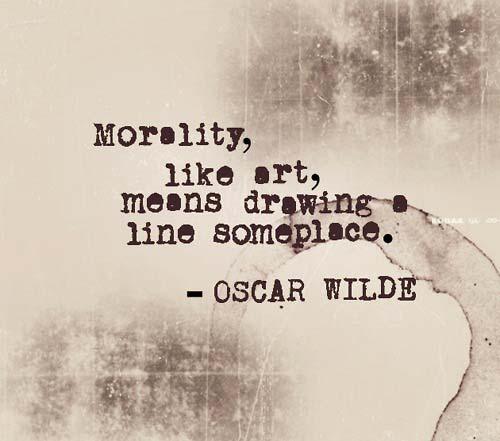
    Clipboard01

    (via)

    Who decides where the line is?

    P.S. Would be glad if you could point out whether I am missing some relevant piece of information or logic here.

  • In the beginning…

    Over on the other blog, I had discussed one of my favourite 2012 trend decks – by Ross Dawson. Within that, my favourite trend was #4 – Institutions in question, in which he talks of political situations (Arab unrest), and the change in status of financial institutions leading to movements like Occupy Wall Street. The last slide is titled “Transformation not apocalypse”, in which he mentions the significance of 2012 for several reasons – from the Mayan calendar’s end of the word prophecy to it being hailed as the year of the Singularity – a subject that keeps popping up on this blog. 🙂

    I, for one, believe that we’re in for a transformation. But it’s not just the political, economic or even technological changes happening around us, I think we’re fundamentally going to change as individuals and how we relate to others – society. So it’s not just the economic and political institutions that will be transformed, but even social institutions – marriage, family, parenthood, friendship and so on.

    As the average human life span increases thanks to medical advances, the ‘rational’ reasons underpinning these social institutions will be under scrutiny. I have a feeling that technology will soon allow us to find surrogates for each of these, one way or the other. It isn’t as though the institutions themselves will disappear, but their importance and the solidity they had thus far enjoyed would diminish. What exactly the changes would be is something I’m still trying to imagine, but the effect of social networks on relationships is probably the beginning of this transformation, and we are likely to be known as the generation under whose watch it all began.

    until next time, a happy 2012 to you 🙂

  • A social club of one

    Sometime back, I read a post on @daddysan’s blog on choices and how we “defend freedom of choice but we criticize those who exercise it because those choices may not be concurrent with ours.”  To be noted that the thrust of the argument is not on ‘labeling’ products/services per se, but labeling the people who consume it, more so in cases when it’s a personal choice and doesn’t endanger or even affect others in a significant way.

    I found this post interesting because I have always been intrigued by choices and their significance, not just from the perspective of whether they are choices at all, but also from that of the judgmental robes we like to wear. The last time I had written about the latter was in the context of expertise. But a comment on this post gave me quite a new direction for thought. More on that in a bit.

    In the context of the post itself, though I understand that labeling (and battles around them) has probably been around from the time the species became 2 in number, I think the publishing power that the internet created has taken it to a whole new level. So while “people who smoke/drink versus those who don’t”, “people who apply coconut oil on their hair versus those who don’t” and so on have had battles fought with much fervour, the internet’s ability to aggregate opinion has escalated many issues to war levels, like the examples daddysan has used.

    And so I wonder if it has something to do with the ‘Like’ necessity that has increased its hold over our lives recently. Social endorsement, even from total strangers. When I am a consumer of X, and you chose to buy Y instead of X, it is as though you have not ‘Liked/Retweeted’ my awesome intelligence in choosing X. Peer reaction was probably a major factor in my choice, whether I acknowledge it or not, and in saying that I have gone wrong, you have invoked my ego and brought up the subject of whether I chose X purely for its tangible or even intangible benefits or whether I chose it to conform to some section’s decree. Now, you probably didn’t mean to do any of this, and also are under some sort of peer review process yourself, but that’s irrelevant and it’s now war. Just like many of the Likes/shares/retweets are from people I don’t even really know, the war just brings in all sorts of strangers and camps.

    For the record, I have exactly one Apple product, which was gifted to me, and if it has any iron parts, it should be rusted by now. I read Chetan Bhagat and when I get a chance, take potshots at him. Just can’t resist. 😀 I think Ponytail sucks, and again, don’t lose a chance to crack a line at his expense, but I have held back much since the time he made a movie with the awesome Funny Deol. Joke sako to Joke low is the policy.

    But, enough. The comment that made me think was made by Jo Chopra McGowan, and it was about how individual choices add up, affect others, and could probably end up in impacting popular culture/lifestyles etc. I’d never thought of it that way. But yes, most of us/our actions influence at least one other person, and so the chain goes. More often than not, our reasons for doing so remain un-shared, and somehow one personal choice could create a conformity wave. Obviously the easy way to stop it is to make conscious choices and that brings us to the vicinity of square one. 🙂

    until next time, unheard mentality!

  • Integral Calculations

    The reasonable man adapts himself to the world; the unreasonable one persists in trying to adapt the world to himself. Therefore all progress depends on the unreasonable man. ~ George Bernard Shaw, Man and Superman (1903) “Maxims for Revolutionists”

    Now, I guess if i stretched that to Charlie Sheen, especially the last sentence you’ll think I have been swiggingTiger Blood” too. 😀 But I did have this notion after I read Scott Adams’ post on him.

    Imagine if you stopped filtering everything you said and did. ….just try to imagine yourself living without self-censorship. Wouldn’t you sound crazy?…. Imagine you are so unafraid of consequences and the opinions of other people that you start sentences before you have a plan for how they will end……I think Charlie is fascinating because he’s living without fear. That translates into a disturbing degree of honesty……But I also think that a total lack of fear would look like insanity to the casual observer. And perhaps it is. But it’s a strangely great kind of crazy.

    When I read up about moral absolutism, I wondered what/who would decide the absolutes one would stand by, and were they really absolutes? After reading all of that, I guess moral integrity towards the self better explains what I had in mind.

    So, if Mr. Sheen has decided that no-self-censorship and no-fear are the integral parts of his self from now on, and lives the rest of his life by it, we might consider it bizarre by civil society standards, but he just might be in a better space than we are in terms of moral integrity. (not hinting at a goddesses irony 🙂 ) The alternate consensus that this is just the drugs talking is not as comforting as it should be, when I think of it from this perspective.

    Does our general dissatisfaction stem from our willingness to conform to society’s norms of moral integrity, and the lack of courage to show society the middle finger whenever warranted? The individual consciousness against the urge to belong? I’m still thinking.

    until next time, integration and differentiation 🙂

    P.S This is not sheenfluence

  • Gulp fiction

    I’m quite a huge fan of Heroes and was quite sad to see Season 4 end, more so than normal season finales, because after quite a while, there was a villain that I could really empathise with.  Robert Knepper as Samuel Sullivan just rocked. Though the villainy is manifested in his selfish desire to become more powerful, there was something in his arguments that made me forget it at regular intervals. To give you some context, the entire series revolves around people with special abilities (think X-Men). This season, mostly through Knepper’s character- Samuel, emphasised a lot on how society treats such people. Samuel’s desperation to belong (and later make normal people respect his kind) is expressed very well in his conversation with another character with abilities, Claire.

    “Freedom is what you do with what’s been done to you”, says Claire, quoting Sartre.

    “I always thought freedom was just another word for nothing left to lose”, counters Samuel, without acknowledging “Me and Bobby McGee” 🙂

    The urge to belong and the pain of being different. Mo wrote a post recently on being chided for missing a reference in a conversation. A reference to Pulp Fiction.  At a broader level its also a small commentary about our consumption of popular culture, and second had experiences. Its a sentiment I share – that somehow the consumption of popular and even off beat culture and getting the respective references is the benchmark for judging a person. So, to get bombarded with “haven’t you seen/read/eaten.. don’t you know..” is now a common thing. Like I told her, thanks to everyone becoming media, C+ is actually a great grade, considering the noise.

    In some ways, I felt it also throws up our need for validation. The consumption and the opinions we have on that decide the kind of role we land in our immediate crowd, and now, the larger world. From “Govinda movies??!!” and “MLTR is why I go away from you” to “Eww, you’re still on Orkut?! .. Omigod, how can you play Farmville??”,  this judgment happens all the time  🙂

    At times, the validation is for others and their expectations, and at times for the self. In many ways, I think its like some gladiator fight where a person is just fighting himself, and the expectations he has set. The audience could be the self, or others. If its the latter, its all okay so long as the person conforms to a broadly accepted set of norms within the crowd.Even if one wants to get out of it, its difficult. Its difficult to sever the connection between a validation that is given to one without asking and the ties that one would want with other humans. 🙂

    In Heroes, Claire’s character’s ability is instant regeneration. Break a bone, receive a bullet wound, and she heals instantly. In the last scene of season 4, she throws herself from the top of a Ferris wheel, lands on the ground all broken up, and immediately heals, all in front of a waiting media crew. An open challenge to society to accept her the way she is. And another character says “Its a brave new world”. To me, it was a statement of hope, one that will get out of a TV show that’s part of popular culture, and enter the real world.

    But meanwhile, for now, until the pill happens, the moment one goes beyond what can be immediately understood, and what provides a point of reference, one has to be ready for “And I will strike upon thee… “:D

    until next time, reverence to reference 🙂