Towards the end of last year, I’d written a post on the ‘social product‘. Its premise was that given social’s conversion to media, the opportunity for fulfilling social’s initial promise would fall on ‘product’ – using data, network effects, and relationships to connect consumers along a shared purpose. In the last few weeks, I have seen rapid acceleration happening on this front. I can see at least two narratives working in tandem, and I’m sure that at some point they will begin to augment each other really well. In this excellent post on technologies that are shaping the future of design, sensors occupy the top slot, and they are at the basis of both the narratives – one on humans, and one on things. The official classification, roughly, translates into Wearables and Internet Of Things respectively for the scope of discussions here.
This post is about the second. So, what is the Internet of things? The wiki definition is simple, but effective – “The Internet of Things (IoT) refers to uniquely identifiable objects and their virtual representations in an Internet-like structure.” The best primer I have come across would be this infographic, which has everything from a quick technology explanation, applications and challenges to market size, statistics, and interesting use cases. For a really solid perspective, look no further than this deck titled ‘The Internet of Everything‘.
How does it affect us? For now, it is about convenience. If you’re familiar with Android launchers, imagine an IoT version – it’s almost there, using iBeacon! There’s more – Piper, which works as an IFTTT for your home, the smart fridge that can order groceries from the online store, the smart TV that can learn preferences and help us discover content, the washing machine that can help order detergent, the egg tray that will let you know about the number of eggs it holds and their ‘state’, the automated coffee machine, Philips’ connected retail lighting system, Pixie Scientific’s Smart Diapers, the GE a/c that learns your preferences, the smart bulb that doubles up as a bluetooth speaker, (!) and so on. Some of the products are really useful and solve a need, while some others are more fads and probably not adding the value that reflects the potential of IoT. But that’s just the learning curve in progress, as the market starts separating needs and wants.
All of this also means that consumption patterns will begin to change, as more purchases become automated, and more importantly data-driven. In my post on the driving forces of 2014, I had brought up technology as the biggest disruption that marketing has seen. This is most definitely one of the manifestations.
What can brands do? For starters, get interested. Think about the tangible benefits that can be offered to consumers. What are the kind of data patterns that devices (or products) can surface to help the consumer make better consumption decisions? What kind of contexts can be relevant? Instead of force feeding advertising on traditional channels and fracking social platforms, can communication to consumers be made seamless using data, contexts and easy processes? While ‘device’ brands might have an initial advantage, ‘product’ brands need not be left behind at all. As the washing machine post (linked earlier) suggests, a Unilever or P&G might subsidise a machine, because it’s pre-sold with 500 washes worth of their detergent. It could even be real time, with SDK, API systems telling a partner brand to push a contextually relevant communication to a consumer. As things start storing and communicating data, privacy will be a major factor that decides whom consumers will share what with. Unlike media, trust cannot be ‘fracked’, it needs to be earned over a time frame.
Where does it go from here? A common language/protocol/registry is a good start, as is a white label platform – both are trying to connect an assortment of devices and gadgets. While there is value in data at an individual level (more on that in the next narrative) one of the critical factors in the success of this phenomenon is the devices talking to each other – humans acting as middle men to pass on data may not be a smart way ahead! Digital Tonto has an excellent nuanced perspective that differentiates IoT from the web of things. (WoT sounds cooler!) The difference is in connection and interoperability.
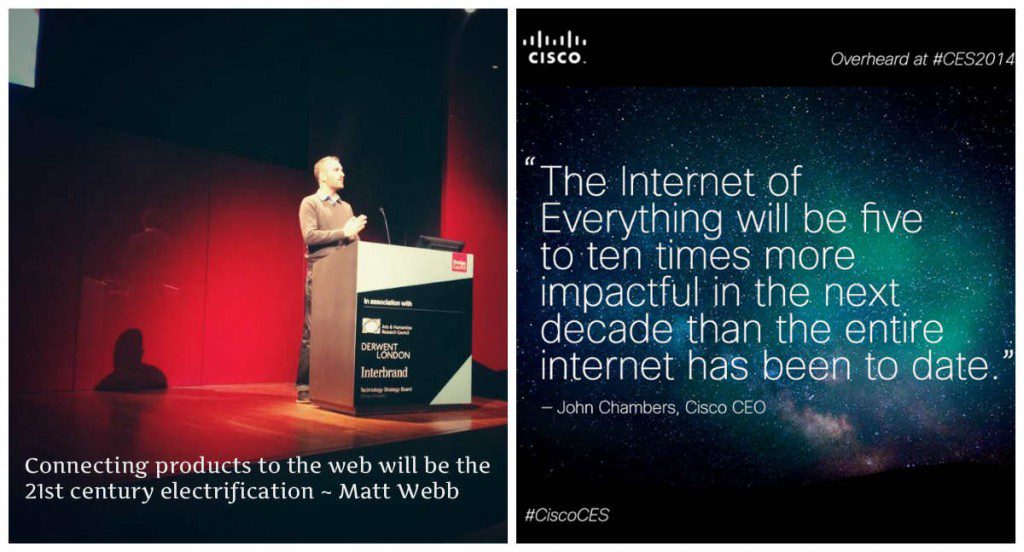
Equally important is this phenomenon’s ability to solve human needs. (Internet of Caring Things)
Collaborative consumption is fast becoming a consumer reality. As always, brands (generalising) are bound to be a few years behind, but the hope is that the web of things will force them to start collaborative creation and distribution and more importantly, focus on consumer needs.
until next time, #WoTever
P.S. In a corruption of Scott Adams’ idea, I think #WoT is paving the way for robot domination. 😉
P.P.S. If the subject interests you, check out my Internet of Things Pinterest board.