Tag: social business

  • A social culture?

    Even as I write this, Titan is looming on the horizon – not Saturn’s moon, but Facebook’s purported mail service, which can (potentially) stake claim on another front that Google has made much advances in, though its still only #3. And so the thoughts from last week’s post continue – on whether culture is the key differentiator that sets apart the dominant player in an era and everything else from superior technology to better marketing evolves from it.

    The two posts I had linked to last time remain relevant in a Google vs Facebook  discussion – “Google’s real problem – GTD” at GigaOm and “Facebook and Google” at Piaw’s blog. Meanwhile, Robert Scoble wrote an excellent post last week titled ‘Why Google can’t build Instagram‘, which brought out a whole lot of other perspectives on what prevents Google from innovating at a rapid pace (also probably the reason why Facebook is stealing its thunder regularly) – organisational size (something we keep discussing here), controlling the scope of products/services, an infrastructure that’s not built for a smaller social scale, the necessity to support all platforms (because they’re Google, that’s expected of them, thought this holds true for FB too), the inability to use a competitor’s graph (in this case, Facebook), the need to ship a product/service that’s near perfect (because they’re Google!) and so on. Scoble also throws in a few pointers on how Google could still innovate, and I thought some of Android’s success could be attributed to one of those – sending it out and allowing developers to build on top of it. You can get another interesting perspective on Google and scale here. (via Mahendra)

    The other understanding I developed was that with scale, even the organisation’s vision could change, (though the reverse is what we see regularly) and that would affect everything from competitor landscape to culture. So the challenge is to keep people hooked on – employees and users.

    I’ve come across excellent posts on both these. The organisational aspect is the core theme of Gautam’s blog, and so its not surprising that I’ve seen two posts in the recent past that tackle this subject – Inspiring People, and Making Work Meaningful. The other must read in this context is the 2010 Shift Index, specifically the ‘Passion and Performance’ part. From a consumer perspective, few people can articulate it better (especially since a toon is usually more popular than a 1000 words) than Tom Fishburne, and again, two relevant posts – App  of dreams (as a devout Angry Birds player, I identify completely) and The Antisocial Network.

    Despite approaching it from two different sets of stakeholders, the common thread is easy to spot – that brands/organisations need to figure out a reason for existence that goes beyond their business mission and balance sheets. This would then help them identify the ‘something’ that people – both employees and consumers  can identify with and would want to belong to. Coincidentally, this is the drawing I got on my Gaping Void subscription today. 🙂
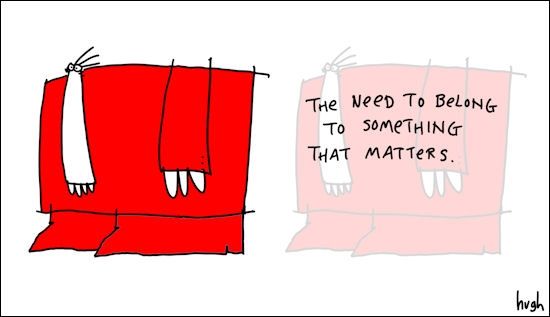
    (Hugh credits Mark Earls for first voicing this thought)

    Not very long ago, Google spearheaded a revolution of sorts, by creating an algorithm that connected a web user with the information he sought. The only thing that topped it was the business model they built on it. Many have attempted it before and after them, but there was only one Google. The world changing mojo seems to have been transferred to Facebook these days, and even to Twitter to a certain extent, as, in different ways, they connect us to people we know/want to know in various contexts. Information sharing then becomes one of the applications of this connection. This phenomenon is called (by) many names, including social media. 😀

    Perhaps brands and organisations fail to understand the philosophy of social platforms/interaction and get lost in the applications. A bit like wanting to build a social layer on top of everything you have created so far and meanwhile, firing an employee for telling the world he got a bonus and raise 😉

    until next time, titanic shifts 🙂

    Bonus read: The Heart of Innovation via Dina
  • Chief Social Media Officer then?

    I remember writing about the ‘technopologist’ about a year back, in the context of businesses only looking at social platforms through a brand/marketing prism and not sparing a thought on the other implications/potential – organisational culture, business policies, to name a few. The technopologist -a hybrid of marketer, technologist and social anthropologist was a hot topic of discussion then, in the wake of P&G’s move in that direction. I realised I was late for that party when I read a WSJ post from 2008. (it still holds true) 🙂

    I didn’t hear much about the technopologist after that, but a related shiny new animal is now the butt of several jokes. Social media experts are now everywhere, and there’s no dearth of brands wanting to ‘do the social media thing’. It is a generic label used without considering the expert’s domain of expertise (strategy/execution/tool specific). But what about the organisations who hire them without sparing a thought on what their core principles are, and how they could re-engineer themselves for new forms of usage. (in this context, do read ‘There is no new media, only new consumption‘) Expertise in a situation when neither the internet nor the brand manager are sure what they will morph into.

    What reminded me of all this? The recent buzz about the Chief Marketing Technologist. Another term that was apparently coined in 2008, thanks to Scott Brinker. The case for it is strong enough, and I did nod in agreement several times while I viewed this deck, and , but I couldn’t help but wonder whether this too will become a buzzignation (buzz+designation – hey, I can try too) that made sense but couldn’t actually fructify.

    From my (limited) experience in dealing with those aspiring to use social platforms in their organisations, I’ve noticed that the actual challenge is not in realising that this direction of technology and marketing is perhaps an inevitable future, (they either know it or the slideshare ppts will convince them), but in evolving a perspective that is not weighed down by someone else’s experiences of social platforms, their own notions of what their brand/organisation is, how their stakeholders view them, and therefore, what they should do on social platforms. A new designation can only help so much in this.

    until next time, cornered offices.

  • The path to transparency

    Google Me is already showing great results, even before its launch. Maybe its the fear of whatever-it-is-going-to-be that has made Facebook release a couple of tools a few days back. 😉

    Facebook Live (via), a live video streaming facility, with features like a live feed, and ‘ask a question’. More interesting is the app that will allow regular Fan Page administrators to add this to their page and the embedding on other platforms – Twitter, Google Buzz etc. But what I’d really like is for Facebook to get into proper video distribution- create an app that will replicate what the Justin.tv and Ustream apps for Facebook achieve. So brands/organisations can stream everything from say, earning calls to new store openings to special brand ambassador promos and so on. Think of the engagement possibilities.

    Notes. I have never found Notes very interesting at all – maybe because I blog a lot. So, except for the occasional note, or using it to get the blog feed into Facebook, my usage has been limited. For long, I’ve been asking why Facebook doesn’t allow me to tag Pages that I need not necessarily have ‘Like’d (in the Facebook way) , but would want to still tag in a status. So I couldn’t do say, “visited the @Wrangler store” as a status unless I ‘Like’ the Wrangler Page. I still can’t, but now I can do this in Notes, and I can add photos too. As ‘Location’ looms, it’ll be interesting to see how brands deal with this.

    Even as the opportunities for brands to engage increase, I can’t help but feel that its also moving them to some inevitable levels of transparency. The good part about all this for brands, though Facebook may not be the ideal way to do it, is a certain accountability that it creates for people who create content and comment on the brand, thanks to identity.

    A few weeks back, Surekha, Mahendra and I had a good commenting session over ‘The Age of Transparency‘ on Reader, an article that talks about the implications of transparency on individuals, society, government, companies. While we’re still far away from a stage when transparency is a default and ubiquitous feature for people, brands and organisations, it might well be a reality in a few years. Like Surekha mentioned in her comment, it wouldn’t do any good for a brand to engage only because it can’t afford not to, but then the question is, will brands/organisations see the trends in the evolution of these tools and more importantly society in general, and be objective enough to start rewiring themselves? Or maybe the ‘forced’ presence and the opportunities that new tools provide will act as a good catalyst for the required change.

    until next time, anonymous comments are fine too 🙂

    Bonus Read: Kapil Ohri’s well researched article on Indian brands on Facebook, (and my earlier post on social media and the scale of organisations) 🙂

  • Go-to-social media

    A few weeks back, I’d mentioned Tac Anderson’s ‘3 types of social media strategy‘ . To quickly summarise, the first is the ‘toe-in-the-water’ approach (not really a strategy), the second is ‘optimising social media for business’ and the third is ‘optimising business for social media’. That happens to be the decreasing order in terms of current practices, probably because its also the increasing order, in terms of thought, effort and time required.

    I am quite a fan of the third approach and saw this excellent presentation by David Cushman, a few days back, which showed why ‘optimising business for social media’ is perhaps the best way in the long run. In fact, it does it in such a way that it almost seems like an afterthought. On the way, it addresses the much maligned combination of words – ‘social’ and ‘media’, and the subject of ROI.

    Like I said, I don’t require any convincing on the third approach too, but the more I interact with clients, I begin to understand that with all the hype, the expectations of social media are akin to the other forms of media, and the stereotyped Facebook page and Twitter account are much sought after in the strategy presentation. And that forces me to think whether we can start with approach 2, and move towards approach 3.  The feedback from open social channels slowly creating a change within the organisation and making it view everything with a different perspective. That’s quite a change from asking for perfect products and services which could ‘withstand’ social media. 🙂

    Meanwhile, I looked at it from another perspective when I chanced upon the new IndiGo Airlines ad, thanks to a post by L.Bhat. The spunky ad, which you can view here, is shot extremely well and showcases IndiGo’s dedication to being on time. Bhat raised a valid point that this punctuality might actually be beyond their control, in some cases. I completely agree, but like I commented, I’ve used IndiGo several times, and have never had a reason to complain. All the people who’ve commented on YouTube seem to agree.

    I have to confess, there’s a style to Indigo that I’m quite a fan of. Right from the way they have communicated this data  below (do note the revenues, number of flights, market share, and compare)  inside the flight, to the menu items to their stickers and even their barf bag, they are quite unique, they have an attitude and are not afraid to show it.Check this out. (thanks @gkjohn)

    Clipboard01

    (Source: Outlook)

    DSC03160 DSC03161

    (Can’t remember other airlines, I know Spicejet has quite plain stuff, anyway I liked these enough to keep a copy 😀 )

    No, i wasn’t digressing. From what I read, IndiGo is hardly a major player in the social media space. But I think the TVC is a good way of approaching what would have been ‘strategy 2’, with a conscious design of reaching strategy 3. All that, without social media. A purely communication  (internal and external)+ organisational culture based approach to  creating a social business. That may not be Indigo’s strategic intent, but it does make me think. Is it possible? 🙂

    What can be done to this with social media, is a different discussion altogether.

    until next time, thoughts in the air

    Bonus: “Culture eats strategy for lunch” via Gautam Ghosh.


    httpv://www.youtube.com/watch?v=kiFMJfrCO_0

  • Wide Labels

    I ended last week’s post with the view that removal of labels and building in the intent and components of these labels into an organisation’s processes might result in structure better than one obtained by a piecemeal approach. I’m still thinking about Surekha’s last comment – on corporate governance, and wondering whether it does indeed encompass (enough) the social facet. Social, both in terms of implication on the larger society, as well as the social used in the context of say, social media.

    While I’m not expert enough to look at the first part comprehensively and offer the soundest of opinions, I think the latter is everyone’s playground 🙂 On that front, I don’t think corporate governance quite makes the cut. And that led me to keep searching for various models being discussed. I also brought into this search the perspective I’d shared earlier on a Dunbar’s number for brands/organisations, retaining the ‘soul of the brand’ (courtesy Chris Brogan) and scalability issues.

    And that’s how I came across the ‘Platform Organisation’ concept. The presentation below approaches the need for this from a communication perspective

    The larger organisational imperative can be read here. This worked for me because I thought it matched business and social needs.  The community would ensure the soul of the brand is intact and would also allow a ‘scaling up’ of the brand’s Dunbar number. But I did wonder whether this would work for large organisations that  have a legacy of systems and processes. Deciphering that would perhaps be the next logical step.

    As I’ve always maintained, the business structures we have built have a huge impact on how we live and consume as a society, and the lives we lead as individuals,(an old and favourite read discovered via Dina) and hence the extended interest on this topic stream. 🙂

    until next time, life’s work 🙂

    PS: While on the subject, a related good read via @vijaysankaran “The Definitive Guide to Scaling Social Enterprise