Tag: social

  • The Agency Experience

    Last Thursday was my first anniversary at GroupM, and the next day was my last there. A short tenure, and one year in an agency is too less a timeframe to be exposed to all the facets, people and processes a large (media) agency has to offer. But limiting though it is, I’d still like to share my (limited) thoughts, because I wasn’t able to get these perspectives before I made the shift to the agency side. My contacts on the client side had near zero clue on life in an agency, and my agency friends were veterans who had always been on that side. It wouldn’t have occurred to them that these things might be unfamiliar to a n00b! 🙂

    These are based on what I saw and experienced, and hence more subjective than objective. I’m restricting it to three aspects that bring out some good and some not-so-good points. (more…)

  • Social @ Myntra – Part 2

    continued from Part 1

    Creating, correcting and maintaining brand perception and resolving customer issues were fundamentally the objectives when operating in the customer care and brand domains respectively. But this was not an end in itself. The end objective of the business is revenue, and that makes up the remaining story.

    3. Product: In this context, it includes the website itself, and the various features/enhancements/new products (eg. gift cards) that get introduced on a regular basis. Including social buttons on the home page and product pages were a given, though getting them above the fold was a mission I lost! The first major change was switching from FB Connect to the Open Graph. The potential applications, using social and interest graphs, are phenomenal, but we never progressed that far. At a basic level, I had slotted activities in this domain under acquisition and retention, and we have only implemented a small portion of the former. The easiest application of the social graph was using it for social proof. Kuliza’s Echo made that job relatively easy for us. It not only helped seamlessly amplify word-of-mouth, but also gave us a lot of data on consumption. One of the plans was to integrate this with Elevate, another Kuliza app – but inside Facebook, to try and beat FB’s throttling of organic reach. 🙂 Another application of Echo, which should soon see the light of day, is a Fab-like social feed. If a user has registered on Myntra using Facebook, he/she would see the actions (Likes, Purchases, Wishlist additions) of his/her friends on a separate feed inside Myntra. Our expectation is that this would prompt more social actions inside Myntra and accelerate word-of-mouth inside FB further. This was actually a Phase 1 of a larger plan I had in mind. Let me explain.

    While brand and customer connect can provide a strategic advantage on social, I’ve always felt that it was in the product domain that social could provide a sustainable strategic advantage. This came from my notion that ‘loyalty’ existed when the exit barrier for a customer to leave Myntra was high enough to beat any sustainable offering from a competitor. ‘Brand’ is one standard way to achieve it, but it is relatively less tangible, and in a commoditised marketplace, it would take more time. Generic discounting is not sustainable. I think, in this context, ‘Product’ can reach this ‘barrier’ in lesser time, and at lower costs. An ideal in my mind was using the social, intent and interest graphs of users from across various platforms to build a personalised experience, and through that, a gamified customer acquisition and retention architecture inside Myntra, (thereby minimising dependencies on other platforms) and then using social media to amplify relevant actions to further drive acquisition. But this approach has a high dependency on changes in the existing product and every new product/feature having relevant social features baked in (or at have it in the vicinity on its roadmap) to contribute to the larger agenda of the architecture. It also takes a mindset and backing. I did have a rough blueprint, but at this point in the e-commerce wars, this approach probably seemed a nice-to-have. 🙂

    4. Sales: Conventional notions claim that social media should not be used for sales pitches, but from my humble experience, I’d beg to differ. It’s just a matter of what-when-how, and how much. From generic product pitches on the Facebook Page as part of the larger content strategy, to custom links on Twitter, we have consistently shown and tracked revenue from social channels. Even Pinterest and Google+ are contributors! I must admit that in the larger scheme of Myntra’s monthly revenue, these are insignificant, but let’s just say that the total contribution are in double digit lakhs every month. In fact, it reached a point where we were given a budget to see if we could scale it. In this context, I have to mention this brilliant idea by S – she used customer generated product images from our Pinterest ‘Shopped from Us’ board every week to make sales pitches on Facebook! Works like a charm. 🙂

    The area where there were a few attempts, but didn’t really pick up was enterprise collaboration. We managed to build a fairly large community on Yammer, but what I’ve realised is that it needs champions at the highest level in all parts of the organisation using it on a consistent basis for it to be sustainable. I also had this grandiose vision of using Google+ and circles to connect customers, Customer Connect teams, Partner brands and employees in general, but this one was limited to a word document! This is an area that I believe to be a must-have as we evolve towards social business, but in the larger list of priorities, is still a few steps away.

    That gives a broad view of what I’ve been up to for two years. The generic point I’m trying to make through the two posts is that from basic business outcomes like customer satisfaction and sales to more nuanced ones like brand perception and sustainable strategic advantage, social can and should play an integral part. There will be differences in terms of scale, strategy, resources etc depending on the domain, maturity of the industry/organisation, target audience and so on, but the important part is to begin because the brand/organisation needs to evolve as well. Social media has shortcuts, I’m inclined to think that social does not. These are days of nascence, and social will continue to evolve – enterprise social networks, social business, big data, the Internet of Things (add buzzwords to taste) and more will all have their hype cycles and age of maturity. By all means, measure ROI, but remember, we spend on movie tickets, we invest in mutual funds. I think we’re clear on the expected time frame of returns in both cases.
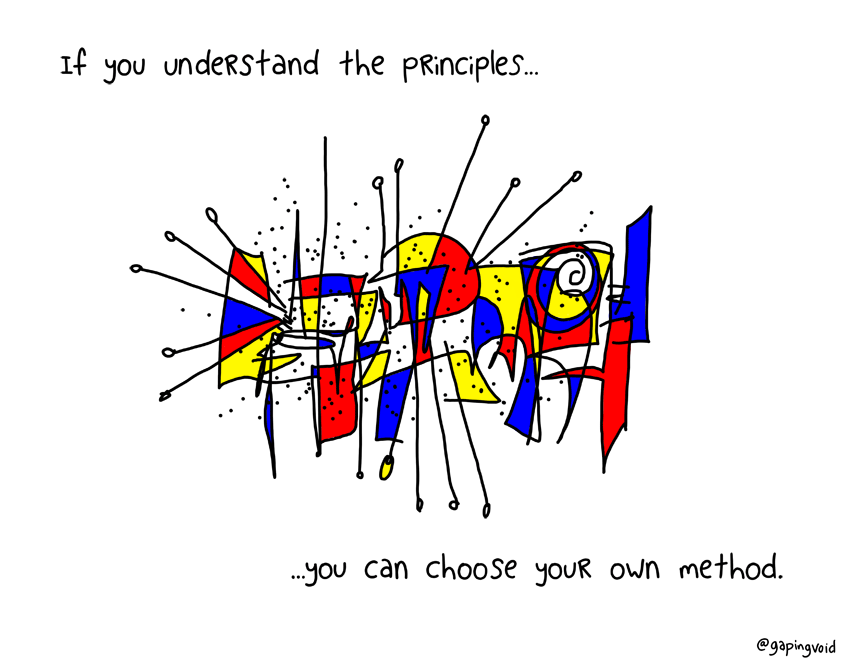
    understand_the_principles

    (via)

    Myntra will remain dear to me, like all the other brands I have worked on, but it will probably have a more lasting signature, because not since my days at GIM have I experienced such a rewiring of my worldview. This stint has given me oodles of confidence, friends whom I hope will last a lifetime, and relationships of trust that I will cherish.

    Before I end, the last hat tip – to the super S, who joined the team mid last year and has since then, proven time and again that she’s the best social ‘investment’ we made, and made this little social adventure a total joy! “I used to believe that we are here to teach what we know. Now I know that we are here to teach what we are meant to discover

    until next time, </ head – social media> 🙂

  • The year that will be…

    Crystal gazing began in right earnest in Dec 2012, and across the web, there were many top x predictions for 2013.

    Trendwatching made a list, and my favourites in it were #9 and #10 – “Full Frontal” and “Demanding Brands” respectively. The first was about brands moving further on the transparency curve and proactively showing they have nothing to hide as opposed to merely reacting. The second was about brands getting their consumers to contribute to their sustainability and socially-responsible endeavours.

    Branding Strategy Insider made 2 lists – Brand and Digital & Media. In the first, I found #5 – ‘The Known and the Branded’ – a very intriguing thought. Brands being thought of as category placeholders, stuff that doesn’t really stand for anything. Understandably, brands will find it harder to differentiate themselves. In the second list, again #5 – omni-channel marketing is something I have written about earlier while on the subject of cohesive experiences.

    JWT has their annual 10 trends list as well, and I thought #1 “Play as a competitive advantage” and #9 – “Going Private in Public” were particularly insightful. The reason I look forward to the JWT list is because while they deal with the immediate, they also come up with a couple of nuggets which are really far out. But the thing is, I can instinctively connect with them and am sure that even if not this year, these are inevitable somewhere down the line.

    This year, I also found Next Generation Media’s list quite interesting, especially because of their ‘implications for brands’ after each trend. My favourites in this list were #9 and #10 – “New Currencies” and “The WOW factor” respectively. I like the direction of the former, but would have liked it to be pushed further, but that’s mostly because of a more (personal) philosophical perspective on us having no alternatives to money as a currency. “The WOW factor” – related to ‘The Known and the Branded’ I mentioned earlier in the post, and the writing is pretty much on the wall for brands!

    Update: Came in late, but Simply Zesty’s list is a must-read as well!

    until next time, hope y’all have an awesome 2013. 🙂

  • Broadcast 2.0 then?

    Facebook is planning a new video-ad product that will offer video advertisers the chance to target video ads to large numbers of Facebook users in their news feeds across devices. It is also becoming more public about its Publishing Garage, that aims to put into place a set of measurements to demonstrate how well campaigns are working. Twitter has partnered with Nielsen for the the “Nielsen Twitter TV Rating” – an industry standard metric for measuring the conversation that TV shows spur on Twitter.

    The commonality I see is the shift from social to media, though to be fair, the Twitter-Nielsen partnership also talks of sentiment being measured in the future, in addition to tracking the volumes generated. I am using the term ‘social’ for two of the biggest platforms around now – FB and Twitter, but considering they have been the trendsetters, it is likely that the others will follow suit. Yes, there would be exceptions, I’m sure, but let me generalise a bit. While time will dictate whether this shift is smart or not, I’d think this shift is massively underplaying the true potential that social has thus displayed as a disruptive force. Social is now walking the measurement rules laid for a thoroughly different kind of media. (I liked this post at GigaOm because it throws light on, and questions why every social network is trying to turn into a broadcast platform) Doesn’t this put them on the same path of vulnerability that traditional media is facing now? Is this inevitable or is this sheer laziness and/or conforming? Also, from a user perspective, isn’t this a fundamentally different direction from the original premise/reason for existence of these platforms?

    Meanwhile, it is interesting to note that this is happening at the same time as users (increasingly) are treating social as broadcast – from the shoot-from-the-hip opinions on everything to the careful posturing. Not so suddenly, it’s more about numbers than actual conversations. Now what does that remind me of? 🙂 I don’t know how much of it is unconscious and how much of it is subtle nudging (read) by the networks and their features. But whatever the reasons, imagine a future where everyone behaves the way media behaves today – loud, pompous, full of themselves, ignorant to their own faults, violent towards any criticism, and generally abhorred. What happens then?

    So in the current direction I see the networks (and users) taking, the future media mashup will show more characteristics of traditional broadcast platforms than the social traits displayed by the social networks in the early days. My concern in such a scenario is because of what Godin has stated in another context – “Media doesn’t just change what we focus on, it changes the culture it is part of.” That’s when I wish social/we would be more ridiculous.

    until next time, growing pains

  • Brands going places

    So, almost a year after I blogged here about Cafe Coffee Day’s potential gains from Foursquare, they have become (as far as i know) the first Indian brand to get an official page on Foursquare and have special offers for 4sq users. (Bangalore outlets). I plan to drop in soon! Meanwhile, I remember the DM conversation then, with the person handling the CCD Twitter account and touching upon the problems of scale that would arrive with a platform like Foursquare. But now we have tools that address franchise needs, so I hope that can be addressed too. Anyway, good on CCD, because it’s not easy for an organisation of that size to be an early adopter marketer. Also good on the agency for (probably) getting them to do it. 🙂

    With Foursquare and Facebook Places, I think that brands whose product/service experience is intrinsically tied to retail outlets are perhaps closest to a kind of interaction utopia I have in mind. Here’s why.

    With every platform advancement, the customised interaction potential has increased – from mass media and the static web to social web, location based services, apps and technology like Augmented Reality. But even now, given the tendency to aggregate ‘Like’s and followers, I sometimes feel that ‘social’ as it relates to friends and followers’ overrules ‘social’ as a relationship between brand and consumer. That’s a dichotomy that few brands have acknowledged or addressed. Conformation!

    And that’s why I feel retail brands on 4sq, Places etc are near to that utopia – because it allows real-time interaction and context at the place of experience. Social is only a topping, and something that the user will scale by connecting his friends/followers to the experience. The brand/platform just has to play along. Technically, you could say it is possible on FB, Twitter too, but there the Like/follower currency is way too prevalent, so it is easier for brands to get sidetracked. (If we go by a recent report, brands will eventually find that it’s not really getting them anywhere)

    Meanwhile, just like FB and Twitter, platform protocols and constraints for brands also apply to apps and location based services. And that’s why, at this level of my imagination, I can only imagine utopia (for non retail brands) as brand ‘controlled’ interactive sensors attached to each product we consume. 🙂

    These shifts would hopefully drive more brands to define their own destiny.

    until next time, CCD, may the foursquare be with you 🙂