Tag: seth godin

  • Jump with a crowd

    ‘Jumping the shark’ is a phrase that has been jumping on to my face regularly, but something that got lost in the rigours of speed reading and processing. Thanks to Tom Fishburne’s excellent post on the subject in the context of brands, products and organisations, I got to think about it a little more. The quick definition would be (from the post), “the moment of downturn for a previously successful enterprise.” The problem with it? “The risk of jumping the shark isn’t getting eaten by the shark. It’s leaving your loyalists behind.”

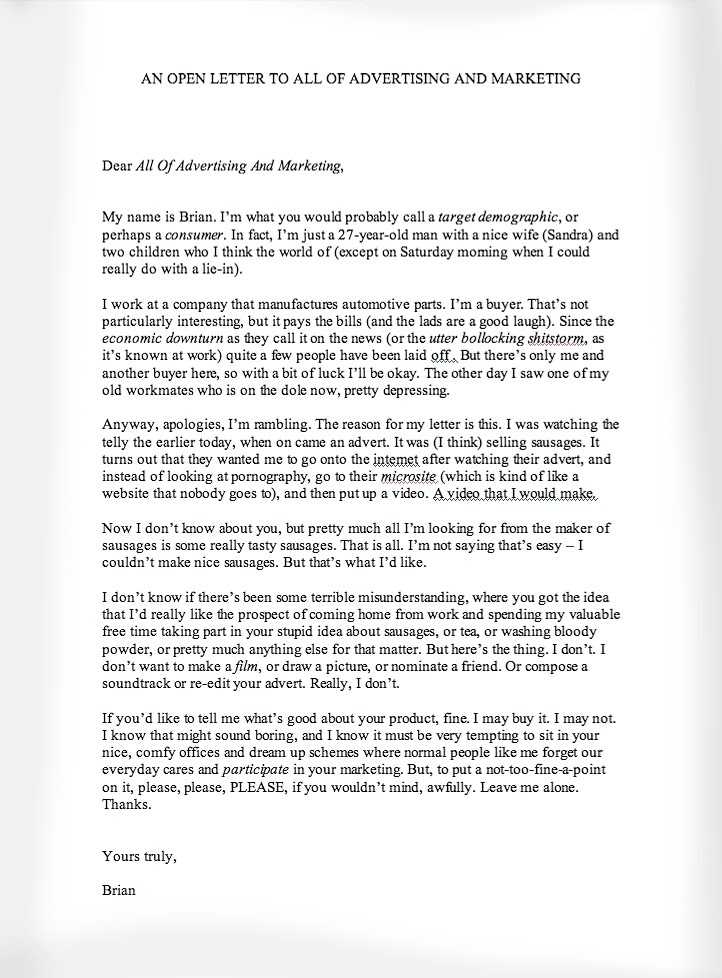
    I thought about it a bit, not in the context of brands or businesses, but more in terms of brand communication as a field, advertising specifically, and brands’ usage of the social web. Consumption patterns, media platforms available etc had pretty much created templates for creative agencies over a period of time. But the arrival of the web, social platforms and the democratization of media have managed to disrupt the ways of the one-way communication age. This post is a good one to read in that context, and talks about the change digital has made to campaigns, and the ‘role of the consumer’. But desperation, hype and the eagerness to get on board makes everyone concerned ‘jump the shark’. And unfortunately, the way I’ve seen many agencies and clients execute it (purely as a consumer), I’m quite inclined to agree with the author of this hilarious letter. (via PSFK)

    Clipboard01

    (click to enlarge)

    The job of the brand manager/creative agency is obviously a more difficult one now, and is made even more so thanks to the approach – of tool strategy. Like this (old but) excellent post states, ‘the technology that underpins social media is changing fast’, but its ephemerality ‘is a feature, not a bug’. It made me wonder whether brand communication/advertising, as a process (the way we see it now) had ‘jumped the shark’, mostly because the thinking process still sees  social platforms in the same light as traditional media and has not changed to be in tune with the former’s dynamics. In other words mistaking social media marketing for social media.

    Maybe they have to dig deeper, figure out the value that people are willing to pay for, and then find their ‘purpose idea + social object‘, and consistently. But that would mean a sea change in the way brands and creative agencies operate. Is adaption possible, or is complete disruption inevitable?

    I juxtaposed this thought with something that Seth Godin wrote recently, about the ‘red zone‘ – the joyless part of the learning curve. His graph also has a green dot, which represents ‘someone on the other side.. rooting us on, or telling us stories of how great it is on the other side’. Perhaps if brands can find from the existing consumer crowd a few who believe enough to play the ‘green dots’, they can adopt a more holistic approach to social platforms and carry the loyalists without it seeming like ‘jumping the shark’?

    until next time, safe jumping.

  • Higher Stakes

    The ‘cow slaughter ban’ bill that got passed in the Karnataka assembly sometime back, got a lot of people’s erm, goat, especially Mallus, for many of whom, paradoxically, its a ‘holy cow’ issue. But the phenomenal prospects of wordplay is not what got me thinking. Its the idea of something getting banned and the protests that follow.

    Take smoking, for example. I’m sure all the smokers would have been fuming at the bans that came out on various aspects of the product and its usage, but a lot of us feel that its a good thing for different reasons. Me, mostly because those lousy forwards with the much abused ‘kick the butt’ subject line, and horrible pictures, have stopped. I find that the majority of people I know support this ban, citing health reasons etc. But the beef ban, which (at least in a way) prevents killing of a life form, finds lesser supporters. Personally, I love beef, but as time passes, my feelings of guilt have also been strengthening, and its the case of a subjective like over ruling a ‘better for the cosmos’ thought. A sad rendition of  the “way to a man’s heart…. ” too. But I do wonder about a future when the majority would say that the beef ban is a good thing. A higher state of awareness?

    A few days back, I read Seth Godin’s post titled “Fear of Philanthropy“, where though his context is mostly to do with ’cause marketing’, he writes about knowing how much (of giving) is enough.  He paraphrases a question (attributed to Peter Singer) “Would you save a drowning girl even if it means ruining a pair of Italian shoes? If the answer is yes, why not use that money to save 20 kids starving to death at the other end of town/world?” Isn’t it the same? (I need to read up more on Singer, Practical Ethics, and the idea of “the greatest good of the greatest number”).  Godin points to proximity, attention and intent as factors that weigh in in our decision to ‘give’.

    Proximity and attention. I remember wondering in a post sometime back whether all this connectivity, instant communication and micro popularity would make us less compassionate and more inconsiderate. But then again, does this connectivity increase our proximity to issues and would it be negated by the lack of attention? Heh. Will it make us more conscious or will it cause to go even deeper into our own comfortable bubble?

    Intent. I saw Will Smith’s ‘Seven Pounds’ when it played on TV recently. The idea of a man donating different organs/parts of his body, after ensuring that the receiver is indeed worthy – ‘a good man/woman’ (“You’re a good man even when no one’s looking”). Commenting on the intent would spoil the viewing for you, but the point here is the time and patience taken to identify and verify the ‘goodness’. I’d have liked to do that too, but I’m afraid of what all it would entail. I convince myself that I don’t have the time. However, I can’t help but wonder optimistically whether one day, the collective consciousness would help take my awareness so high that my intent is made all the more stronger and then, everything else will cease to be a factor. But then I look in the mirror and say that I’m better off looking within myself, for its difficult to refute an oft asked question “I didn’t make it this way, why should I contribute to making it a better place, when I can buy my happiness in other ways?” As Godin says, its effective enough, sadly so.

    until next time, streamlined thoughts 🙂

    PS. meanwhile, if you’ve been reading this blog for a while, and have liked it, do officially ‘like’ it here 🙂

  • Brands – Interesting vs Popular

    These days, Reader is helping me find a balance that contains both ‘interesting’ and ‘popular’ content. I came upon a very interesting post on Reader via Mahendra Palsule, which was one exactly this topic – Would you rather be Interesting OR Popular by Justin Kownacki.

    For the purpose of this post,

    Interesting: Arousing or holding attention

    Popular: Regarded with favour/approval by general public

    To briefly summarise, Justin sees a clear dichotomy in ‘interesting’ and ‘popular’, and states that when something becomes popular, “it will simultaneously cease to be interesting.” The reason, and I would more or less agree to it basis my experiences, is that when it becomes popular, my relationship with the ‘interesting’ entity changes. Suddenly, it is an interest that has moved from a relatively private territory to a more public one. Like Justin notes, it creates dissonance with my self perception of being an interesting person. Meanwhile, money also has a role to play. “interesting sells, but popular sells a lot“, for various reasons.

    Meanwhile, like many many others, I subscribe to the uber popular (and interesting) Seth Godin, and on the same day, he wrote a post titled ” Driveby culture and the endless search for wow“. I felt that they were related, especially when Godin writes about the creation and consumption of culture.

    As the comments in Justin’s post indicate, there are entities which have successfully been both interesting and popular, but I’d say they are exceptions. I’ve always believed in ‘interesting’ (against ‘popular’) over a larger time frame, and if I go by Godin’s last paragraph in the post, I think he is on that side too. Which is why, I wonder with the massive changes that social platforms bring to creation and consumption of content, brands will have to choose between interesting and popular.

    To generalise, the era of mass media made ‘popular’ easy for brands. Like Godin says, money could buy an audience. And that’s exactly what happened when there was scarcity of content. The audience had, and paid, attention. A percentage consumed the brand, sales went up, more money bought more attention. The message  also often pandered to the lowest common denominator. Brands didn’t have to be interesting until they operated in the commodity space, and then it became a gimmick.

    When I started using the platforms of what is labeled as social media, I thought there was something that could change this cycle. I still do, in spite of this post (most of it justified, by the way) by Steve Hodson. I think what we’re seeing now is brands seeing social as just another media, and going the ‘popular’ way. The  majority of the audience too, is discovering popularity, and would like to have a share of that themselves. So their consumption and creation would be on that front. In a way, for now, one set of media is being replaced by personal brands.  But in spite of that, the basics of social platforms create opportunities for those brands with ‘interesting’ as their way to be, to have their say. While examples are few and far in between now, I think its just the learning curve taking its time. Maybe the examples are not so easily available precisely they are only interesting to a smaller audience set of users now. Maybe there never will be, because it IS difficult for popular and interesting to go hand in hand.  🙂

    I think ‘popular’ is going to be even more difficult to sustain, and not just in terms of communication, but organisational culture, scalability and so on. As content becomes even more abundant, and as technology permeates the lion’s share of our daily interactions, I think the audience will swing towards ‘interesting’, because in  it, I sense, is freedom, and opportunity. And that goes for brands too. However, it remains, as always, a matter of intent, and though I feel that it is indeed a question of ‘interesting’ vs ‘popular’, in the medium term, both kinds of brands will co exist.

    until next time, popularity chats in the comments then? 🙂

    P.S: Do you think Apple is interesting trying to be popular?

  • A Dunbar’s number for brands?

    Seth Godin had a very good take on the Dunbar Number recently in the context of connections made on Twitter and Facebook. (Wikipedia: Dunbar’s Number is a theoretical cognitive limit to the number of people with whom one can maintain stable social relationships. No precise value has been proposed for Dunbar’s number, but a commonly cited approximation is 150) Godin was of the opinion that “You might be able to stretch to 200 or 400, but no, you can’t effectively engage at a tribal level with a thousand people.”

    A few months back, I’d written a post wondering whether smaller organisations were better placed to use social media effectively. This was based on a post by Chris Brogan. Smaller organisations with a flatter structure, and a culture more open to ideas. In that post, I’d questioned whether ideas becoming products/services and then further on brands, meant that the large audiences developed by brands would dictate the kind of communication used, and if mass media one way messaging became easier then. Also, I’d wondered whether larger organisations could handle the empowerment required to work in a social media environment.

    When I read the post by Godin, I wondered if there was a Dunbar number for brands, dictated by the number of people  the brand can connect with- internally as well as externally? There are two things I read recently which added to the thought. One was the idea of the Intention Economy (via Surekha) which “grows around buyers” and is “about markets, not marketing”, and which is builts beyond transactions alone – conversations, reputation, authority, respect all of which are earned by the sellers and buyers. This is a provisional idea, the other is a report from 360i (via Mashable) which states that “that a majority of social media search listings that appear for brand-related queries are created by individuals not affiliated with the brand”, an increasing trend.

    Meanwhile, another interesting thought occured to me when I read Jeremiah’s  post on #OperationBlueWater – where he proposes sharing one’s personal goal plan with online and offline social networks to help people achieve it. I wondered if organisations could ever approach this scenario- not so much as an objective, but the openness and the willingness to share and collaborate along the journey.

    With or without Dunbar’s number, brands would have to involve either consumers or employees (ideally both) to thrive in a ‘social’ world. If its employees, it means hiring people who are passionate about the stuff they’re working with. Yes, the communication has always been that way, maybe the virtual and social forces will make it happen in reality. As for consumers, in most mass advertising, we have been seeing for sometime now, what Godin describes as “politician’s glassy-eyed gaze or the celebrity’s empty stare”

    until next time, social goal setting 🙂

  • Brand Chats – Google & Godin

    Last week, Seth Godin’s company Squidoo launched “Brands in Public” (BIP from now), a  service which creates pages -‘public-facing dashboards’ that aggregate conversations about brands on Twitter, YouTube and blogs, in addition to news, videos, images etc. BIP will create the pages anyway, but for a fee, brands can develop this page. Brands then get control of the left column on the page, and can respond to the content, highlight certain content, run contests etc. (example) In Seth Godin’s own words, brands “can respond, lead and organize.”As Godin himself states, there are many monitoring tools online (found an excellent wiki by Ken Burbary) which can be used to ‘listen’ to the conversation, but this service allows brands to respond publicly.

    I saw a couple of posts which asked an interesting question – whether by creating pages ‘anyway’, Godin was brandjacking. Godin had clarified that if a brand requested him to take a page off, he would do so. And in a later update (to clear the air) he took off the 200 sample pages that had been put up. Bravo! Not that there was anything technically wrong with it – after all, like one of the articles states, Google does something similar- sell ads next to contextually relevant others- generated content (search, ad sense on sites), but the non-paid for brand pages just didn’t sound right.

    But it made me wonder again about the location of brand-consumer conversations. Before we get to that, another interesting news item in context, albeit a bit tangentially. Last week, Google launched Sidewiki, “which allows you to contribute helpful information next to any webpage. Google Sidewiki appears as a browser sidebar, where you can read and write entries along the side of the page.” The entries which are shown, are selected not by recency, but an algorithm that has among other things – the contributor’s previous entries and the feedback on the entry. Moreover the entry will also be used on sites with the same content. Users will have to be logged into Google for leaving comments and rating.

    As Jason Falls notes in his post about Sidewiki, this adds another layer for brands to keep in touch with, because users may not even have to search for information about the website (or the product/service sold there). If they have the toolbar downloaded, they can see the information as they browse the site. He also rightly remarks (IMO) that we should expect ads (even that of competitors) in the wiki soon. Meanwhile, like any good social product, there is no control that a brand can exert on this content, as it exists on Google’s servers. Jeremiah Owyang  also has a post on the same subject, which offers several great insights and advice. Apparently, the comments a user leaves will also be displayed on his Google profile. The web as one giant social network, he’s right, that’s what Google’s after. There is also the option of sharing it on Facebook/Twitter. It’d be interesting to see a Facebook version of this whenever it happens – a play with Facebook Connect, the website, and perhaps, Facebook fan pages. The Facebook newsfeed means that it can bring the conversation back to Facebook. That’s something Google can’t do..yet.

    Now, back to the location. Attempts are being made to aggregate these conversations, and in BIP’s case make it a conversation involving the brand itself. My problem was not with brandjacking, the conversations are happening anyway, and brands are free to create their own ways of aggregation and response, I was more concerned with two other things. One, the creation of a destination point , a ‘middle man’ whose only context connecting its users was the brand itself. Like a subject popping up while chatting over coffee vs a focus group – they both have their uses, but for me, the former is more social media, simply because of the difference in intent. To be fair, I’ve always thought aggregation was inevitable, but Chris Brogan wrote recently about ‘Feeling the Community‘, where he talks about how “we don’t join communities because we  happen to like a product or service. We gather around people who feel what we feel, and we share passion for things that bring us some sense of pleasure or joy, or even healing.” I can completely relate to that, it is the reason I’m not a fan of many things on FB, and was/am not an active member of the groups I’d joined. Now, I talk about all these things (whose group/fan page I am part of) on Twitter. I follow blogs and use these as conversation points there, on Twitter and offline, whenever I feel there is a context, and whenever I can identify with what’s being said on the subject.  What I’m trying to say is that the objects (brands) or even the platforms are not the important context, the people are. Even though the brand has an identity and a personality, different people associate to the same brand differently, and my conversations happen with people who I feel can relate to what I’m saying. Also, the aggregation may not really show the context in which a comment was made. (esp. Twitter). For that, the brand has to be present on Twitter. I’m not sure whether an aggregation point would have the same effect. Woods, trees, and mistakes.

    The second issue I have is whether such destination points would tend to become band-aid fixes for a larger problem. Would brands approach the issues with a short term tactical mindset – highlight the issues that they’re able to solve, gloss over the ones they can’t? In essence, see this a point where they can control the conversations? Shouldn’t the greater priority for organisations be changing their internal processes and structures to adapt to social media, than having a dashboard responding to comments? I’m just not very sure it can work in parallel.

    So, conversations on the brand website, on its side, and on some other site..actually everywhere. At some point, all data would have to become portable, and depending on context (and perhaps other parameters) I would choose the platform/service/location for interaction. For now, world wild web indeed. 🙂

    until next time, a website with a sidekick 😉