Tag: self

  • A devious self

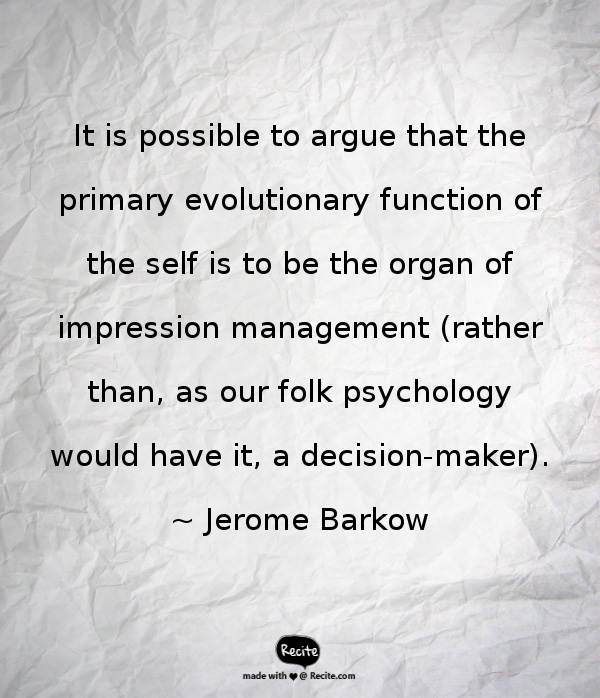
    recite-1ofj9ut

    These days when I think of the self, I am regularly reminded of this. I use ‘ego’ interchangeably with ‘self’. Ego as in egotism, not the Freud definition. The inflated view of the self that most of us refer to when we say ‘ego’. While the scientific-philosophical perspective is something I am very interested in, it is more the day-to-day reveals that are more frequent.  (more…)

  • The entitlement of the self

    IMO, Season 4 of Mad Men really took it up a notch. I think it’s because the human condition started showing up much more than before. Episode 6 – Waldorf Stories – offers quite the example. <spoilers> To quickly give context to the non viewers, a flashback shows how Don Draper, the show’s lead character and a fur coat salesman then, was hired by an inebriated Roger Sterling (partner at an ad agency) years ago. Don rises right to the top, becoming a partner at the new agency that Sterling, and others form. When the agency wins its first award, Roger feels entitled to an acknowledgement from Don. When he doesn’t get it, he asks for it. Later, in the same episode, Peggy, whom Don ‘raises’ from secretary to copywriter, also feels entitled to Don’s  acknowledgment of her contribution to the award winning ad. In the first instance, Don is gracious and acknowledges Roger’s hand in making him what he is, but in the second, he is furious at Peggy.

    It made me think of entitlement. I have read many an article about the millennial generation’s sense of entitlement, but maybe it’s not a generational thing at all. Maybe, it’s just that this generation expresses it more than others, and this is being documented much more courtesy the web. A point of difference is probably what is being asked for – opportunity (millennials) and acknowledgment. (earlier generations) (more…)

  • Id+entity

    There was this experiment suggested in ‘Tomorrow’s God‘ – to look in the mirror and stare into your eyes. If you concentrate and hold your gaze long enough you’ll begin to ‘step outside yourself’ and ironically, have a more objective view. Its a bit similar to some meditation techniques, I think, and though I read (and tried) this about 6-7 years back, I remember having thought of things (about myself) that don’t usually surface. But it does lead to a very interesting question – who are you? 🙂

    Is it the job you do or the designation you hold? Or do you define yourself by your nationality or religion? Or the perception you have created among your friends, family, extended family etc? Or a persona you have created among those who you deal with, only virtually? Or the things you consume and the thoughts that arise in your mind? The beliefs, the notions, the perceptions, the likes and dislikes that are created in you over time? The things you say and the things you do? The person you see in the mirror, the physical manifestation of you? All of these are transient, in varying degrees. Even nationality and religion because for me, they are notional. The fun part is, this ‘you’ is the way you see it, the moment you change the point of view, it all changes. So, who do you think you are?

    until next time, identify yourselves in the comments 😉

  • Mirror Images

    I came across this passage while reading Kiran Desai’s “The Inheritance of Loss”. The context is of a young girl, who, because of a new found romance suddenly becomes conscious of herself.

    “But how did she appear? She searched in the stainless-steel pots, in the polished gompa butter lamps, in the merchants’ vessels in the bazaar, in the images proffered by the spoons and knives on the dining table, in the green surface of the pond. Round and fat she was in the spoons, long and thin in the knives, pocked by insects and tiddlers in the pond; golden in one light, ashen in another; back then to the mirror; but the mirror, fickle as ever, showed one thing, then another and left her, as usual, without an answer.”

    I found that I could also identify with it in the context of our encounters with the social platforms around – Orkut, Twitter, Facebook, LinkedIn.. and how slowly the ‘Like’ and RTs seem to be defining the interactions and affecting even perceptions and understanding of the self. Its not as though people and comments never existed before, but the sheer mass of people we come into contact with, thanks to the social platforms is unprecedented. Through the conversations and responses, we see a bit of ourselves, a self colored by the other person’s perceptions. As the voices around us continue to increase, at some point, is there a danger of losing touch with what we really are? Yes, you could ignore or be selective, but then we’d just get back to an objectivity argument.

    “The biggest danger, that of losing oneself, can pass off as quietly as if it were nothing; every other loss, an arm, a leg, five dollars, a wife, etc. is bound to be noticed.”

    I read that, thanks to @aanteadda‘s share on Twitter – an excellent take on the Ramayana,(do read it) and in a completely different context – that of dharma, it happened to arrive around the same place. Rama, having lived his entire life by what he considered his dharma, is distressed by what he must do with Sita after the end of the war with Ravana, irrespective of what he personally wants. The author thinks that this is Rama’s tragedy, and that of every person who lives by ‘impartial and abstract principles’, which don’t take into account ‘individuals as persons,’ and can’t see the difference between a situation and a personal situation’, and it can only lead to the destruction of the self.

    And so I wondered, whether its people, or a moral code that one follows, whatever dictates what we do, is there really a difference – between the reflections from others and ourselves? Is there one right answer for what should define us and the way we live. I think not.

    We must prioritise, I guess, based on what we think will give us happiness, and just like this neat article on addiction (the internet in particular) ends, “we will increasingly be defined by what we say no to”, all thanks to an abundance of choices, from within and without.

    until next time, you always have a choice, but do you always want a choice?

  • Imago

    That I worship Bill Watterson and simply adore Calvin & Hobbes is not a secret. In fact, it mostly irritates people when i quote from that unique mix of humour/sarcasm/wit and profundity. But no, this is not a gushing post. A few days back, when a friend was talking about her kids, I told her to be thankful that they weren’t like Calvin. She said one of them does have imaginary friends. I am not sure about kids these days, but I simply cannot remember any imaginary friends I might have had in my childhood. To be very fair to everyone concerned, I am quite befuddled even when it comes to recognising real friends of that era and erm, a few eras later too.

    But I wonder about the character of these childhood imaginary friends, and why they exist. Is it loneliness? Considering the minimal baggage that we have at that young age, are they confidants of doubts and thoughts that we think we can’t share with others, even if they are of the same age? Calvin has his club, theories about society and education, ‘scientific experiments’ etc which he shared with Hobbes. Is it because he felt that he would be laughed at, if he shared them with others?  Hobbes usually attempts to give him a more mature perspective on all the stuff he discusses. I’d like to ask the kids with imaginary friends about the conversations. 🙂

    Maybe, as we grow up, our baggage grows and as we conform to the norms around us, we figure out that imaginary friends have to go? Or it is perhaps a need that gets filled or forgotten about amongst other priorities, as we acquire new real people – friends, relatives or any other relationships along the way, and maybe figure out that we can share different things with different people, and not have to reveal ourselves totally to everyone? And that takes away the reason for having an imaginary friend to whom we confide all?

    Real people bring their own baggage, they perhaps shield us a bit, and tell us things that we want to hear. They perhaps validate our beliefs and thoughts and inferences, either because they don’t want to be the people who deliver the bad news or they don’t care enough. Of course, I am not taking away anything from the good friends that we manage to get, if we are lucky enough – the conscience keepers. But they’re human too, and their objectivity would waver, they’d have their biases. Perhaps, we should build an imaginary friend all over again, our own objective self, one which can show our own prejudices without fear of retribution.

    until next time, object of my imaginary attention 🙂