Tag: science fiction

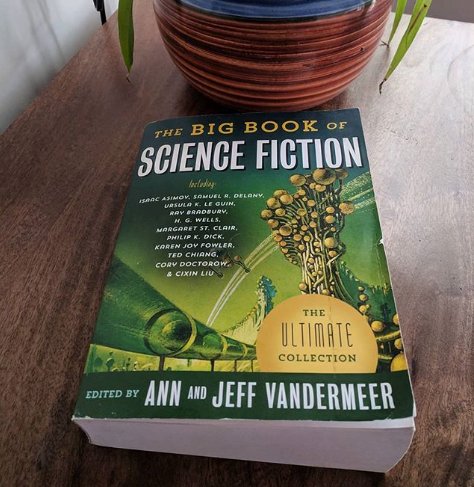
  • The Big Book of Science Fiction

    Ann and Jeff VanderMeer

    If science fiction is even remotely of interest to you, this is a veritable treasure trove! 105 stories spanning 1160 pages. Only a couple of authors get to have more than one story, and that means there is a diversity of work that’s arguably unparalleled in any collection of this nature. The stated objective of the book is indeed that – diversity. And it happens on multiple counts – non-English writings (and therefore, the variety of geographical settings – other than Antarctica, all continents are represented), gender (of authors and characters), and most importantly, the type of science fiction – dystopian, alien encounters, space operas, post-apocalypse, and even satire.
    The stories are broadly in a chronological order of when they were written. The introduction to each author before the beginning of a story is very helpful in terms of context setting.
    While I do love science fiction, I really haven’t read enough to comment on the choices of representation made by the authors. I can count on one hand the number of stories I have previously read. But at least a couple of them are my all-time favourites in fiction – Asimov’s “The Last Question” and Ted Chiang’s “Story of your life”. I also found a story – Sandkings -by an author familiar to many of us from an alternate “universe” – George R.R. Martin. An absolute thriller that I thoroughly enjoyed.
    My other favourites are these : The Triumph of Mechanics by Karl Hans Strobl, a macabre, dystopian tale with a sense of humour! Desertion by Clifford D. Simak, a story based on pantropy – modifying humans for space exploration, as opposed to changing the alien environment. Another favourite that uses this theme is Surface Tension by James Blish. Philip K. Dick’s Beyond Lies the Wub seems quite prescient about “we are what we eat”! Katherine Maclean’s The Snowball Effect is about an experiment by academia in a sociological setting that leads to a more-than-anticipated impact. William Tenn’s Liberation of Earth is a brilliant commentary on US intervention in Korea/Vietnam, even while doing a great job of reducing the collective ego of the apex species of earth! His other work The Ghost Standard, later in the book, is an absolutely delightful satire.
    Grandpa, by James H. Schmitz has alien ecology as a theme and builds the tension excruciatingly well! Stranger Station by Damon Knight is an intense first-alien-contact story that dwells on the complexities very well. Vadim Shefner’s A Modest Genius is a lovely tale of romance and invention while Sever Gansovsky’s Day of Wrath is a thriller based on biotech experimentation gone wrong. The Hands by John Baxter is a creepy tale that reminded me of Aliens.
    F.L. Wallace’s Student Body would make it to my top 5 in the book, exploring both alien contact and environmental impact really well. The feminist utopian world created by Joanna Russ in When it Changed is subtle yet impactful. Yasutaka Tsustsui’s Standing Woman is as poignant as it is surreal. Sporting with the Chid by Barrington J. Bayley is dark and builds up to a terrifying climax.
    Josephine Saxton’s The Snake Who Read Chomsky is another incisive tale on biotech experimentation with some excellent twists and turns. Reiko’s Universe Box by Kajio Shinji is somehow sad and upbeat at the same time. Greg Bear’s Blood Music combines microscopic phenomena and macroscopic impact really well. Robert Reed’s The Remoras uses a space opera setting for an excellent human drama. The last story in the book – Baby Doll by Johanna Sinisalo – is a disturbing take on sexualisation of children that falls well within the realms of possibility, sadly.
    Isaac Asimov, Ursula K. Le Guin, Ray Bradbury, H.G. Wells – the book has work by all the greats of the genre, and you are also likely to discover authors whose stories you will enjoy!
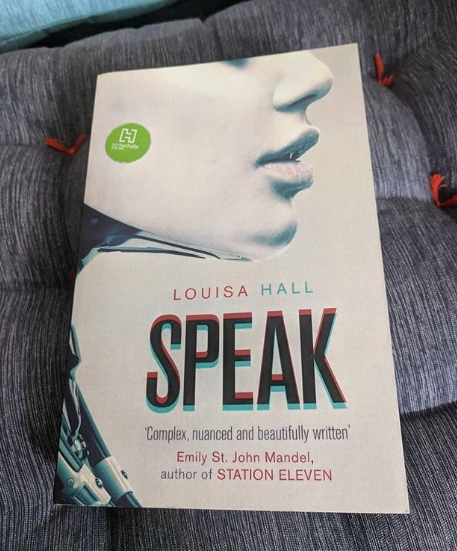
  • Speak

    Louisa Hall

    If you’re familiar with Asimov’s works, you’d know one R.Daneel Olivaw. The robot who lived closed to 20000 years and shaped the fate of humanity. If you follow the Robot and Foundation series, it’s almost like Daneel’s biography. “Speak” reminded me of that because it is almost like a biography of AI. Or rather, an AI that was the most commonly used one until its doll manifestations – babybots – are shipped away to a desert for being too human-like. That’s where the book begins, and through five different narratives, we see its progression.

    The book is as much about the narrators as it is about the evolution of the AI itself. Their voices live on through the AI, and a motley bunch they are. Mary Bradford makes her way across the ocean to Massachusetts some time in the 17th century, on a voyage (and a marriage) she doesn’t really fancy. She fills her diary with her thoughts on the soul, memories of her dog and her own confusions regarding her husband. In the 60s, the diary is read by Ruth Dettman, who convinces her husband Karl to name the (chat) bot he created MARY. They disagree on what memory could bestow on an AI (“MARY will remember your words, but it won’t ever feel them. It won’t understand them”, says Karl.) A little before that, Alan Turing writes poignant letters to his best friend’s mother. In 2035, Gaby White is a paralysed child, who cannot handle the trauma of her babybot being recalled. In 2040, Stephen Chinn, the inventor of the babybot, is a tech whizkid whose rather unfulfilling personal life is in sharp contrast to the various companionship tools and books he has given society, the climax of which is his imprisonment for a creation that was too human. MARY has been shaped by them, and their lives have been shaped by MARY.

    The strands of cause and effects are too complicated to be completely unraveled, but there is a cohesive narration that is evident. I liked the book not so much for this structure, but the sensitive portrayal of nuanced and layered emotions. There is a neat irony here – what it means to be human conveyed through AI and flawed humans who worked on it.

    Each “voice’ hits its own distinct note of poignancy, and the author’s prose handles them wonderfully well. There is a lyrical quality that adds much to the narrations. One of those books where the words reach out from the page, and make you pause and sigh before you read on. I think it worked for me because at its core, the book is about a fundamental human need – the desire for companionship, and the need to be understood.

  • Axiomatic

    Greg Egan

    I have always been amazed at Neal Stephenson for being able to write Snowcrash and The Diamond Age in 1992 and 1995 respectively. I am now equally amazed that Greg Egan wrote this in 1995. In fact, even more, because while the first two books were novels and dealt with a smaller number of concepts, this book is a collection of short stories, and except for a (connected/repeat) couple, are unique concepts. Imagine, 18 stories with ideas that would still be regarded as science fiction!

    In addition to this, there are at least two factors that made me a fan. The first is that while the ideas themselves are wonderfully imaginative, the focus really is on the effect on humans and humanity. Nuanced explorations of how the human psyche functions and reacts when faced with profound moral choices. The technology, though advanced, is taken as a backdrop against which societal, psychological and philosophical questions are raised and consequences revealed. ‘The Hundred Light Year Diary’, for instance, where everyone knows their fate, or ‘Eugene’, in which a couple try to design a perfect child. Both stories featuring the ‘Jewel’ are a wonderful study on the idea of consciousness. ‘The Walk’ is a fantastic thought on ‘identity’. ‘The Moat’ I found particularly relevant in this era when we are facing a widening economic divide. (more…)

  • The Immortal’s reality

    ‘1984’ is a subject that has appeared in many conversations, no, not Indira Gandhi’s assassination, George Orwell’s book. And every time it did, I have smiled politely and pleaded ignorance except for ‘Big Brother’, nothing to do with Shilpa Shetty’s adventures or Sunny Deol’s movie, in spite of my Bollywood fixation. I read the book a while back, and was absolutely fascinated by the dystopian world Orwell has created.

    Though I found many facets of the book interesting, there were two that were more equal than the others. 🙂 One was the idea of a few people controlling the minds and actions through unrelenting propaganda (among other things) and the sentence ‘He who controls the past controls the future, he controls the present controls the past’. History being written by winners, and it being what’s recorded (either in books or other data storage devices), or people’s minds. The second interesting thing is to do with the latter, of how reality is such a deceptive thing, and is of our own making. If there are two of us, and both of us agree that one is flying, then that is reality for us. Yes, you might laugh at the simplistic approach, but in the context of the book, absolutely possible.

    The human mind, its storage capabilities, and its evolution is a subject that keeps popping up regularly in this blog. Recently, the concept of singularity has interested me a lot, and I’ve been reading up material available on the net. While I’ve been interested in science fiction for quite a long time (from watching Star Trek and Sigma on DD, okay well, that’s a start to Doctor Who and the Foundation series in school and college, with minor setbacks like not being able to like Clarke, and recently, not able to enjoy Doctor Who on the BBC) and I saw singularity as a natural progression of that basic interest. Except, as I read more, I realise the lines between fiction and reality are beginning to get blurred.

    I had an interesting conversation recently with a friend S which was a sort of mash up of both these subjects. We were discussing the effects of these advances on society. I brought up the argument from 1984 that whatever happened the three tier classification of society (high, middle and low classes) would be retained in some form or the other. S was of the opinion that the have- have not divide would widen, he even brought up the concept of human farms, harvested for body parts. (a human controlled version of the Matrix). The 1984 premise of thought control would be perfect for that.

    And then, after teleportation, time travel, whether teleportation would be significant if we are able to replicate all sensations before that (as of now, we can see and hear across distances, smell, taste, touch remain) and similar interesting stuff came the subject of immortality. I said , one of the things that sadden me when I’m reading science fiction is that I’ll not be around to witness science fiction becoming reality. But I also  wondered whether, even if the body were capable of lasting for an infinite amount of time, would the mind be ready for it. All of our life, we base on finite time – things to be done, objectives to be achieved, what if we had all the time in the world, how would we adjust? S pointed out that these things happen gradually, and by the time we become immortal, we would have already grown used to really long life spans. Like many things now, we would take it for granted, and would not appreciate the significance. We were only having coffee but discussed how there might still be loss of (memory of) experiences so far, and how there would perhaps be preloaded SIM cards one could install, and how the immortal’s “will” would have instructions of the “I don’t want a Windows OS for my body, Chrome is where my heart is” variety. Ok, cheesy, but can you imagine the possibilities?

    My biggest concern was the revenue model. If i lived forever, how would I afford it? What would be the economics of such an existence? Writer this century, sportsman the next, will natural ability be of any value or significance? And the final question, will we able to control time enough to have alternate realities? S says never, but i get back to the 1984 premise of reality, of controlling sources of information to ensure that the past is consistent with the present, and I wonder what humanity will end up doing.

    until next time, morality and mortality…

  • Isaac Asimov: The Complete Stories

    Isaac Asimov

    Forget science fiction, if you are the kind who is affected by story telling and the imagination involved therein, this is a must-read. Its amazing that even after half a century has passed, and humanity has advanced quite a bit, Asimov’s work, even in terms of human relationships, raises questions we haven’t even begun exploring. He has a great sense of humour, which raises its head at the most improbable moments, thereby making it all the more fun.
    The collection has quite a few stories about Multivac, the super computer that guides humanity and its actions. ‘The Last Question’ is an amazing piece of work that deserves special mention. In addition to being a fantastic science fiction tale, it also offers a wonderful take on the origin of the universe.
    The other story that’s interesting happens to be Franchise, whose storyline is that by studying patterns of human behaviour over a long timeframe, Multivac is able to use one person as a representative sample and elect the US president basis his choice of candidates. The story is set in 2008. I guess humanity hasn’t progressed as fast as Asimov imagined. More change we need. 🙂
    Now for Volume 2.