
Tag: sales

  • Social @ Myntra – Part 2

    continued from Part 1

    Creating, correcting and maintaining brand perception and resolving customer issues were fundamentally the objectives when operating in the customer care and brand domains respectively. But this was not an end in itself. The end objective of the business is revenue, and that makes up the remaining story.

    3. Product: In this context, it includes the website itself, and the various features/enhancements/new products (eg. gift cards) that get introduced on a regular basis. Including social buttons on the home page and product pages were a given, though getting them above the fold was a mission I lost! The first major change was switching from FB Connect to the Open Graph. The potential applications, using social and interest graphs, are phenomenal, but we never progressed that far. At a basic level, I had slotted activities in this domain under acquisition and retention, and we have only implemented a small portion of the former. The easiest application of the social graph was using it for social proof. Kuliza’s Echo made that job relatively easy for us. It not only helped seamlessly amplify word-of-mouth, but also gave us a lot of data on consumption. One of the plans was to integrate this with Elevate, another Kuliza app – but inside Facebook, to try and beat FB’s throttling of organic reach. 🙂 Another application of Echo, which should soon see the light of day, is a Fab-like social feed. If a user has registered on Myntra using Facebook, he/she would see the actions (Likes, Purchases, Wishlist additions) of his/her friends on a separate feed inside Myntra. Our expectation is that this would prompt more social actions inside Myntra and accelerate word-of-mouth inside FB further. This was actually a Phase 1 of a larger plan I had in mind. Let me explain.

    While brand and customer connect can provide a strategic advantage on social, I’ve always felt that it was in the product domain that social could provide a sustainable strategic advantage. This came from my notion that ‘loyalty’ existed when the exit barrier for a customer to leave Myntra was high enough to beat any sustainable offering from a competitor. ‘Brand’ is one standard way to achieve it, but it is relatively less tangible, and in a commoditised marketplace, it would take more time. Generic discounting is not sustainable. I think, in this context, ‘Product’ can reach this ‘barrier’ in lesser time, and at lower costs. An ideal in my mind was using the social, intent and interest graphs of users from across various platforms to build a personalised experience, and through that, a gamified customer acquisition and retention architecture inside Myntra, (thereby minimising dependencies on other platforms) and then using social media to amplify relevant actions to further drive acquisition. But this approach has a high dependency on changes in the existing product and every new product/feature having relevant social features baked in (or at have it in the vicinity on its roadmap) to contribute to the larger agenda of the architecture. It also takes a mindset and backing. I did have a rough blueprint, but at this point in the e-commerce wars, this approach probably seemed a nice-to-have. 🙂

    4. Sales: Conventional notions claim that social media should not be used for sales pitches, but from my humble experience, I’d beg to differ. It’s just a matter of what-when-how, and how much. From generic product pitches on the Facebook Page as part of the larger content strategy, to custom links on Twitter, we have consistently shown and tracked revenue from social channels. Even Pinterest and Google+ are contributors! I must admit that in the larger scheme of Myntra’s monthly revenue, these are insignificant, but let’s just say that the total contribution are in double digit lakhs every month. In fact, it reached a point where we were given a budget to see if we could scale it. In this context, I have to mention this brilliant idea by S – she used customer generated product images from our Pinterest ‘Shopped from Us’ board every week to make sales pitches on Facebook! Works like a charm. 🙂

    The area where there were a few attempts, but didn’t really pick up was enterprise collaboration. We managed to build a fairly large community on Yammer, but what I’ve realised is that it needs champions at the highest level in all parts of the organisation using it on a consistent basis for it to be sustainable. I also had this grandiose vision of using Google+ and circles to connect customers, Customer Connect teams, Partner brands and employees in general, but this one was limited to a word document! This is an area that I believe to be a must-have as we evolve towards social business, but in the larger list of priorities, is still a few steps away.

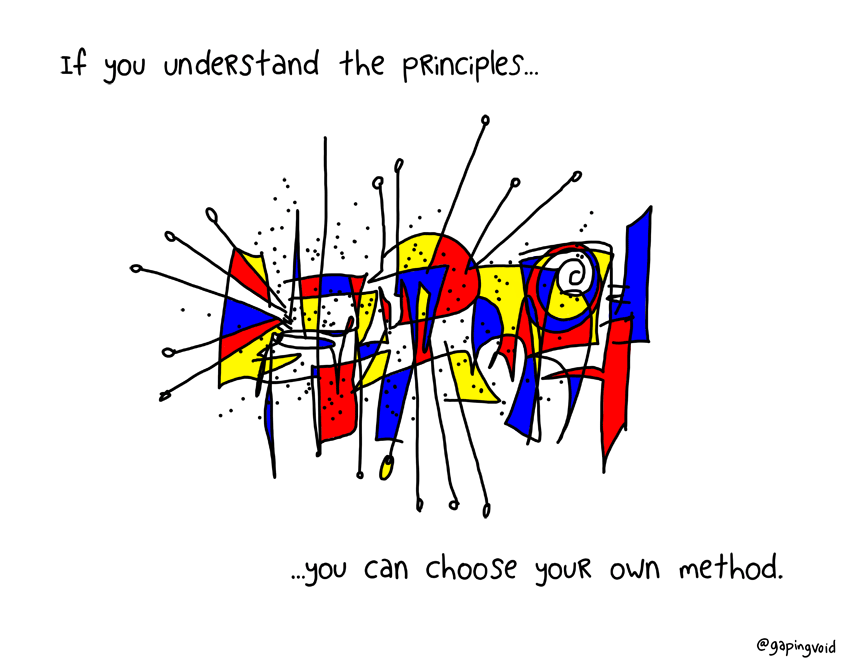
    That gives a broad view of what I’ve been up to for two years. The generic point I’m trying to make through the two posts is that from basic business outcomes like customer satisfaction and sales to more nuanced ones like brand perception and sustainable strategic advantage, social can and should play an integral part. There will be differences in terms of scale, strategy, resources etc depending on the domain, maturity of the industry/organisation, target audience and so on, but the important part is to begin because the brand/organisation needs to evolve as well. Social media has shortcuts, I’m inclined to think that social does not. These are days of nascence, and social will continue to evolve – enterprise social networks, social business, big data, the Internet of Things (add buzzwords to taste) and more will all have their hype cycles and age of maturity. By all means, measure ROI, but remember, we spend on movie tickets, we invest in mutual funds. I think we’re clear on the expected time frame of returns in both cases.
    understand_the_principles

    (via)

    Myntra will remain dear to me, like all the other brands I have worked on, but it will probably have a more lasting signature, because not since my days at GIM have I experienced such a rewiring of my worldview. This stint has given me oodles of confidence, friends whom I hope will last a lifetime, and relationships of trust that I will cherish.

    Before I end, the last hat tip – to the super S, who joined the team mid last year and has since then, proven time and again that she’s the best social ‘investment’ we made, and made this little social adventure a total joy! “I used to believe that we are here to teach what we know. Now I know that we are here to teach what we are meant to discover

    until next time, </ head – social media> 🙂

  • Hairsay

    So, the Old Spice man  increased the sales of the product. Now we can renew the debate on the efficacy of social media on the bottom line. We obviously won’t ask for correlation data. 🙂 The other side effect is that every brand manager will now want to replicate it – especially the viral and the ROI. Quite like a poster child (in India) of an era gone by – Sunsilk’s GangofGirls, which at that point had made many a  brand manager experimenting with digital media tell their agency “I want one too”. Damn virals work at meta levels!!

    I recently read Kapil Ohri’s article on afaqs, on the site’s makeover – the shift from blogs and gangs to trends and forums and the ‘mandatory’ buttons – Facebook and Twitter. Its early days, so it’d be unfair to make a comment on the numbers, even if they were to be considered a parameter of success/ failure. But while, on buttons, I think YouTube videos would’ve been a help. More on that in a bit. A revamped GoG, and the Pantene vs Dove war for hairspace being fought offline and on blogs (Karthik, L Bhat) gives me enough food for thought.. and opinion.

    Sunsilk Gang of Girls: GoG could have (like an industry person commented on the afaqs post) integrated Facebook in a much better way. Check out what Levi’s has done at their online store. Instead of separate registrations and profile, Facebook’s plugins could make life easier for the user and automatically bring in the ‘gangs’. It could get them to pull their own photos from Facebook for the ‘Makeover Machine’, suggest it to friends, and so on. Or build a Twitter app that uses the display picture. It could have perhaps thought bigger and had their ambassador (Priyanka Chopra?) interact with the users through her own identities on these platforms. Or used a location based tool like Foursquare (or FB Pages or later Google Places) to start building a resource for salons and tips at each place (think of a Burrp! for salons), maybe in sync with a YouTube channel for tips.

    Pantene: Good Morning! They obviously missed a little thing when they didn’t pay attention to the pwnage of DNA at the hands of the Times Group during the former’s launch campaign in Mumbai back in 2005 (?), or the more recent Airtel- Reliance DTH fun. Not to mention the cliche that after a certain point, the only person who gets teased is the brand manager. Ok, I won’t overstate, but c’mon this is a real-time era AND they did walk into a Dovetailed ambush. Since the internet already has made them un-mysterious (thanks for that info, Karthik), maybe Pantene should have just added those FB page and Twitter links to their mass media communication, and solved the mystery immediately online. Mind you, thanks to our dismal internet penetration, they could still demystify it again on mass media, later, after perhaps, adding the content from their online and offline activities. (think non market research agency 80%) That way, there would’ve been at least some buffer against a Dove’s sneak attack. Arguable, but possible.

    Dove: All of us should take the time and remember the controversy over the ‘campaign for real beauty’. But hey, they saw an opportunity and used it. Effects on long term goals are again arguable.

    A little note on ‘low involvement’. I wrote about brands, content and new media platforms in the last post, in the context of the Old Spice campaign, and also mentioned the importance of ‘intent’ and setting objectives. Once the ‘why’ is done, the relevant crowd can be identified, along with the platforms and activation strategies – ‘(to) who’, where and what. (Read Rohit Awasthi’s comment on Karthik’s first post) When the ‘right’ content is pitched to the ‘right’ people at the ‘right’ time (and the ‘right’ platform too), very few categories are low involvement.  (read Naina’s comment on that post) And that’s the beauty of the web in general, and the tools that social media have provided marketers. Old Spice could be seen as low involvement too, until they did this campaign.

    But having mostly seen communication as advertising (except arguably PR), creating content for social platforms is in itself quite a challenge for brand managers. Even if they were to  view ‘social’ as ‘media’, it requires a complete realignment of how media and content strategy is done, mostly because the mechanics of distribution are completely different. At a fundamental level, brands are dependent on users of platforms to create a buzz, and money doesn’t always work. At this point, tools can help with the ‘time’ (including location and other contexts) and ‘people’ (interest), and the way it works, if the ‘content’ is done right, people will get other people.

    Therefore brand managers need to make a more diligent effort. The fragmentation of traditional media does not seem to have made much of an impact on the costs involved in using them as distribution channels. So when ‘social media’  presents ‘free’ channels, brand managers see a value proposition and jump right in with a TVC and or/other weapons of mass mediocrity. Brands, I believe, need to invest a bit more on who they’re trying to reach, and then invest some more on building content and designing networks and constructs (irrespective of platform) that will drive the crowd to interact with the content and share it more. Content and people that will drive more connections, and help meet everyone’s objectives.

    But yes, until Augmented Reality allows me to scan a shampoo and tell me how many of my friends liked it, and think I should use it, (though my hair won’t last that long 😐 ) lets keep playing all the shampoo games we can play. 🙂 And while on using social platforms purely with a sales objective, I’m reminded of how Grandma uses her laptop. (vid below) Can it be used for those purposes? Of course! But is that its best case use? We can argue 😉

    httpv://www.youtube.com/watch?v=Vg6emajJmEo

    until next time, sometimes brand strategies can be real poo!!

  • For a few dollars more…

    This won’t be the first time I’ve written about Twitter’s revenue model, and I suspect it won’t be the last. In fact, the last time I wrote about it, it was in the context of the deal that almost happened between Facebook and Twitter. Its been a couple of months, so I thought its a good time to check what both have been upto on the subject of revenues.

    There was a scare recently on how Facebook is going to make money by selling users’ data, but that turned out just to be misinterpreted statements, based on a demo that they did at Davos to show real time crowd insights, and had nothing to do with the Engagement Advertising model. Facebook has been growing very fast, (stats) and though this is claimed to be a demo, real time insights (permission based) from the exact target audience could indeed add a lot of value to brands, and any other entity that could be interested in data. Market research firms should actually be working with Facebook and starting to develop pools specific to their client’s audiences. With Facebook implementing the Friendfeed style ‘Like’ feature, the tools are becoming as simple as possible.

    Meanwhile, I also wonder about the data that could come from the sites that have been tied through Facebook Connect, especially since there are some big names in their respective fields. This could reveal a lot more about the individual’s interests – basis his interaction with the other sites, and that data would be easier to handle since in many cases the site’s content would dictate the context, unlike the generic data that could be picked up on Facebook itself. This would be an interesting space to watch, and that’s an understatement.

    A simple yet possibly history making story of how Twitter was made. And in another simple yet profound statement, Seth Godin described it as a protocol. And yet another good one which describes it as a social experiment. Which then raises the question of how a revenue model can be made for this protocol or experiment. As someone once said, “Twitter is what you make it to be”. There are pains too. Twitter’s humble origins and the scale envisioned may not have made a vision mandatory then, and there is also talk that Twitter could ‘go for years’ without earning, but to survive in the long term, Twitter does need a vision, one that’d then give some direction for its revenue model.

    There have been many entities trying to use the stream for transmitting ads, adCause and TwitterHawk, being the latest, but honestly, it does seem like a force fit. But I’ll admit that the location+context based approach of TwitterHawk does seem very interesting. In fact, there have been many apps built around Twitter, some of which require the user to give the Twitter password to use the service, and there have been security problems thanks to that too. Hopefully that’ll get sorted out once OAuth is implemented, perhaps we’ll see a new generation of mashups too, leading Twitter towards a revenue model. Here are some very interesting thoughts on Twitter, including searching conversations based on category, and a marketplace around conversations and real products. Its interesting to note that brands have already begun experimenting with Twitter, and with tangible expectations, as the recent Dell promo of exclusive deals shows.  More likely to follow that model with the launch of TwtQpon. In this context, check out CheapTweet too. Meanwhile, here’s a good set of thoughts for Twitter revenue.

    Twitter Contest-Denuology Entry94 Update


    With enterprise versions (Yammer)and even college versions (Wiggio), Twitter needs to hurry, if it does not want to lose out segments altogether. This story about Twitter thinking about charging brands is turning out to be true. I can imagine those social media evangelists within organisations groaning already!! But all the best, and we await the Business Product Manager. 🙂

    While Twitter scores on the real time aspect (my opinion since I use both) Facebook offers a lot more easily available data on an individual’s demographics, interests etc. The other parameter is that while Facebook is being adopted by the masses easily, Twitter does require a bit of getting used to. Facebook might have to sweat a bit to crack real time, and Twitter would have to do many things – consider scaling up groups to other regions, have better ways of segregating conversations and data mining.  But in the end, it all does seem to boil down to using real time information of potential/existing consumers, with precise demographics and interests based targeting.

    We keep saying that social media and its tools are all about the human touch, and the personalisation. And brands utilising these platforms should understand that. I wonder if the same applies to revenue models too, and whether this extreme customisation will mean that both these networks will find it difficult to conceptualise and then implement, revenue templates, that will fit all.

    until next time, money makes the social world go around 😐