Svetlana Alexievich
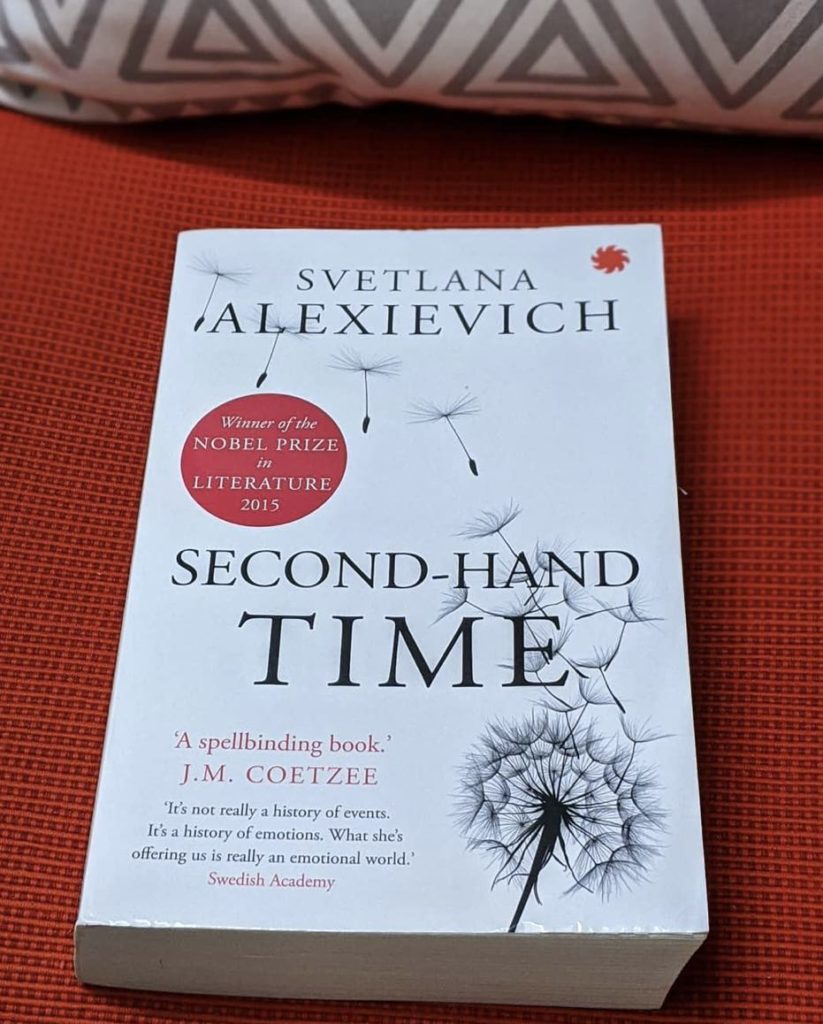
As I was reading the book, I wished it were fiction. But unfortunately, it’s contemporary history – lives lived by people, and events that impacted their life. To think that millions of lives have been spent in ways that one could not even endure for days – conditions that are not just physically gruelling, but mentally debilitating. Ordinary citizens of the former USSR and current Russia, whose belief systems, values and hopes went through upheavals as the country’s political system experienced two decades of turmoil after the fall of the USSR.
Different generations whose worldview has been shaped by leaders from Stalin to Putin. Housewives, small traders, ordinary soldiers, students and staunch party workers, no one was really spared as the political, economic and social systems went through multiple changes upending millions of lives. Savings, livelihoods, lives, all lost, thanks to the whims and fancies of the powers that be. At an individual level, relationships with parents, siblings and friends were affected as the state created paranoia. Everyone was a potential informant, after all.
The author documents the atrocities of Stalin as told by folks who lived before, during, and after the era. Many acknowledge that the system could not have been this ruthless if there weren’t people to operationalise it. Was it by choice? Between making great history, and leading a banal existence. Many also believe that the Soviet became great because of him, and what he did was justified. Khrushchev opened up the system, and people even started making jokes about Communism (“A communist is someone who’s read Marx, and anti-communist is someone who’s understood him”).
Brezhnev brought in stability, and some success in foreign policy, but corruption, inefficiency and a widening technological gap with the West was the trade-off. It was hoped that Gorbachev would bring in the “happily ever after”, but glasnost and perestroika didn’t lead to better socialism, it paved the way for capitalism. The dissatisfaction and a foiled coup led to Yeltsin, and the rise of oligarchy. And then came Putin, in whose regime, there are confrontations between different ethnic factions. And at full circle, there are now many voices who hope for a return to Stalinism.
In all of this, even as ordinary people suffered hardships, the pride for the purity of thought, and belief in the power of a united country persisted for many. Ideas and idealism stayed alive. But for most others, the only desire was to escape the system.
It is quite a brutal read, and I found it depressing, but these are stories that must be told.