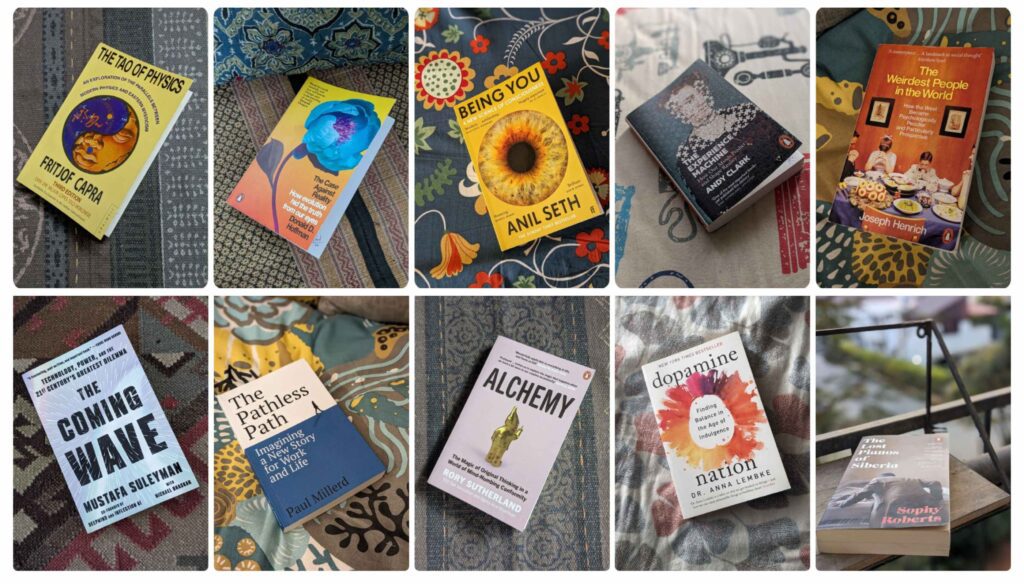
I think Alchemy is the first book I’ve read by anyone associated with marketing/advertising. For anyone involved in selling anything, I’d say this is a must-read. You should also read this if you’re intellectually curious, because in essence, this is a behavioural science book. It is even more relevant now because of the obsession with data. It isn’t that you should not look at data, but as Rory says, if you’re only using data, it’s like playing golf with only one club. “Logic should be a tool, not a rule”. This book is about the magic, which I think we’re forgetting in the fixation for data. Rory calls it psycho-logical, which is the way we make decisions in daily life.
Thanks to books like Donald D. Hoffman’s The Case Against Reality and Andy Clark’s The Experience Machine, the hypothesis is that our entire biological system (body and mind) are built to navigate the world, and we only see a version of reality. The brain predicts based on its experience and hypothesis and we fill in the details. When we do not have a complete understanding of decisions we ourselves take, it is hubris to think that we completely understand the motivations of others. Especially without considering nuances beyond data. “By using a simple economic model with a narrow view of human motivation, the neo-liberal project has become a threat to the human imagination’.
In 2024, the mind seemed to be obsessed with the mind and the reality it perceives, and that’s a good thing because I was able to take a shot at some synthesis on why I am the way I am. When you see the books, you’ll know why/how. And so, as per tradition – from 2019, 2020, 2021, 2022 and 2023 – we have this year’s list of ten (plus a few extras 🙈). From the 63 books I read in 2024…
There was an article recently at PSFK, which, in addition to the impending data explosion, also talks of the need for brands to invest in technology to mine, analyse and identify changing consumer needs and opportunities. Though probably, at a later stage, the automatic ‘sensors’ mentioned in the article would beat the self-expression media services as the largest data source, at this stage, the latter seem to be the biggest contributors.
So what is the data that’s getting generated? As social networks evolve, the role that they play in the individual’s life is also evolving. While flow of information, and communication seem to find social networks as natural conduits, the networks are also now sources of entertainment for many. (study by Edelman) What does this entail for brands, their communication and the content they generate?
Amidst the social network revolution, brands have been trying hard to eke out a place for themselves – to slide in easily into the conversations, and lives of individual users. Some have been successful, and some have not, the latter mostly when they try to use these as distribution channels for other media content alone. I read a few days back that the two official sponsors for the World Cup – Adidas and Coke, had been trumped by their competitors – Nike, and Pepsi, as far as WOM goes. Not surprising, both tell excellent stories. It makes us feel.
httpv://www.youtube.com/watch?v=idLG6jh23yE
httpv://www.youtube.com/watch?v=eQmu48sZohc
There’s this excellent presentation by Rory Sutherland about intangible, and perceived value that brands create. A bit dated, but I happened to see it recently. It made me think about Maslow’s Hierarchy of needs and the tangibility of various levels.
As civilisation advances and scarcities and abundance are rapidly traded, and as brands progress, don’t the lower levels of Maslow’s needs hierarchy become hygiene? So, would users prefer brands that help them in the esteem and self actualisation areas? It perhaps might be an example of ‘seeing the subtext you want to see’, but the Nike ad – ‘Write the Future’ seemed to be all about self actualisation and the Pepsi’s ‘Oh Africa’ seemed to be all about an ever-changing crowd that seems to be impossible to keep pace with. To quote Clay Shirky, “The category of ‘consumer’ is now a temporary behavior rather than a permanent identity.”
Which brings me back to the data explosion. The challenge, I guess, is an old one. Finding motivations, sensing patterns out of all the data to understand why we ‘Like’, why we ‘share’, and so on, and then give us a value proposition. With rapidly evolving technologies, even the value needs to adapt much faster than before, because if the brand is late, there’ll be another that delivers. But then again, at higher need levels, when the individuality/uniqueness quotient increases, will the manifestation of needs show a collective pattern? Or will the individual’s behaviour pattern become more important for brands? Multiple data sets, multiple patterns, multiple challenges. Interesting times indeed 🙂
Meanwhile, here’s one closer home. (via Gaurav) A very interesting project by Tithiya Sharma – The 100 Heroes Project. I’m sure it’ll be a wonderful story and if I were an airline brand or even a MakeMyTrip/Cleartrip or anything to do with travel, I’d take a look at the project.