Tag: robots

  • Loneliness and the AI evolution

    In a post that I found extremely poignant and true, the Guardian calls it out as The Age of Loneliness. It lists out the structural shifts causing this social collapse. “The war of every man against every man – competition and individualism, in other words – is the religion of our timeWhat counts is to win. The rest is collateral damage.” Seems we are but slaves of a ‘hedonic treadmill’, in denial.

    In earlier posts (The Art of Live In, Emotion as a Service) I’d written on how (IMO) even the micro-unit of society – the family- is ripe for disruption. At both societal and familial levels, I think the related fallout is an increasing lack of compassion and empathy, something that I notice a lot on Twitter, for example. Irony that the more connected we are, the more disconnected we are from each others’ emotions, and what impact our actions/inactions have. But guess who is coming to the rescue? Quite possibly, robots, that care! (12) (more…)

  • Artificial Humanity

    In Natural Law, I had touched upon the idea that we will have to make choices as a species in the context of the role of artificial intelligence in our lives, and how/if compassion towards each other would play a part in these decisions. As I watch thoughts and events unfolding around me, I am beginning to think that it will most likely not be one crucial decision later in time, but a lot of smaller choices, made at individual and regional levels now, that will shape our society in terms of acceptability, morality etc. And so, just as I wrote in a post around five years ago, that we might not be able to recognise the final step we make in our integration with AI, there might be an increasing inevitability about our choices as we move forward in time.

    What sparked this line of thought? On one hand, I read a New Yorker post titled “Better All the Time” which begins with how a focus on performance came to athletics and has now moved on to many other spheres of our life. On the other hand, I read this very scary post in The Telegraph “The Dark Side of Silicon Valley” and a bus that’s named Hotel 22 because it serves as an unofficial home for the homeless. It shows one of the first manifestations of an extreme scenario (the nation’s highest percentage of homeless and highest average household income are in the same area!) that could soon become common. The connection I made between these two posts is that increasingly, there will be one set of humans who have the will and the means to be economically viable and another much larger set that doesn’t have one, or both. This disparity is going to become even more stark as we move forward in time. I think, before we reach the golden age of abundance, (if we do) there will be a near and medium term of scarcity for the majority.

    (more…)

  • The Art of Live In

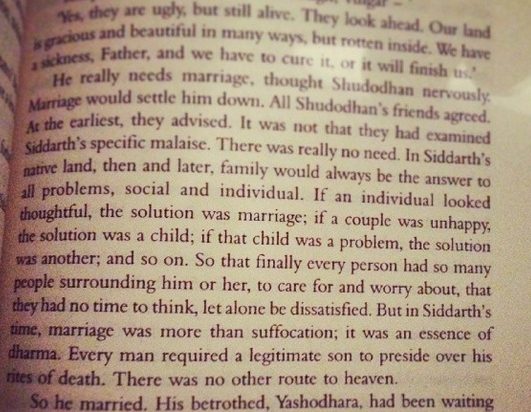
    I borrowed the title from a post I wrote nine years ago on live in relationships. We have come quite a way since then, but I am also seeing an evolution in this narrative. I call it the same narrative because fundamentally it challenges the institution of marriage as we know it. The way I see it, marriage was an evolutionary necessity – as a relatively structured process of procreation, and thereby organising society. The words below are from a work of fiction based on the life of the Buddha, it would seem that neither is it far from truth nor have things changed much.
    Sid

    So why is this institution primed for ‘disruption’ now?

    Technology is one factor. The family unit made sense when younger members of the species had to be protected. As AI advances, maybe a family unit will not be necessary for safety or security. Technology also might play a hand in the physiological aspects, more on that in a bit. As I mentioned in an earlier post (Emotion As A Service) marriage is as much a transactional relationship as an emotional one. To paraphrase Scott Adams,  (fromthe internet has allowed us to have a barter economy of relationships….a virtual spouse comprised of a dozen separate relationships

    The second factor – advances in medicine and increasing lifespans. Imagine living up to 150. The ‘life partner’ that you chose when you were a carefree 20 year old may not be the one you’d want to have fireside conversations with in your middle age – 95. Interests, outlook, worldview, personality etc change with time. Maybe you’d be living in different cities at different stages. 

    Another factor I’d consider is depleting resources – these may be natural, (on a larger scale) and economic (on an individual scale) (any thing else you can think of?) These might force the species to rethink the institution, even though it seems hardwired into the brain by now. 

    I can already see several paths diverging from this point. Robots as companions for the aged is a fast developing area, it could be used for young ones in future. In a physiological context,  though we might not be there yet, s3x with robots is a distinct possibility by 2025. There’s bound to be a learning curve, but hey! 

    i130925bb

    (via)

    In a relationship context, The Atlantic had a long article on polyamory, including perspectives on how society sees them, and the challenges involved. I was actually more surprised when Bangalore Times carried an article on the subject on its front page recently. The point here is that it is getting mainstream attention, arguably the first step in societal acceptance of units that are radically different from the traditional family. Even children with DNA from three parents might soon overcome legal hurdles and become an accepted practice.  

    With all these paths, and many more, the institution of marriage might become one of the many options available. Some communities might hold on to it – as a tradition. But as time progresses, both individuals and society will undergo not just transformations on the outside, but in mindset as well.  After all, isn’t evolution just a logical response to a creature’s living environment? If it is, once the evolutionary necessity has passed, even this tradition might just fade away.  

    (The views expressed above are just the author’s attempts at intellectuality, and do not represent his actuality. He hopes he doesn’t have to sleep outside!) 

    until next time, along came poly! 

  • Artificial Morality

    It wasn’t my intention, but the title did make me think of the morality we impose on ourselves, and that perhaps has some amount of implication on the subject of this post too. The post is about this – we seemed to have moved from debating artificial intelligence to the arguably more complex area of morality in robots!  When I first read about robots and ethical choices, (did they mean moral?) my reaction was this


    It’s probably a good time to discuss this, since a robot has recently become a Board member in a VC firm as well. Ah, well, in the Foundation series, R. Daneel Olivaw pretty much influenced the mental state of others and controlled the universe. That seems to be one direction where we are headed. The Verge article mentions funding for an in-depth survey to analyze what people think about when they make a moral choice. The researchers will then attempt to simulate that reasoning in a robot. They plan to start with studying moral development in infants.

    Thanks to this article, I learned that there were different kinds of morality – operational morality, functional morality, and full moral agency. This is all fascinating stuff and my mind was racing in multiple directions. For one, did morality develop because living in groups was more advantageous from a survival perspective and to live in groups, there had to be some rules that governed this coexistence? Did this ethics then evolve into an acceptable moral framework? These may or may not be in line with our individual instincts. Does that explain why each of us have a different moral code? If that is so, can we ever develop a uniform code for robots? To be noted that ethics are a tad more objective than morals, so they might be relatively more easier to ‘code’.

    I also began to think if the augmented human would serve as the bridge between humans and AI and as he develops, will find ways to transfer moral intelligence to AI. Or maybe it would just be logic. Alternately if, as per this awesome post on what increasing AI in our midst would mean, if we do start focusing on human endeavours beyond functional (and driven by money alone) maybe our moral quotient will also evolve and become a homogeneous concept.

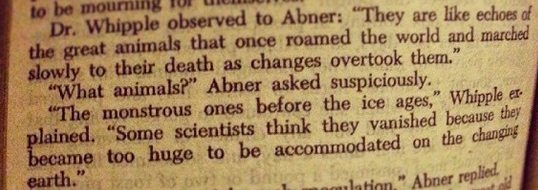
    In Michener’s Hawaii, one man of science and spirituality discusses dinosaurs with a man of spirituality. I shared this on Instagram, wondering if humanity will be talked about in this manner.

    Hawaii

    The changes could be the ones we’re causing nature to make and ‘huge’ could be our gluttonous consumption of resources. In the context of robotics and morality, I immediately thought of Asimov’s Zeroth Law “A robot may not harm humanity, or, by inaction, allow humanity to come to harm.” What would happen when one set of humans begin to do something that might harm humanity? What would a robot do?

    The answers, are evolving. It’s a good time to be human, and to be able to experience wonder.

    until next time, moral science

    P.S. On a  related note – Bicentennial Man – RIP Robin Williams :'(

  • The Change Imperative

    Ever since I first wrote about institutional realignment, I have been more conscious of it and its implications on our lives. To a certain extent, even paranoid, because of the pace of change. Ray Kurzweil is hard at work to make himself immortal, and believes we should get really close by the 2030s. He has been right before on many things of this nature. Moore’s law, digitisation and everything related are also getting us really close to the singularity. I am reasonably convinced that I will see both in my lifetime. If you live to be 200 and have robots smarter than you around, what does that do to education, money, marriage, work and pretty much everything that constitutes life? On the flip side, natural resources are running out, and I can see the complications already. It’s not a good sight, or experience!

    I am finding it impossible to wrap my head around what all of  this would mean to our concept of life. In the meanwhile, I do know that everything is changing at breakneck speed, and in order to survive, we need to be cognizant of things that can impact our lives – as individuals, and as organisations.  I have deliberately avoided the word ‘disruption’ because it gives me a sense of suddenness and it is a furiously debated topic these days. Rather, to quote John Green (said in another context) I think we’re in the first state of “Slowly, and then all at once”.  This, is my take on ‘Change’.

    (Thanks Nikhil for helping on a couple of alphabets and Amit for Unsplash, the source of many images used)