Robert M. Sapolsky
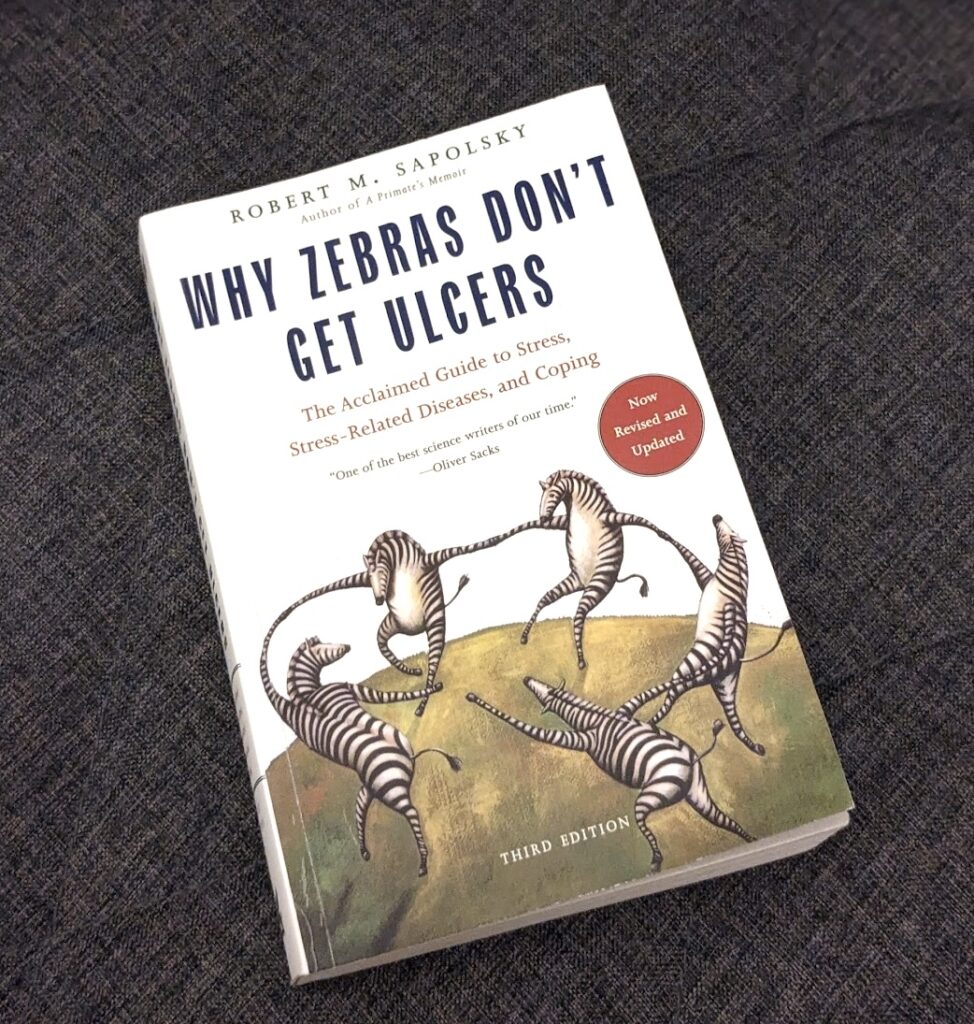
Sapolsky’s ‘Behave‘ was in my list of favourites back in 2021. So when I got to know about Why Zebras Don’t Get Ulcers, it became a must-read, and that title really helped. The book was originally written in 1994, and is now in its third edition, so things continue to be updated.
He gets the title out of the way very quickly, and this is perhaps the underlying premise of the book – zebras, and the lions who chase them both are stressed, and their bodies are brilliantly adapted to handle these emergencies – fear of life and fear of starvation respectively. Go up to the apex predator – humans, and it can even handle things like drought, famine, pests. But when we include psychological and social disruptions – from finding a parking spot to an unpleasant conversation with a manager/spouse etc – and start worrying about them, we turn on the same physiological responses.
When this is chronic (and it is – think about the things you get stressed about daily), the stress response itself becomes harmful to the body, sometimes even more than the stressor itself. Because they were not meant to do this all the while, they were only for emergencies!
The early pages of Why Zebras Don’t Get Ulcers also draw out a significant difference – between homeostasis and allostasis. ‘The brain seeks homeostasis’, but the concept itself is now modernised because there is no single optimal level (e.g. it can’t be the same when sleeping vs skiing) and because we now understand that the point cannot always be reached by a local regulatory mechanism, it requires ‘the brain coordinating body-wide changes, often including changes in behaviour’. And this tinkering has its own second-order consequences. Even more complicated because in allostatic thinking, there can be changes made in anticipation of a level going awry. When it is stressed for ’emergencies’, the body goes for homeostasis, with consequences in the long run.
The book then traces out the working of the brain – and the regulation of glands and hormones (and how it is different in males and females), before getting into specific areas that stress specialises in! This includes physiological things cardiovascular health, ulcers and IBS, (oh, if only I knew this 3 years ago, I would have been better equipped to deal with idiot doctors) pregnancy and parenting, sex and reproduction, pain, immunity and diseases, memory, sleep, cancer (the jury is still out on this) and aging and death, as well as psychological domains like addiction, depression. It also looks at how temperament and personality can either assist or resist stress.
In the personality section, Sapolsky practically described my (former) Type A personality down to a behavioural “time-pressuredness” (research by Meyer Friedman and colleagues), default hostility, and a persistent sense of insecurity, the last being a predictor of cardiovascular problems. Add to it disciplined, discomfort with ambiguity, and (formerly) repressive in terms of emotional expression, and you have my profile! Damn!
Towards the end of Why Zebras Don’t Get Ulcers, there is also a very interesting section (and studies) on how socio-economic-status (SES) can affect stress. The poor have more chronic daily stressors, and feeling poor (not the same as being poor) in our socioeconomic world (digital media expands ‘our’ from friends, family and neighbours to anyone on Insta) predicts poor health. Income inequality predicts mortality rates across all ages in the US.
The last chapter is on managing stress – exercise, meditation, increasing control and predictability, social support, finding outlets for frustration. And building coping mechanisms around fixed rules and flexible strategies – when stress management is not working, instead of trying extra hard on our preferred strategy – problem solving/emotional/social support – switch the approach.
I was expecting a fair amount of trudging and it turned out to be that way. But Why Zebras Don’t Get Ulcers is definitely fascinating to see the stress fingerprint in so many of our ailments – ranging from very visible to almost invisible. Great book, if you have the interest and patience for it. 🙂
Notes from Why Zebras Don’t Get Ulcers
1. Water shortage in California. Homeostatic solution: mandate smaller water tanks. Allostatic: smaller toilet tanks, convince people to conserve water, buy rice from SE Asia instead of doing water-intensive farming in a semi-arid state.
2. When stressed, the sympathetic nervous system is activated, the parasympathetic nervous system is turned down, the heart shifts into a higher gear, glucocorticoids enter the play enhancing the effects of epinephrine and norepinephrine. As a result blood pressure goes up, the blood sent to nonessential areas like digestive tract and kidneys go down (fascinating how we wet our pants in fear though the kidney function is kept low – basically to remove excess water quickly from the bladder). Chronic use of this mechanism promotes plaque formation in arteries by increasing the chances of blood vessels being damaged and inflamed and the likelihood of platelets, fat, cholesterol sticking to those areas.
3. Also when stressed, the contractions in the colon increase to get rid of the ‘dead weight’. See how IBS and diarrhoea works!
4. In a British Victorian family, the mother’s favourite son David dies and she takes to bed, ignoring her 6 year old son. And when the boy comes to the darkened room, she asks ‘David, is that you?’, before saying ‘Oh, it’s only you’. The younger boy stops growing, because this is the only way he seems to get some chance of affection. He is J M Barrie, the author of Peter Pan!
5. Stress-induced analgesia (not feeling pain during strenuous activities – from war to exercise) and stress- induced hyperalgesia (feeling more pain, e.g. waiting for a dentist) Both are emotional reactivity to pain and do not involve pain receptors or the spinal cord.
6. Personality style can lead to stress-related disease – either due to a mismatch between the magnitude of stressors and respective stress responses, or even reacting to a situation that is not a stressor
7. How does social capital turn into better health throughout the community? Less social isolation. More rapid diffusion of health information. Potentially social constraints on publicly unhealthy behaviour. Less psychological stress. Better organised groups demanding better public services.
8. If you want to improve health and quality of life, and decrease the stress, for the average person in a society, you do so by spending money on public goods – better public transit, safer streets, cleaner water, better public schools, universal health care. The bigger the income inequality is in a society, the greater the financial distance between the wealthy and the average. The bigger the distance between the wealthy and the average, the less benefit the wealthy will feel from expenditures on the public good. Instead they would derive much more benefit by spending the same (taxed) money on their private good – a better chauffeur, a gated community, bottled water, private schools, private health insurance. As (Robert) Evans writes, “The more unequal are incomes in a society, the more pronounced will be its disadvantages to its better-off members from public expenditure, and the more resources will those members have (available to them) to mount effective political opposition.” He notes how this “secession of the wealthy” pushes toward “private affluence and public squalor”. And more public squalor means more of the daily stressors and allostatic load that drives down health for everyone. For the wealthy, this is because of the costs of walling themselves off from the rest of society, and for the rest of the society because they have to live in it.
8. Heaven, we are told, consists of spending all of eternity in the study of the holy books. In contrast, hell consists of spending all of eternity in the study of the holy books. 😀
9. In a diagnosis that helps explain the confusing and contradictory aspects of the cosmos that have baffled philosophers, theologians, and other students of the human condition for millennia, God, creator of the universe and longtime deity to billions of followers, was found Monday to suffer from bipolar disorder. ~ The Onion