
Tag: revenue

  • Where’s the movie tonight?

    Google has been struggling to get some money out of You Tube for sometime now, and a few days back,  introduced ‘Paid Search’ in You Tube. They appear on the right hand of the page and one small image and Google Adwords style text ads, as ‘Promoted Videos’. These link to the advertiser’s channel on You Tube itself, and sometimes to their homepage. You Tube has anyway been a fertile ground for viral campaigns. This should well work for branding, leads remains to be seen, since (unlike Paid search) users are only looking to be entertained on You Tube. On an aside, they also have a deal with CBS now to play CBS programs on the site, and Google TV advertising.

    The latest monetising attempt from You Tube is click to buy. (via Marketing Pilgrim) If you happen to see a good music video on YouTube, and are wondering where you can buy the track, there are Amazon and iTunes links nearby to help you out. As of now, this works only in the US, but of course, this is only a start and Google will work on scaling this up for additional content and product partners, and international users. I wonder how this will affect the distribution model of sites that promote indie music? On another front, Facebook is plotting a move into the digital music business.

    Meanwhile, closer home, Medianama recently carried a story of Landmark making a foray into online music sales, with a ‘pay per song’ model. I agree with the article and wonder how this model can work with piracy that’s so rampant. I wonder if someone would try out the Popcuts model, about which i’d written about earlier. Otherwise, mobile seems to be the only way for digital music.

    While audio seems a tough place, there is definitey some action happening in the video space. Here’s a review of Moviemart, an online DVD rental company, and a report on the DVD rental market in India, on Trak.in. I also came across the news of Hulla’s release on BigFlix, simultaneously with its release in cinemas. I think Vivah was the pioneer in this.

    With DVD rental companies getting their distribution in place, online video sharing sites figuring out revenue models, and DTH, with its ‘movie halls’, increasing its penetration, I wonder if we’ll see the simultaneous release of mainstream Bollywood and regional movies on DVD, DTH & online (a pay per view model) and cinema screens. I’ll be particularly interested in the online piece – a social angle to it by tying Bigflix with Big Adda, and involving movie communities to do word of mouth publicity, ‘invites only’ premieres and so on? Perhaps a virtual multiplex screening on Second Life later? 🙂

    until next time, so many tubes..
  • $ocial Media

    This is why I love the conversational web. It provides an excellent means to connect ideas, and er, write a post. I saw a tweet from @jowyang which was about a company looking for community managers. No, it wasn’t the job per se that interested me, but more the fact that companies are finally getting into conversations and hiring community managers. Before you harangue me about web companies having had community managers for ages, this one is a grocery review community. Well, at least happens in the US. 😐

    And then, I also happened to read a post that spoke about a wiki for brands that is created and maintained by the users. Thats already happening a bit on the Facebook fan pages, but I’m guessing the brand would have to have its official spokesperson acting as a moderator at least in the initial stages, that’s like a community manager.

    And lastly, i read a post by Chris Brogan that talked about social media not being a replacement for marketing strategy. (I wholeheartedly agree) The takeaways he has mentioned towards the end not only provide a direction on how social media can finally pull its weight in getting revenue (possibly a beginning to answering this, a thought on everyone’s mind), but also roughly defines what a community manager’s role would be. It would not only be the basic answering of community queries and using conversations with them to evolve the product/service, it would also include identifying evangelists, nurturing them, helping a sales team to categorise potential customers. I am sure there are a lot of add ons possible to these brand communities.

    Meanwhile, it might also help social media tools like twitter to figure out revenue models. For at the very base of it all, a Twitter is perhaps like a Hotmail, the difference being in community and the speed of conversations, but in essence a tool for communication. And like email, there are usages to be figured out – for example, what role they play in the brand communities discussed above. These usages will drive revenue models. And hopefully, that’ll make one happy world… until the next revolution. 😉

    until next time, tweet dreams

  • Social Icing

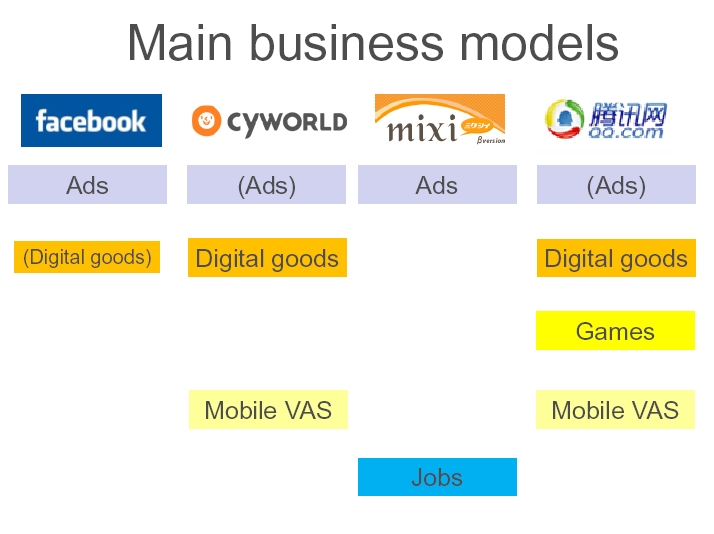
    Continuing from what i wrote earlier, the social networks we’re familiar with (assuming you don’t use our friendly neighbourhood sites – cyworld, qq, mixi) have a revenue mix of ads and virtual goods. However, as the chart below will show you, this is not the only way to monetise a social network, as the chart below will show you.

    clipboard01.jpg

    Courtesy – http://www.plus8star.com/ 

    Now, should that make our familiar networks hmm, disoriented? :D. Not exactly, because the population is there, even if its lesser than the other sites. The word of caution, is that the audience reaction to monetisation can never really be predicted.

    Social media is indeed popular, though it is felt that it lacks metrics which are so important for monetisation.That however, has not stopped brands from using the networks in a variety of ways. From making groups to building applications and so on, brands have cashed in on the network’s popularity to hook the customer on one more platform. This, for example is a post on social media marketing strategies.

    The common newspaper ad sales motto is that they lease their relationship with their customers to paying third parties. While the digital scene has diverged from traditional media in a lot of ways, I’m not quite sure why this can’t be made true for social media. I agree that a lot of applications are also a value addition to the site since they keep the visitors glued, but that can’t be the case always.

    For instance, look at this application on Facebook by Coca Cola. I doubt if Facebook is making any money from Coke. But the basic questions are ‘Whose platform is Coke using?’ and ‘Whose audience is Coke using?’. And so, why can’t this be a way for Facebook to make money? By all means, allow developers to make applications, but if brands are involved, no harm in asking them to pay. Use part of the revenues to keep users happy by providing better features. That’d be the icing.

    until next time, socialism 2.0