More than four years ago, I’d written a post juxtaposing product and consumer life cycles wondering how products could evolve, yet be relevant to users at various stages of their usage maturity. Personalisation as a theme has advanced much since then, and web based services are definitely closer to cracking this. I also got a perspective from Jeff Bezos in this post “All businesses need to be young forever. If your customer base ages with you, you’re Woolworth’s” though I’d take it with a pinch of context.
But when disruption is the norm and technologies like 3D Printing and themes like the Collaborative Economy (and others) are poised to have an impact on an increasing number of business models, how does a brand pace its innovation? Branding Strategy Insider asked a relevant question on this premise – Can brands innovate too soon? The post quotes Michael Schrage in providing a good perspective “Your own rate of change is determined less by the quality or price/performance of your offerings than the measurable readiness of your customers and clients … Their inertia matters more than your momentum.”
This post I came across cites a research by Forrester which points out that most innovations remain incremental in impact, rather than being radical innovation..Companies often ‘innovate’ things customers don’t even want. The post suggests a simple cyclical framework of Learn (strategy) – Make (technology) – Test. (design) A more nuanced view (and framework) of innovation can be found at Digital Tonto. Bezos once again has a take on it “We innovate by starting with the customer and working backwards. That becomes the touchstone for how we invent.“
Social technologies provide multiple ways for an organisation to simulate scenarios and structure their innovation pathways in ways that will optimise customer benefits and business objectives. In fact, I believe that the responsive organisation (via) will soon become a strategic imperative. As quoted in that post “If the rate of change on the outside exceeds the rate of change on the inside, the end is near.” I also think that the biggest challenge in this entire movement is a mindset-culture lag. In a sense, all the so-termed disruptions happen because incumbents were not agile enough to adapt to a rapidly changing environment. There is some wonderful learning from the founder of Sonar in this post titled “Postmortem of a Venture-backed Startup” One of may favourites is “Think of culture as a cofounder that is present when you are not.” The thing is, it can work both ways! A cultural mindset to experiment, fail, pick yourself up and work harder, and win is probably what will define the winning institutions of the future.
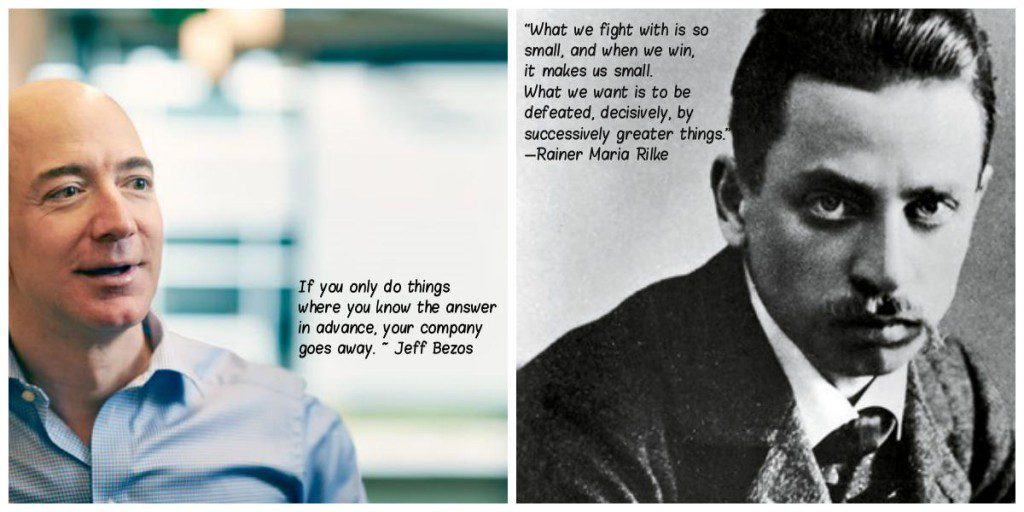
until next time, “It is not the strongest of the species that survives, nor the most intelligent, but the one most responsive to change.” ~ Charles Darwin
