Tag: responsibility

  • Know your mind?

    We had an interesting conversation the other day – four of us, with a 25% woman representation. From a bunch of directions, we finally reached #MeToo. While we all agreed on there being no excuse for a conscious man committing such acts, we did argue about a couple of points. One, our individual reactions to something that might happen in front of us, which IMO is subjective and contextual, and two, the responsibility of those who commit such acts, but were not in control of their mental faculties.

    The second is something that has intrigued me since I saw an excellent Malayalam movie called Mumbai Police. Yes, our titles are geography agnostic. 🙂 The movie was released in 2013, and since then, I have read quite a few books that approach the subject.  (more…)

  • A responsible meritocracy

    Every story needs a hero, the one who stands up against injustice and wins. In the story of inequality, meritocracy has long been a hero. To be fair, it did quite a job, dislodging inequalities that had become systemic. But then again, to twist Ra’s al Ghul’s words “..if you devote yourself to an ideal, you become something else entirely.

    One entity that has been at the centre of the debate around meritocracy is Silicon Valley given its influence on the immediate environment and clones developing across the globe. A popular line of thought among those who have made it there is that they earned it all on their own and are not obliged to give anything back to society. (read) (more…)

  • I, the responsible

    …and the poor poor girl died earlier in the day I wrote this. Given the delay between my writing posts, and them getting published here, we should have collectively moved on from the issue by now, at least in terms of mind space and media space- mainstream as well as trending topics.

    Much, much has been written about the issue – the male/female/Indian/ NRI/feminist/opportunist/armchair activist/ weekend activist/ ‘I was there to protest’ perspective, and these were only some examples – slice and dice any way you like and you’d find a voice that spoke on behalf of the piece you carved. Like this.

    Much as I abhor what happened, I see it (rape) only as one symptom of the disease we all have – our own malformed sense of justice. Probably one of the worst symptoms, but not the only one. Injustice is injustice, and it varies by degrees only on the basis of our own perspectives of right and wrong. It happens everyday – talking on the mobile phone while driving/riding, fudging tax forms, making the maid plead for a salary raise, bribing a cop, drinking and driving because you have assured yourself that you are still in control… ask your conscience, you’ll come up with many more. No, I’m not really confusing it with breaking the law – here’s an example. Five hundred times you speak on the phone while driving and nothing happens, but nothing stops the five hundred and first time being the instance that maims someone for life, and leaving him/her bereft of limbs, and perhaps dignity. Ask that person which is a larger crime – what happened to him or a gang rape – the answer should not be surprising. Every action/inaction that affects the dignity of another person, that shows another person that one can get away with breaking the law, that walks the grey area between absolute right and wrong in however minute a way, is injustice in some form.  And in this daily, casual, personal #theekhai attitude to justice lie the seeds of every horrible act of injustice. Any kid watching this today and seeing the perpetrator walk away scot free will imagine he can get away with a bigger crime. And so it grows, and morphs into multi-thousand crore scams and gang rapes further down the chain. A bit like the broken windows theory.

    Granted that an elected government has among its duties the responsibility of ensuring the protection of its citizens. Should we protest if they do not? Of course, but that does not absolve me of my obligation, nor does it free me of the nagging thought that as a race, our notion of justice is based on convenience. Sometimes I wonder if the birth of laws in society was a response to the slow death of justice within human beings.

    So yes, I am the privileged who can update my Facebook status, and move on with my life. I am responsible and there’s nothing I can do about it. Before I casually judge others, I have to wonder if I have the moral authority to do so. After all, I only vary by degrees.
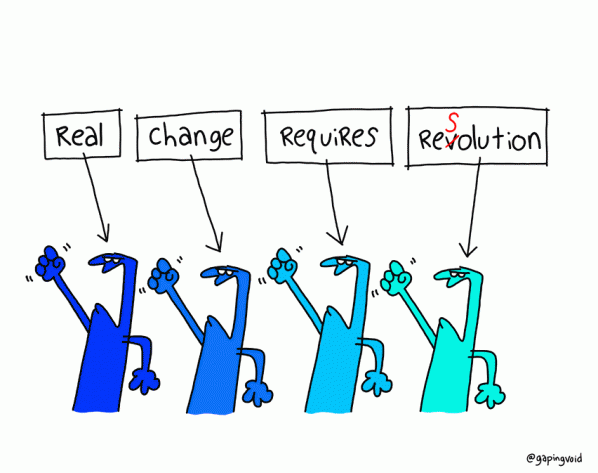
    (image via gaping void)

    until next time, </justice>

  • Brand Personalities

    The discussions on anonymity are back in full force on the web, mostly courtesy Google’s stance against pseudonymity on Google+. Google has its reasons and is supposedly working on it.Considering that I represent myself as ‘manuscrypts’ and an icon/logo on most social networks, identity on the web is an issue that I can definitely relate to.

    But when I consider this from a brands’ perspective, I sense an equally grey area. The brand is usually represented on social networks as a logo and a ‘voice’ that cannot be tied down to a person. Most studies indicate that consumers/users would rather talk to a person than a brand. But that also sets the stage for a BBC-Twitter like incident to happen, a scenario I had written about a couple of years back. I have seen only a few interesting alternatives. (eg. Chicago Tribune’s Twitter directory or adopting a persona like Hippo)  There is a different side to it too – how many brand managers would like to associate themselves with the product they manage? (for various reasons) When agencies manage social platforms on behalf of clients, what is the best way to present that? A person has many identities, some he/she wants to share, and some others he/she does not, a brand is rarely given this leeway.

    I feel that in all the time that has elapsed since my earlier post, the networks have not yet built systems that allow brands to fully explore the ‘people-conversations’ aspect that makes social work. Twitter and Facebook, the premium players, both lack a way to surface the identities of the people tied to the brand, in context. There is only so much a Twitter bio can hold, and no one looks at the Info tab on Facebook. (LinkedIn is best placed, but very few brand centric discussions happen there.) The focus, whether it’s Facebook’s Ads API or Twitter’s promoted tweets, seems to be on broadcast, albeit more targeted. Foursquare is still early in the game, but the self-serve brand pages are a decent step. I hope Google considers all this when they do allow brands to play on Google+.

    If a platform does manage to work it out, it would be helpful for all concerned. Brands could apportion responsibilities. Monitoring systems and reaction mechanisms could build in roles, ‘filters’ and ‘rights’ accordingly, and users would know exactly who to speak to for what issue? The other way, of course, is for brands to build that network themselves, feeding in data, personas and conversations from existing networks. That way, they can even assign responsibility to early adopters within the organisation to test out new platforms on their behalf, and communicate that. With the rise of SoLoMo (social, location, mobile), the need for a distributed social architecture is now of much importance.

    until next time, a brand’s personal identity