More than a year ago, in a post titled A plan to be, I wrote about how at different stages of life, one has the need to stand out, and the need to belong. Both driven by various combinations of happiness, self-image, and of course, the gene that just wants to get to the next generation. Though I didn’t really express it in the post, the “plan to be” had belonging as a large part of it. Exactly a year ago, I wrote The half of it, in which I took the thread further. I found “relevance” being rooted in “belonging”, and wondered whether we settle for that. At the cost of meaning. (more…)
Tag: relevance
-
The half of it
It’s that time of life, when there are a bunch of reunion invites – school(s), engineering, MBA. The sudden influx makes me realise that it’s halftime. We are pausing – to collect our thoughts, to take a deep breath. I wonder aloud to D if the journey is like a mountain, and halftime puts you closer to the peak. The way is downhill and you can read that in more ways than one. Maybe that prompts folks to look back at the journey and savour the moments – the significance and insignificance, the hits and misses, the gains and losses. Or maybe it’s just a moment taken to catch our balance in a world that’s changing at a dizzying pace, and to seek the anchor of certainty that the unchanging past provides.
-
The transience of consumption & marketing
Rajesh wrote a very interesting post recently on ownership, and how it would impact brand/marketing/purchase. My own view of ownership has undergone a massive change in the last couple of years, thanks to a combination of factors like increasing life spans, the changing nature of jobs, and the rise of on-demand services. Add to that extreme income disparity, economic flux, and technological advances that have the potential to create obsolescence faster than ever before, and I’m reasonably sure the concept of ownership is up for a revamp.
Rajesh brings up two factors that caused previous generations to value ownership – financial success (trophies) and asset building. If I have to analyse my own motivations in the past, both of these would find a place. If I dig deeper, I also see a couple of others. One would be lack of access on demand. (eg. music/movie CDs, books, even say, photographs) You can see how streaming and cloud storage have changed this. The other subtext I can vaguely discern is ‘control’. A car, home, all lend an air of certainty and being in control. Maybe it has something to do with growing up in middle class India which had quite a lot of experience with scarcity. But in the line of anti fragile thinking, the key skill going forward would be agility rather than trying to retain control. In essence, a whole lot of cases for ownership that no longer seem relevant. (more…)
-
The entitlement of the self
IMO, Season 4 of Mad Men really took it up a notch. I think it’s because the human condition started showing up much more than before. Episode 6 – Waldorf Stories – offers quite the example. <spoilers> To quickly give context to the non viewers, a flashback shows how Don Draper, the show’s lead character and a fur coat salesman then, was hired by an inebriated Roger Sterling (partner at an ad agency) years ago. Don rises right to the top, becoming a partner at the new agency that Sterling, and others form. When the agency wins its first award, Roger feels entitled to an acknowledgement from Don. When he doesn’t get it, he asks for it. Later, in the same episode, Peggy, whom Don ‘raises’ from secretary to copywriter, also feels entitled to Don’s acknowledgment of her contribution to the award winning ad. In the first instance, Don is gracious and acknowledges Roger’s hand in making him what he is, but in the second, he is furious at Peggy.
It made me think of entitlement. I have read many an article about the millennial generation’s sense of entitlement, but maybe it’s not a generational thing at all. Maybe, it’s just that this generation expresses it more than others, and this is being documented much more courtesy the web. A point of difference is probably what is being asked for – opportunity (millennials) and acknowledgment. (earlier generations) (more…)
-
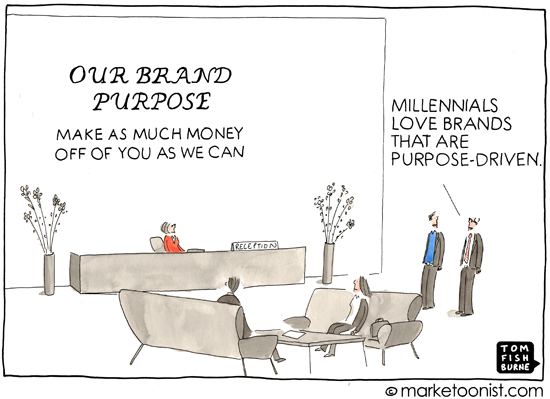
The purpose of brand
The Guardian had an interesting post recently, titled “Brand is becoming meaningless“, it (brand) is being replaced by a company purpose that the organisation can rally around. Yes, there is a study that this is linked to, and quotes. To paraphrase, brand is the effect, not the cause, and that has made it lose its fashionable shine. Someone should tell Maggi this, they just lost $200 mn in brand value, even as the corresponding goods value is ‘only’ $50 mn! (via) Now, just so we are clear, I am not completely against this thought, all the more because this is something I have been writing about for a while now.