Tag: Relationships

  • One off a kind rating

    (‘off’ is intentional. Thanks)

    A while back, in ‘The Currency of Relationships‘, I’d written this – But there is no standard currency in relationships, and my lesson from this experience is to not to take for granted that my approach is the one that works for people at the receiving end. I should spend some time first in understanding expectations, and then meeting them. Recently, a little incident on Facebook reminded me of this. But first, a step back.

    Don’t laugh, but I think of myself as a kind person. This is a recent phenomenon, and one that finds a parallel in my struggles with being judgmental, though I have had more success on that front. Together, a reasonable (and sarcastic) wit, a tendency to see things from a skewed perspective and more often than not, the propensity to see humour in the worst of (others’) circumstances, have made being kind a very difficult task.  I rib people all the while, and am probably the poster guy for “People who don’t know me think I’m quiet, people who do wish I was.” It is very rarely that my intent is to hurt, I try to be mindful of all my words and actions, and that is what has probably created my own perception of the self as a kind one.
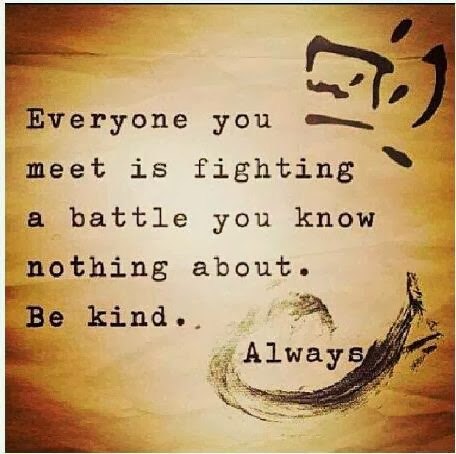
    kindnessAs with all perceptions, this one too built on itself. Maybe that is why I was quite surprised when a share on Facebook (the message being the same as what you see on the left – via)  – something I believe in and try to practice – elicited one response that I was in no place to ‘preach’ this. It made me think about my self perception, and reminded me of currencies. I also gained a few perspectives – common, yet usually forgotten. (Thanks N)

    One is that my words and actions have effects that I might be completely unaware of. This is not a new understanding. In fact, for a while – a couple of years ago probably- when I became aware that my words could hurt, I willfully restrained myself from saying a lot of things I came up with! I realised that it might get laughs and LOLs but I might hurt someone too. (even if that may not have been my intent) But then I realised I was just being miserable and at least with friends, I let go, thinking that I didn’t have to prove the lack of malice. The fact that I was ribbed back by many only reinforced this. My credo since then has been based on “how would I feel if I were at the receiving end?”  But maybe that is a flawed approach. After all, what gives me the right to say when a person should feel hurt and when not. I plan to be a little more careful, and if you’re a friend and reading this, give me a heads up when you think I’m going overboard. 🙂

    The second perspective was that it is probably my ego that wants others to perceive me as kind. If I trust the objectivity of my own moral compass, I wouldn’t need a reinforcement. I should also maybe realise that I can’t have the laughs and the label.

    The third perspective came from looking at kindness itself. You might say it’s semantics but I noticed that there is a difference between kindness and compassion. Arguably, compassion is about how you feel, and kindness is about what you do. I can instinctively see that on a relative scale, I am more compassionate than kind. No, this is not me asking for a new label. Both deal with empathy and understanding, but maybe compassion is only the first step to kindness.

    Meanwhile, my new ‘social’ plaything ‘Secret‘ is a good reminder. Its prompt when I have to comment on a post is ‘Say something kind’. Sometimes I can, and at other times, I keep quiet. 🙂

    until next time, a different kind
  • The overhaul of currency

    Back in 2012, in my first post on institutional realignment, I’d written this – “…my biggest hope is that the current currency of our lives – money – will have a better successor, one that will be better connected with our unique identities, and weave in contexts better.” In the two years since, this movement has not only begun, but is also figuring out its own dynamics. I had expected, or wanted, a disruption of money, but it will most likely be a transition. At this stage, I see at least three broad areas to frame this movement -the democratisation of finance, alternate currencies and marketplaces for value exchange.

    Democratisation of finance: This is probably where it began, because the internet has a reputation for removing intermediaries who do not add value in this case, financial institutions. From projects in Kickstarter, Indiegogo, and GoFundMe to social investments like RangDe and Milaap, there are now many ways to mobilise funds for me and you from people like me and you, according to personal passions, interests and belief systems. I’ll add more to this in the ‘marketplace’ section.

    Alternate currencies: Arguably, money as an institution has built a network involving processes, dependencies and establishments keeping in mind the dynamics of an earlier era. A civilisation connected by the www may find these tedious and irrelevant, and thus it’s only natural that it builds its own institutions. Bitcoin (a good introductory guide) is the one that made this phenomenon (relatively) mainstream, to the point that it even has ATMs. Bitcoin may or may not survive, it is probably the Napster in its domain, it has changed the game irretrievably. While on the subject, do read this fantastic tongue-in-cheek take on how it’d be if the roles were reversed – a cash based mechanism replacing digital currency. Meanwhile, there are other currencies similar to Bitcoin, and then there are completely different thoughts – for example, Pay With a Tweet. Which leads us to the various payment mechanisms that are being built.

    Marketplaces & Value Exchange: While the other two are the dynamics, this is where the mechanics play a part as well. In the ‘democratisation’ section, I had referred to several platforms that aid both discovery and action. There are many more stories in this line – from AgreeIt, an app that allows crowdfunding from friends on Facebook to crowdsourcing for emotional advice, ideas and so on to selling one’s reservation at a restaurant/spot in a line through Shout to  a ‘new media company’ Ideapod that wants to “amplify the ideas that shape our world, create genuine and enduring dialogue around ideas and spread ideas that matter through new and traditional media channels.” to ordering food from neighbours, (Eatro in London and Imli – a startup I mentor at the Microsoft Accelerator- closer to home) there are various models of value exchange that are shaping themselves. In fact, the entire ‘social commerce via collaborative consumption‘ route is based on these marketplaces. (a few good perspectives and stats on its drivers here)

    But, irrespective of the currency, every transaction requires (another) key element – trust. The social web is also building its own mechanics for this – from relatively generic clout mechanisms (Klout, Kred and the likes) to more context specific ones like LinkedIn or GitHub or even Wiki and review mechanisms. (from Amazon to TripAdvisor to Foursquare to GoodReads to Zomato) We earn trust through our knowledge and actions in these mechanisms. We earn social currency. That brings me to the final portion – how does all of this impact brands and what would be their role?

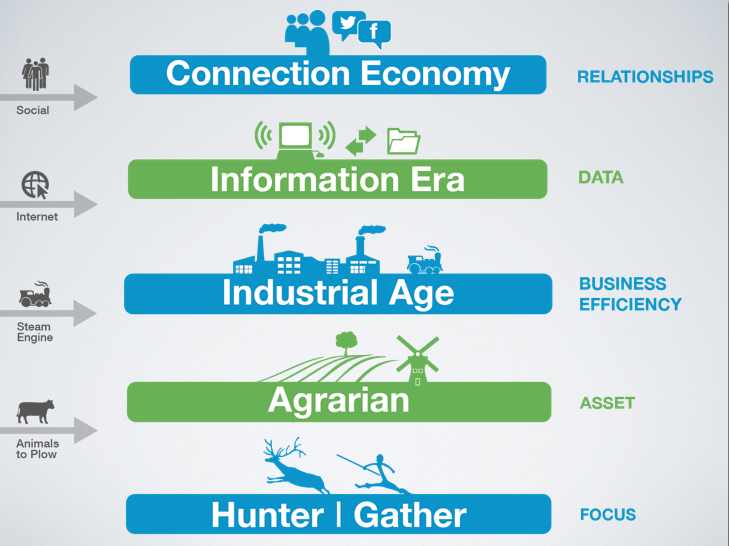
    Brands & the trust economy: Across the ages, corporations have been built on competitive advantages pertinent to the economies they operated in. I found a fantastic illustration in this context here

    Economies and competitive advantages

    I think relationships are indeed going to be the major competitive advantage in the future, and if so, the currency that would play a bigger role than money would be trust. As in many other developments prior to this, there are opportunities here for brands to weave themselves into the consumer’s narratives and go beyond transactional relationships, and to earn social currency. Many of them are already on it, finding ways to earn consumer trust and helping him/her develop and change perspectives about various currencies and relationships between them. Since we’re talking of finance, let’s use an example in that domain. Fidor bank helps its consumers discover crowd sourcing options, staying true a bank’s generic commitment of excellent wealth management. Yes, it’s still money, but it understands that it can be deployed beyond traditional options. In the process, it also helps the consumer to belong to a community.

    Brands actually have an option to join in wherever there is consumer spending. Nike+, as usual, did something back in 2012 – they allowed runners to trade in (running) mileage for Nike goods (I had shared the video in the institutional realignment post too) While this ties in beautifully with Nike’s business purpose, maybe some brands would have to lean a little more towards the consumer side and get into relatively unrelated narratives, and a relationship, before connecting it back to the business purpose. For example, airBaltic’s loyalty program Baltic Miles rewards frequent fliers who jog enough to burn off the same number of calories as miles they’ve flown. One of the aspects of agile marketing would be to enable identification of opportunities early. For example, imagine Coke getting into the act in Beijing’s first reverse vending machines that pay subway credits in exchange for returned containers.

    In what might seem like a ‘changing of goalposts’, just as brands are beginning to vaguely realise that their currencies of engagement with consumers need to change, the consumer’s relationship with the common currency of transaction – money – is also changing. The two are very related, and brands need to tackle both to have meaning and relevance in a consumer’s life, because if (as Godin says) “money is a story“, we’re probably nearing a plot twist.

    until next time, the end of money’s monopoly

    P.S. For another detailed look at the subject, you’d want to read Gauravonomics’ post on ‘The Future of Money‘.

  • Emotion as a Service

    More than a year back, I had written about institutional realignment and had briefly mentioned the institutions of marriage and parenting. ‘The currency of relationships‘ made me think of this, and family – immediate and extended – as a societal construct/contract/ institution, and probably even as a tradition. Where we are born, and whom we are born to, are apparently out of control, but we do have an illusion of control courtesy the choices we make as we go along. Thanks to these choices, our lifestyle and our perspectives may follow a trajectory that is totally different from the circumstances and people we grew up with/in. This is not just about the people from our childhood/youth, but is a continuous process through life. Each of us find our own ways to deal with the constant flow of people through our lives. These are again choices, and like most choices involves some amount of sacrifice and bring with them their own set of consequences.

    Clipboard02

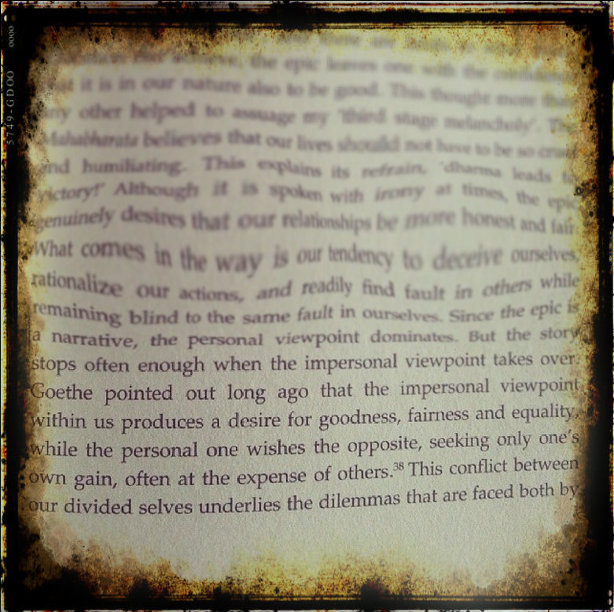
    I loved that Goethe paraphrase, because I think it sums up our relationships very well. At the risk of sounding cynical, (or receiving a ‘speak for yourself’ comment) I’d say that we’re increasingly becoming selfish as a species. I have always had the notion that most relationships are contextual, and it would be difficult to scale our emotions/feelings for others for an indefinite time frame. Yes, I do acknowledge there are exceptions, but that’s what they are – exceptions. Do a quick test and find out how many people across your life you’re still in touch with – bouts of nostalgia not included?

    It is with all this as the backdrop that I read Scott Adams’ “The Future of Marriage“. It articulates very well a thought that had crossed my mind earlier. (Of course, he obviously explores it way better than I could have) He deconstructs the institution of marriage and argues that marriage made sense “when the world was inefficient. You married a person nearby who could provide most of your important needs while hoping your lesser needs could also somehow be met.” Now, he says, the internet has allowed us to have a barter economy of relationships. In other words, a virtual spouse comprised of a dozen separate relationships. He tempers everything by saying that in the future, marriage may be one of the many options available. By sheer coincidence, and in a different context, I came across this quote attributed to Steve Macone “A tradition is a habit whose logic has faded“.

    I thought about this in the context of the expectations I had mentioned in the ‘currency of relationships’ post. If the institution of marriage can have a barter economy, why not other relationships? After all, isn’t every relationship a barter at its core? It’s just that we are rarely comfortable with voicing our expectations in the case of an emotional ‘transaction’, quantitatively or qualitatively. (generalising) Parents expect their children to look after them when they are old, in return for bringing you up; relatives expect you to return the favours they once did for you, and so on.

    So who knows, maybe our pace of life and our need to be (seen as) fair in all our relationships will conspire to form a barter ecosystem that offers emotion as a service. It is possible that an alternate path to prosperity might take us in a different direction, but in the era of the quantified self and the augmented human, when we slowly transition our selves into the cloud, maybe ‘Emotion as a Service’ (like)  is not an impossibility. What do you think?

    until next time, a qualified self

  • The currency of relationships

    Clipboard02

    Some people know me way too well! 🙂

    A few days ago, I received a message that gave a jolt to my perception of how I deal with other people and what they make of it. I had written this post sometime back on taking friends for granted, and while that was in the specific context of friendship, this is an approach I extend to all relationships, be it transactional or emotional. I like to think that I’m fair in my approach and try to give back more than I get. But apparently, at least according to one person, I am not, and am “Mr.Use and Throw”. It hurt because I have always acknowledged the help that I’d received, to that person and others. I have not had an opportunity to repay it in kind, but whenever I have felt that my presence would bring happiness, I have made it a point to be there. I did reply with my perspective on the accusation, but it led me to think of the subject and how our actions are perceived by others.

    In this case, for instance, there were possibly expectations from me that I had not known of – not of a monetary kind, I think, but some other kind of help or acknowledgement. (Generalising) We live in an increasingly transactional world, where we are able to quantify all sorts of things and are also able to throw money at issues/problems/situations to resolve them. In scenarios where that is not applicable, we use our judgment to repay a gesture of kindness/affection/love. Over a period of time, I have dealt with the latter by acknowledgment and thanks in word and deed, and by paying it forward. But there is no standard currency in relationships, and my lesson from this experience is to not to take for granted that my approach is the one that works for people at the receiving end. I should spend some time first in understanding expectations, and then meeting them. When the price and currency are not agreed upon at the outset, you will need to keep paying until both parties have agreed that there are no dues.

    20131117_163614

    until next time, emotional monthly installments

    P.S. and a happy Thanksgiving 😉

  • The Time Traveler’s Wife

    Audrey Niffenegger

    It is easy to treat this book as a simple love story, with the added twist of time travel, but it goes much beyond that, and in that lies the magic. The love story of Henry DeTamble and Clare, who meet when when she is six and he is thirty six, though he’s only elder to her by eight years. They get married when she’s twenty two and he’s thirty.

    That doesn’t even begin to describe the story of a man, whose genetic disorder causes him to time travel unpredictably. So, without warning, he finds himself disappearing from his present and appearing in some time in the past or the future, stark naked. It is only his love for Clare that keeps him going as they try to lead a normal life.

    If it had continued this way, it would just be a good story, what actually makes it a wonderful read is the wonderful way the climax has been developed. Sadness, hope and an appreciation for things that really matter. (the last matches my perspective)

    I wouldn’t consider science fiction and romance a natural pairing, and so, the author must be credited for blending it superbly. While these two are definitely the themes, the sheer lack of control in two lives which so desperately want to be together, makes one ask deeper questions on the nature of life and human existence.