Tag: real time

  • ..the question remains

    It has been more than a couple of years since I wrote on the subject of planning – the acceptance of destiny vs free will in The Uncertainty Principles and the balance between change and stasis in its follow up. In my mind, the debate continues to rage, with flash points on a regular basis, thanks to various life scenarios and the things I read. I also realised that the recent narrative posts (1,2) are also a different way of framing this debate. Like I wrote in the posts, some narratives are already chosen for us, and some we choose, but these are all our attempts to fulfill our sense of belonging. In other words, our endeavour to find the reason for our existence – our purpose. Does one find it by working towards something or by dealing with life on a real time basis?

    A few days back, I read an article in HBR titled “It takes purpose to be a billionaire“, in which the author classifies ‘purpose’ into three buckets. Not that everyone’s idea of ‘purpose’ is to become a billionaire, but this is very clearly a planned path to achieve something that contributes to the sense of purpose. While the article does not mention it, the category I have always wondered about consists of people who have followed their passion – sports people, artists etc who have worked on a skill and honed it to near perfection. A very interesting perspective I read on that premise is the Scott Adams’ “Practice and Genes“, which takes a look at the theories on the subject and finally states that the critical element is luck. The most important skill involved in success is knowing how and when to switch to a game with better odds for you.

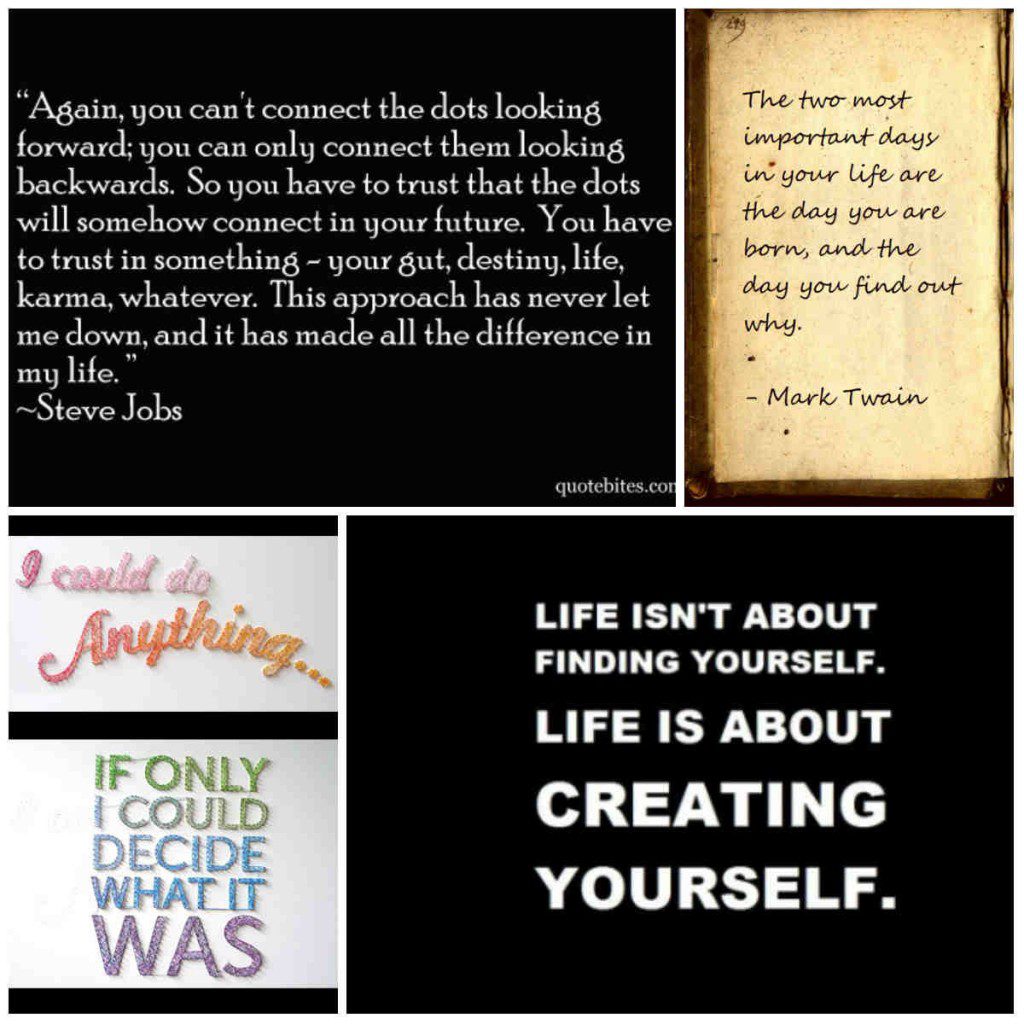
    Which brings me back to purpose and how we find it, and my introspection. “Who looks outside, dreams; who looks inside, awakes” ~ Carl Jung. (via) I thought about the ‘living in the moment’ perspective that finds a place in Buddhism texts and several other works of wisdom. At first, I thought it supported the destiny and real time approach, specially because it is difficult not to have baggage associated with the plans one makes. (literally and otherwise!) But then I realised that it was less to do with the planning aspect and more to do with how we deal with scenarios. Even if one works on a plan, how one deals with a setback to it is where the advice has value. In essence, that won’t help solve the debate.

    collage

    There are profound statements that support both ways of looking at it. I continue to rack my brains to find the path that will fit me, or make it. I think there is an element of subjectivity involved. That does not make the job easier, in fact, it probably makes it tougher. After all, “He who knows others is wise. He who knows himself is enlightened.” Lao Tzu

    until next time, the clock ticks away in real time

  • Social Obligations

    Sometime back, I had this conversation with Surekha. Let me give you the context. I subscribe to a lot of sites on Google Reader, and therefore find a lot of links that I want to share. I end up sharing them – on Reader itself, where i can also ‘Like’ it, on Twitter, rarely on FB, many times on delicious. I also use many of these links for the posts on my other blog. Surekha’s  observation was that I was stingy with praise. I, as is my wont, proceeded to defend myself. I said that since my sharing had multiple layers and filters, the very fact that I shared it on Twitter was a praise in itself. She called me elitist (which, after a recent post, is almost as insulting to me as being called a vegetarian :p) 😀 From where she’s looking, she’s right, and its a valid perspective, though I wouldn’t admit it then. 😀

    It made me think about how I share links. Now, I’m not sure if this is retrofit rationalisation or an inbuilt mechanism. In my chat with Surekha I had mentioned that my varied interests meant that what I considered a ‘Good Read’ might be a lousy read for someone not interested in the subject. I wonder now, if my binary kind of approach to things (0 or 1, extremes) coupled with my objectivity fixation makes me just share something without an opinion, so that the person who reads is without the baggage of my bias, good or bad.

    Sometime back, after watching the stream for a while, and reading opinions on a subject, I asked Mo, “post this generation,do you think anyone will know there is a ‘don’t like it,don’t use it’ option? wouldn’t they feel obliged to comment? :|”.  I felt that, what blogging started, microblogging has accelerated. From books and places and events to personal traits – not just of celebrities, but of other users’, everything finds its way into the stream, the digital version of the collective consciousness. To corrupt the current Videocon line “We is the new me”. Our ‘stream world’ and all its inhabitants seem extensions of ourselves, a huge canvas of vicarious living. Do many of us feel obliged to share our opinion in real time, some kind of pressure to constantly contribute, and so we comment on everything we can lay hands on?

    In this sharing blitz, do we spare a thought for the object of our comment? Specifically people. With real time, opinions are being formed in minutes. Yes, everyone is entitled to one, but does it also mean we become trigger-happy? When we stick labels, when we judge, do we think of the effort/thought/perspective of the person at the other end? (those on Twitter, think #mpartha, #princesssheeba…I must say, i confess to some silly work on the latter) As we have more listeners, do we feel obliged to pass judgment and evolve into what others would be impressed with/like? Is that why people change when they become popular on say, twitter? It happens in real life too – this modeling of self based on the audience, but in real life, its difficult to enter the streams of thousands of people. With each of us getting a microphone, I wonder if we have entered ourselves unwittingly into a new form of rat race, in which the casualty is compassion and consideration for others?

    until next time, this is an opinion too 🙂

  • Big brands, small ideas

    I ended last week’s post with a note that social media services provide brands a way of having their lifestream online, and weaving themselves into the consumers’ context. Last week, I read an interesting article on Six Pixels of Separation titled “Your Company is a Media Company“. It talks about how the different social media tools allow companies to publish their own content without the aid of the earlier generation’s tools and processes – newspapers, PR companies etc, and how these companies are finding new ways to tell stories. It also discusses how consumers now expect companies to be connected, listening and reacting – in a human voice. I remember touching upon this subject in a few old posts of mine – “The new media owners“, and “The Evolution of Content Marketing” a few months back.

    One of the biggest gripes that come up when big brands arrive on social media services is how they use it as just another broadcast channel for their TVCs/microsite/contest etc without adding any value to the reader/consumer. I have seen many a brand on Twitter completely disappear when their promotion ends, perhaps it came up only because ‘Twitter account, Facebook page’ were the current flavours in the marketing communication checklist. These are obviously generalisations, and the three examples that I’d discussed in the last post are obvious exceptions.

    While wondering why it has to be this way, I remembered an old post of mine, which though discussed the future role of a brand manager, had started out on a different premise. It had been triggered by a superb post by Russell Davies titled “the tyranny of the big idea“, and a couple of wonderful notes at Misentropy, which took the idea further. (All the three posts I have linked to are 1-3 years old, and I still find them great reads. What I’m trying to say is that you MUST read them)

    In the last few days, I have seen a few posts that have explored this theme, from different perspectives. Six Pixels of Separation has a post that discusses how the combination of 3 factors – a conversation based social media, real time and fragmented media would mean that marketing strategy would have to move away from the big idea and be more involved with smaller ideas basis the type of people the brand talks to, the platform of discussion, and the context. Closer to home, I read a good post  on afaqs – a question posed – whether television is hogging the resources (financial and talent) because in India it is the most preferred medium (not basis revenue) for marketers as well as the advertising fraternity. L Bhat has a very pertinent post on regional branding, and how Indian brands approach it with a one-size-fits-all approach, relying on translations which don’t do justice to the original idea, or showing contexts which have no relevance to the local audience. He notes (illustrated with examples) that brands which have developed communication specifically for the region have touched a chord with the audience. Another indicator that media fragmentation is not just about the web, let alone social media.

    With the advent of the internet, and specially social media, brands have the opportunity now to use this means of distribution to explore the long tail of audiences and marketing communication. The economies that dictate the usage of television, print etc – in terms of both production and distribution, do not really apply on the web. The NYT has an article on the rise of sentiment analysis – the social web as a ‘canary in the coalmine’, as a way to identify opinion leaders, as a forecasting tool, and so on. Its still early days yet, and we will obviously see much improvement in the current systems. In BlogAdda’s interview with Avinash Kaushik, Google’s Analytics evangelist, I had asked about the effect of the ’emotional responses’ in social media on the field of analytics. As he explains, there cannot be a single tool that can capture all data, and those who monitor this, will have to get used to the idea of multiplicity. From just deciding where communication will be distributed (and to a certain extent, consumed) to  having to track where conversations are happening in an ‘everything reviewed‘ (Transparency, Trendwatching’s September trend)  world, and then deciding the what-why – that is quite a drastic change. These are obviously not mutually exclusive, but it still is a challenge.

    The earlier models of communication (and even some elements of strategy) have perhaps been conceptualised and practised without factoring in instant two way communication, conversation among consumers, and multiple touch points. It was relatively easy for everyone concerned to have one big idea and push it into all the channels. That is perhaps what is happening as ‘social’ is seen as just another ‘media’, but it works differently. It involves a whole new set of rules, some yet to be even thought of. While there will be quite a few advantages, there will also be several challenges for the brand- to be different within the core brand idea, to add value to the different kinds of audiences in context, to decide levels of transparency and be comfortable with it, to be a ‘media company’, to be also comfortable with the rigours of listening and possibly having to react real time. There will be challenges for the brand manager, like I mentioned in the post earlier. There will be challenges for the creative agencies – when they develop ideas, they have to be medium and context specific, and also know how to respond in real time. They will also have to be churning out fresh ideas on a regular basis. There will be challenges for media agencies – to find out the maximum possible touch points relevant for the brand. And this is not just to do with the web and social media alone, but the better usage of other media too. Brands can actually be different things to different people, and be relevant. In short, a drastic overhaul of the system which currently operates, before they an get to being a media company. Being a ‘media company’ and ‘always on’ means that the ‘content’ cannot solely be made of big ideas. Possible, but impractical, I’d say, unless its an idea with several rendition and execution possibilities. From one big idea every quarter/year to a stream of small ideas. Not necessarily, perhaps, but probably so. I wonder, how many big brands and agencies will be game for playing with small ideas.. and failing sometimes?

    until next time, a tyrannosaurus hex 🙂

  • Re: Search

    There’s this lovely Greasemonkey script that does the job of getting the best of both worlds- Google and Twitter, for me, but then it would be quite interesting to have Google bring out a microblogging search engine. (conjecture, but very much in the realm of possibility) In fact, with the recent pain I’ve been having with Twitter Search, it would actually be a big help. What this would do to Twitter Search and would Google add sense (in terms of ‘authority’/ relevance etc and indexing shared links) and Ad Sense to it, and would they share revenues with Twitter are a few questions that interest me. Let’s wait for the engine before we talk about that.

    Meanwhile, the Facebook vanity url brought out an interesting service from Social Too. According to RWW, Social Too is “extending our existing Facebook profile redirect URLs, which redirect yourusername.socialtoo.com to your Facebook profile, and adding an additional layer of analytics to the whole process. So tonight, you’ll be able to get a Facebook vanity URL and get the SEO benefits, but the URL you’ll want to hand out to all your friends will be your SocialToo vanity URL because we’ll provide statistics around those clicking on the URL, the browsers they’re using, where they’re located, and where they’re clicking from.” This would be a very useful resource for brands and even people, just ask any blogger who obsesses over page views 😉

    So what is Facebook upto? I just read that Facebook has rolled out a beta version of its news search that allows people to search their News Feeds and brings up results chronologically from their streams. It means that I can now easily see what my friends think about a recent event/product/service, and that can be notes, videos, status messages, photos etc. ( I did ask for that 🙂 ) The kind of search results that used to get displayed in the earlier avatar of search (people, groups etc) are now listed on the side. (via Tech Crunch) Wonder if it searches comments on the shared content too? Also, thanks to this beastly tweet from Karthik 😉 ,  I noticed that there is a location tab in my newsfeed now. Nothing much for now, but that is a start, and they could add events, among other things. For instance, since a lot of people are auto updating their Twitter status on to FB, I noticed quite a few with the #cisia tag, which is for an event happening in Bangalore. But both the friends using the tag are from Mumbai, so they don’t show up in the Bangalore feed. But yes, it is a start.

    So it does seem that Bing’s launch and the simultaneous bundling of One Riot with IE8 (One Riot is a real time social search engine) has shaken the search box a bit, especially in the realm of real time, though it could be just a coincidence. I have wondered why Bing didn’t launch with some One Riot like mechanism, that would really have been a differentiator, at least in the short term. A reason why I should use Bing, which seems the problem that MS should be addressing.

    Before we end, while we’re on Search, a couple of services I came across that you might want to look at. Hunch, a new discovery engine, from Caterina Fake, co-founder of Flickr, helps you answer questions, basis its understanding of you from the questions it asks you and your further usage of the site. Yep, this is a decision engine which asks you a few questions first 🙂 Mashable has a full analysis on it. I’ve just started using it a couple of days back, and it takes some time to get used to, and what it can do for you is directly proportional to the time you spend on it. So the task for Hunch would be to keep nudging people to interact with it more.  While I did start with a simple question, for which the sponsored link was an obvious choice, i think the question-answer way of search gives sponsored links a lot of relevance. I like the me+crowd way of answering questions and I think it just be the kind of service that grows on you. The other service I came across is Aardvark (via WATBlog – and they’re giving away free invites) which again uses a community network (via IM) to answer your queries.

    Google has claimed that search is in its infancy and there are many avenues for new and existing avenues to explore. Now while Hunch and Aardvark seem to be great products, if Google puts its mind to it, there’s no reason why it cannot replicate either of the services, especially considering the data it has of me from its various services I am a user of. Also, Wave, when it happens, can build on the power of incremental networks easily.  If the microblogging engine does emerge it will give Google the path to real time too.  The advantage for now, is that once these services reach a certain usage level, a me-too product, even from Google will have to work hard on getting people to jump ship, simply because of the lethargy and the time, content etc already invested.

    until next time, the search continues

  • Change is here, hard cash?

    The question I posed on the Digital Marketing India group in LinkedIn, on whether advertisers would consider Facebook a better place to spend than Twitter, post the FB redesign, yielded a good discussion. Inevitably, the discussion entered the territory of whether the redesign would alter the status of the differentiated audience that each provides, and therefore the monetisation opportunities that both could develop.

    My post last week dealt more with my usage patterns on both services. I think that usage patterns would drive the kind of conversations and the context, and therefore be a major factor in deciding revenue streams. While on Facebook, we start with known friends, and then add layers to the relationship, the opposite happens on Twitter – you discover people with common interests and then the conversations evolve. It makes me wonder what really is the magic of Twitter – real time interactions, the discovery of people, or the ability to have conversations without revealing a lot of one’s profile. While most of the Facebook redesign conversation is happening around real time, and upgraded fan pages, the upgraded privacy settings which allow ‘follow’ without friending could be the feature that  gives FB the most commonality with Twitter.

    Mark Zuck had this to say about real time  – “the pace of updates accelerates. This creates a continuous stream of information that delivers a deeper understanding for everyone participating in it. As this happens, people will no longer come to Facebook to consume a particular piece or type of content, but to consume and participate in the stream itself.” Facebook might be trying to equalise Twitter’s advantages, and as per Erick Schonfeld on TechCrunch. “Facebook doesn’t want Twitter to become the way large companies and public figures connect to fans.”. (via Adage)

    But I have a few concerns on this. Will the crowd be able to handle the deluge of items on their newsfeed, even with the filters being provided? In Twitter, the stream is everyone’s base (it differs based on the people one is following, but there is a public stream too) When conversations happen simultaneously in various ‘crowds’, they are connected by devices such as hashtags and RTs. In Facebook, the individual’s profile/home page is the base, so how does the connection of conversations happen? On the fan page, but there seem to be a few issues there? Groups could help in providing this base for a lot of conversations, but there are no updates as far as groups go. Lastly, as a user of both networks, I wonder if I can have the impromptu conversations that I have on Twitter, on Facebook. The third party clients that have been developed for Twitter have made sure that users have a wide array of options for their interface. Is that a major factor in boosting these conversations. Perhaps. (via Sampad)

    During the discussion, Sanjay pointed out that Facebook provides multiple engagement spots , and with the redesign, it could integrate the large user profile it already has with the real time stream to offer more accurate brands/ads placement. I’d like to add one more data component in this mix- Facebook Connect. According  to TechCrunch, work is already happening on the “Facebook ads + Facebook Connect = Social Ad Network” concept.

    Facebook has, as part of the new design also brought in location and language based targeting capabilities for advertisers. RWW also notes that, thanks to the Facebook Connect integration with Brightkite (a mobile social networking service), there are possibilities of hyperlocal targeting in the near future. The other market that would open up in the future could be based on the language versions. (Facebook is working on five Indian languages, for example) While Facebook has been making changes, basis features from Twitter and Friendfeed, it might also be to their benefit to look at an old adversary – MySpace. Though, at 236 million users, Facebook is rapidly leaving MySpace behind, the latter seems to have pipped Facebook as far as time spent on the site goes. It needs to be seen whether the new design will change that statistic too. Mashable has a post on the challenges and opportunities that the Facebook redesign throws up for brands. A consolidation, like streamlining the search function to aid easy tracking of conversations, might have to be done soon, to enable brands to utilise the service’s redesign better.

    In the discussion at LinkedIn, I had also brought up Stuart’s very interesting post on Twitter emerging as a personal advertising medium, which led me to wonder if large brands would gravitate towards Facebook, since they give a more structured way of interaction and small brands/individuals would use Twitter for promotions/advertising. But as Sanjay pointed out, Twitter would then, still have a revenue problem. 🙂

    Twitter is growing..and fast. Going forward, Twitter would need to watch Facebook carefully and choose a course that uses a different set of parameters for clustering users, and so deliver a differentiated audience, by usage or some other criterion, to create revenue streams. This could mean buying out a few services that complement the simple proposition that Twitter offers or helps measure brands’ activity on the service. Though I had mentioned that the big brands might want to look at Facebook because of the more structured approach,there are several brands already active on twitter. Like I said earlier, different user behaviour and contexts might mean that brands have different uses for Facebook and Twitter. While on the subject, check out Mashable’s cool sociable ads concept, and the debate about paying to be in the list of  suggested accounts to follow. (a list of 100 provided by Twitter to new users to start them off on the service)  It opens up a new line of thought. What if Twitter could find a way to serve real time contextual tweets on blogs, websites etc, perhaps as a (Twitter combination version of Google Search + Sponsored ads- if a brand wishes to be seen in a particular keyword context, for starters) widget. Let me think a bit more on that.

    Meanwhile, what brands should think about, is that in all this real time information overload on various services, they should not lose focus of what they are, and what their objectives are. Like I’ve said earlier, tools cannot replace strategy.

    until next time, some real time comments? 🙂

    PS. Must Read: A great Twitter FAQ list from Jeremiah