
Tag: quora

  • While on contextual reputation…

    Though I don’t answer much on Quora, I am quite a gawker and vote up answers too. One feature of Quora that I found extremely interesting and useful (and tweeted about) is the way Quora gives contextual ‘reputation’ (while reading answers) using the person’s topic bio. The interesting coincidence (because he also RT ed this tweet) is that I noticed it thanks to Mahendra‘s answer to a ‘Google Reader’ based question, and right next to his name was “Daily, dedicated user. Subscribed to over 200 feeds, followed by over 700 people on Reader/Buzz”. I must admit, before I realised that it was a topic bio, my first thought was why Mahendra was ‘wasting’ his Quora bio on Reader when he had such a huge list of phenomenal things he could say about himself. 🙂

    But yes, coming back to ‘contextual reputation’, I liked it because it gives a lot of relevance and credibility and adds a layer to an answer – you can better understand where this  answerer and his response is coming from, for example. Another nuanced way of helping the reader weed out noise. I also thought this was a good way for brands/organisations to develop credibility in their domain, and involve their users, using function specific spokespersons, (brand, HR, operations etc) since “brands are currently not supported on Quora“.

    And now we can go off on a tangent and check out a few brand experiences I had last week, all with oblique connections to contextual reputation, though lycra like they might seem 🙂

    When Airtel changed its logo sometime back, though there were infinite debates on the need and quality of the new logo, their on ground management of the logo change was almost unequivocally appreciated. However,
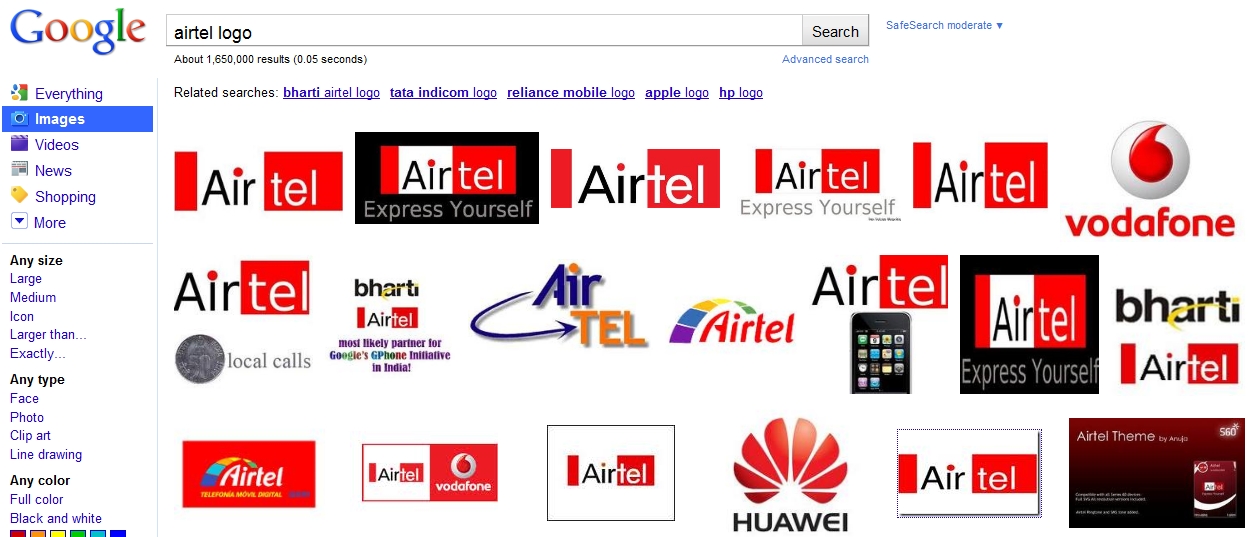
    To their credit, the ‘everything’ search, though has the old images, has the first link pointing to the new logo. But from an image perspective, ‘contextual reputation’ for logo change online gets a thumbs down.

    Cleartrip, quite a favourite brand for their ‘no nonsense. clear talk and action’ way of managing their product and online presence, has a new campaign ‘Every trip has a purpose‘. But favouritism unfortunately doesn’t stop me from wordplay and I tweeted
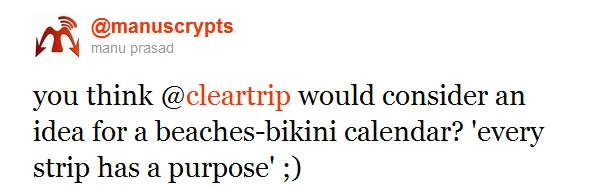
    Just as i was chided for provoking a brand, and was replying that I trusted Cleartrip to have a sense of humour, they replied with a ‘laughing hard’. Contextual reputation thumbs up. Hopefully they weren’t being sarcastic.

    The last experience was from Tanishq, whose new Blush campaign I came across last week. Like I tweeted then, immediately after the Quora tweet, I found it quite interesting and worth an applause that a brand was experimenting with a Firefox/Chrome plugin. Instead of me explaining how it works, I will, in my new found enthusiasm for imagery, give you a screenshot.
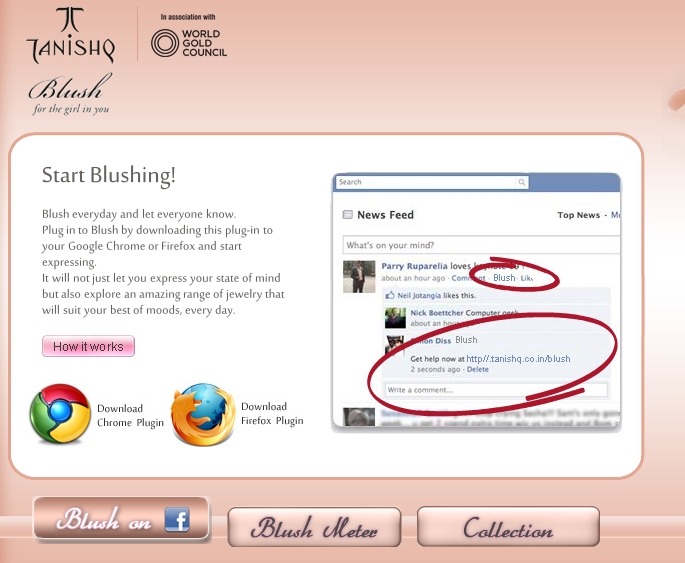
    As you can see, the plugin gives you, in addition to the ‘Like’, ‘Comment’ options you see after a Facebook status, a ‘Blush’ option, which when clicked, adds a comment with a link to the ‘Blush’ page. Hmm. I won’t get into a ‘app within FB vs outside website’ debate (there must be some reason, I assume). But unfortunately, boring that I am, I’ve never seen a jewelery that has made me blush. I can’t even see it in the Tanishq collection, assuming that I have the ‘where to wear it’ right. Maybe girls/women see it differently. So, why didn’t Tanishq just have a ‘Gold’ button, which would actually add to their ‘contextual reputation’ more than blush, and tie it to some sort of action that would actually get something tangible for all involved.

    For example, I install the plugin and start using it just because of the ‘show off’ value. What if they tied in an offer linked to the number of “Golds” I gave/received on statuses, and then communicated that in the comment that appears after I have ‘Gold’ed a comment. Or how about virtual gifts, a way to showcase the gallery, and then an easy app to add the virtual gift to a profile pic? I have an inkling that women are likely to have a “nice earrings/pendant. where did you get it from” conversation. They could even make this Like based contest i.e. if you virtually gift someone and get them to add it to their profile pic, and they get maximum likes (make a leaderboard) we’ll let you actually gift them for free. Do that on Valentine’s day, and it just might work.

    Meanwhile, I have a ‘reputation’ for longish posts, so I’ll just stop here.

    until next time, add to the context?
  • A Contention

    Ever since Facebook released the new groups, I have been wondering whether, in one sweep, they have started on a path to make the communities (vs) social networks dichotomy redundant. Yes, there is a difference. Of course, they would exist separately, but the dichotomy may cease to be a hugely relevant thing. Yes, I could list out an entire set of things that need to be fixed before they get there, but its still a very good start, when you compare it to its own groups, or groups on other networks like Orkut/LinkedIn.

    There’s a reason I thought so. One of the very interesting services that I don’t use (much) is Quora. Quora is a huge knowledge resource. It does this by allowing users to follow their areas of  interest, ask questions, which are answered by the community. Users can also follow specific questions and even follow people who they think will add value. Imagine the best in the field answering your questions, that’s usually what happens there. Its not just technology. I just saw that Ashton Kutcher had answered a question on Hollywood. And I still can’t make Quora a habit, though I’m trying to. But then I thought, what if this ‘interest’ was a (new) group on Facebook. Facebook is anyway one of my default tabs and an established destination site, and there’d be a much better chance of me participating if interesting QnA and people were a given.

    Back then to networks and communities. I was also looking at it through the prism of Gautam’s content-community social model, and wondering if this potential shift in the nature of networks and communities means that content is becoming a titular king, and distribution the real power. Content would obviously matter since conversations happen around it, and I’m not talking about the 140 character/ FB status message here. But in a social perspective, would good content be able to deliver value for its owner (in this case, I am referring to brands and media outlets) only if it exists in a network like Facebook or is able to deliver as much social functionality in its own network as say, a Facebook does, or has a huge distribution network on say, Twitter?

    Yes, yes, the strategists will say that Facebook, Twitter are just tools, and they’re right, but think about it. My hope is that in the next step of the web’s evolution, we’ll be able to see niche networks in perspective.  🙂

    until next time, contentious?

  • ‘Like’ Minded People

    I read an interesting post by Dare Obasanjo titled “There will be many social graphs“. It took me back to the context of my post on Google’s social plans, where I’d mentioned the possibility of creating networks around different contexts – with not all connections being ‘friends’- a Twitter kind of asymmetric relationship, and how Facebook and Google both have an opportunity at that level. The form and kinds of data that we share – blog posts and thoughts, status updates, photos, videos, answers, people and the contexts we share them in, are many, and sometimes I wonder if one service can actually aggregate all this, while still providing user friendly privacy options.

    When i read (and saw) that Facebook is replacing ‘boxes’ with tabs, and also saw that my ‘Like’s (Interests and Likes seem to be undifferentiated now!) were now displayed prominently on my profile, I wondered if Facebook could really aggregate everything. Imagine, if those Likes+ interests were differentiated – i.e. Interest was ‘Music’ and ‘Greenday’ was a Like. Now, the way I’d like it is, if I had Interests displayed on my Profile page (or a tab, if you prefer) – there could be options of ‘how many’, ‘most active’, ‘most recent’ etc, with the existing ‘who can see’ privacy option, but more finely grained for each interest. For each interest, I should be able to build a page – with third party content included – subscription to blogs on the subject (either through FB Notes or say, Networked Blogs), Facebook Questions  and Quora, it could be Facebook groups, Pages that I have liked (so the interest ‘Music’ could have every artist/band/music media brand/ label I’ve liked), Friends who share the interest, people I ‘follow’ in that interest category (will explain in a minute) and when FB plays location, include that too, and sync Events. Goes without saying that I should have micro-level privacy setting options for sharing with others. I should be able to ‘Like+follow’ an interest of a person even if I’m not his friend (assuming he’s kept his interest public),  and even recommend to my friends.  A sort of ‘Twitter list’ for each interest. Yes, of course I need to be able to import Twitter lists too. There would also be a universal ‘Interest’ page that collates data from all the Interest Pages created by individual users, and also gives suggestions on ‘Whom to Follow’ for that interest – an algorithm based not just on mass ‘Like’s, but also basis contexts like Location, sub-genres, and my previous activity. To scale even further, use (mass and personal) data from services where I’ve used some form of Facebook Connect. Of course, Facebook would then have ginormous data on me, but they have it anyway, so I’ll be optimistic and hope that they use it to ‘personalise the internet – like Hunch, than for anything evil. Of course I’m assuming I get data portability too. Then maybe the different Facebook Search options can also really have fun. The entities who want to ‘engage’ users would also find this useful. I realise that I might be being simplistic about this, but what about the direction?

    And though most people are skeptical about Google’s social efforts, perhaps justifiably so (read this at GigaOm and Stowe Boyd’s “Can Google go Social“), and the Wave crash doesn’t really help perception, I don’t want to rule out  the possibility  (like I said in the earlier post) of Google getting over their privacy agony, and surprising us – imagine the ‘Interests’ as a separate service/ something around or integrated with iGoogle/Profiles/Buzz (brrr)/Chrome (browser or OS)/ Search itself.

    While on interests, suggestions and discovery, Twitter’s ‘Who To Follow’ hasn’t excited me much in terms of the people it has suggested. It says that the algorithm is based on people you follow and those they follow, but for now everyone’s busy trashing it, using its own acronym – WTF. So, how about using interests (Why To Follow – work harder on the existing Interests structure?) – either ask me when when i register, you can ask me now too, the lists that include me, keywords from tweets and bio, hashtags and hopefully ‘learn’ my preferences over a period of time. Popularity by itself is really not that great a parameter – if they’re popular, chances are I already know, and there’s a reason I don’t follow, even if its ego 😉

    Its not as though these are the only guys who can build a more nuanced social platforms – perhaps its possible for someone like Quora to start with questions and build more – eg. relevant posts from say Networked Blogs, and more people from Twitter Lists? Foursquare, or any of the LBS could scale too – from places to activities and consumption that happen at those places.

    Meanwhile, interests, context, relevance, building authority and influence, all of these are established on identities,  but there’s a debate on whether an old friend merits a return – anonymity. 🙂 More on that later. 🙂

    until next time, interesting?

  • Influence Cycles

    The term ‘influencer’ is a recurring one in social media. Mahendra had a tongue-in-click post last week on the subject, and Surekha and I ended up taking it on a tangent, and it reminded me once again of the way ‘influence’ is changing, for all parties concerned – influenced, influencer, the object that links them and the medium that connects them.

    It was relatively easy when the medium was one way – mass media. The number of influencers were limited and there was really no way to locate or measure the individuals who made up the long tail of influencers. Or at least few were interested in doing it. The web disrupted it. The influenced found an abundance of content, the influencer saw his power being diminished by millions of publishers. The object (including the service provider/brand/organisation/group etc) figured out that it wasn’t at the mercy of limited influencers, but discovered a huge list which had its own quirks, but had the power to influence a multitude. Yes, known stuff, just summing up for context.

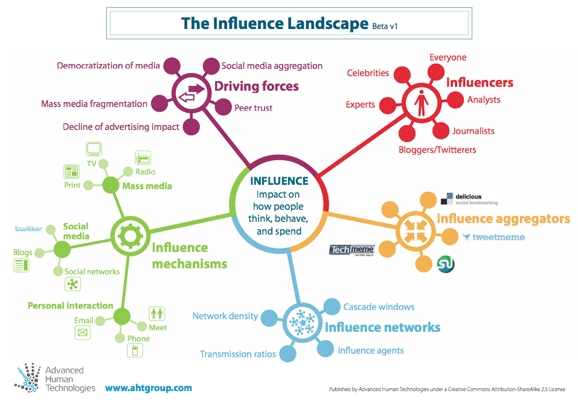
    I remember touching upon ‘social influencer relationship management’ (yes, there is actually a term for it) late last year, and the importance of trust. Influence, for me, has been a difficult thing to wrap my head around. There are so many factors erm, influencing it – time (specific and relative), context, trust (and objectivity) and the fast changing content platforms- each of which seems to add yet another layer. The complex structure has been well illustrated well in the chart below

    Influencer

    via ( a post similar to Mahendra’s, but more serious in tone 🙂 )

    At least in the medium term, I think its only going to get more complex, primarily because the platforms are only evolving – Quora, the service I mentioned in the comment to Mahendra’s post, for example, can help in establishing context specific expertise and therefore trust. Facebook, when its QnA service starts, will try to establish it within a known network. Twitter has already tried it too, but I agree with Surekha. I’ve noticed that with web platforms, after a certain scale is reached, the culture starts resembling that of mass (media) and the ‘influencers’ as well as ‘influenced’ begin a relationship that’s familiar from a mass media era. What also complicates is that the ‘object’ of the relationship sometimes discovers that it too has a voice or can hire a ‘voice’ and attempt influence. This is one of the ways it is trying to adapt to new platforms. But while there might be flaws in each approach, I do feel the direction is right.

    At this point in time, as a user, I’m still evolving in terms of the platforms I use to establish networks of trust. The tools available still don’t allow me the freedom to aggregate and disaggregate at will in different contexts. That’s probably something brands can identify with too, thanks to the plethora of platforms and influencers across networks. Its perhaps the difficult transition state when brands have to manage traditional communication outlets, new media barons, their own content management systems that need to evolve, and a long tail full of influencers. More importantly, brand processes (like advertising, PR etc) had evolved in a mass media milieu and a struggle to adapt to the disruptions brought around by a two way communication mechanism is what we see around now. We’ll keep that for another post, and quickly jump to an aspect that intrigues me from the four influence factors I mentioned earlier- that of time.

    Long back, I wondered how we could juxtapose product and consumer life cycles. Let me address it in this context. Different consumers will ‘reach’ the product/service at different points in its lifecycle. There is a ‘time divide’ that separates the different sets of users. The motivations of this set would differ and therefore , its influencers will also be different, as will their motivations. Brands (using it as a blanket term, includes services too) these days are constantly in the hunt for early influencers, which is why I found this article, which discusses why gadget manufacturers should target late adopters, very interesting. This could apply to platforms as well. I wonder how this thought can affect when and how brands try to influence on new media platforms. Does it make sense to wait till platforms evolve to an extent where they can work better for the brands or is technology moving way too fast and lifecycles of all concerned behaviours becoming too small to wait?

    Meanwhile, what if the millions who have never used Facebook are influenced by the movie? 😉

    until next time, in flux

    Bonus Read: I plan to riff on this soon, but in this context, you could check out pages 147-173 of this amazing document. (via Pluggd.in)