
Tag: quantified self

  • A mind beyond auto pilot

    The world we create for ourselves, as I wrote a fortnight back, is a filtered version of all the stimuli we encounter. As we grow older, our stream of consciousness gets more populated because of our experiences and we automatically try to find patterns. That’s the brain’s basic learning process which helps us to navigate stimuli. The world though, does become complex, the navigation more difficult, and that’s probably how we slip into auto pilot.

    We think we’re conscious of the things we do, and we are, at a superficial level, but are we really mindful? The simple experiment to do, and I think I’ve written this earlier, is to re-imagine the last hour of your life. How many actions you can remember is probably an indicator of mindfulness. There’s no question that the auto pilot is useful, but I doubt we’re in actual control of the takeover, and that’s where the problem is. Our decisions and our actions become mechanical, and even when they’re not, they’re dictated by filters designed by the auto pilot.
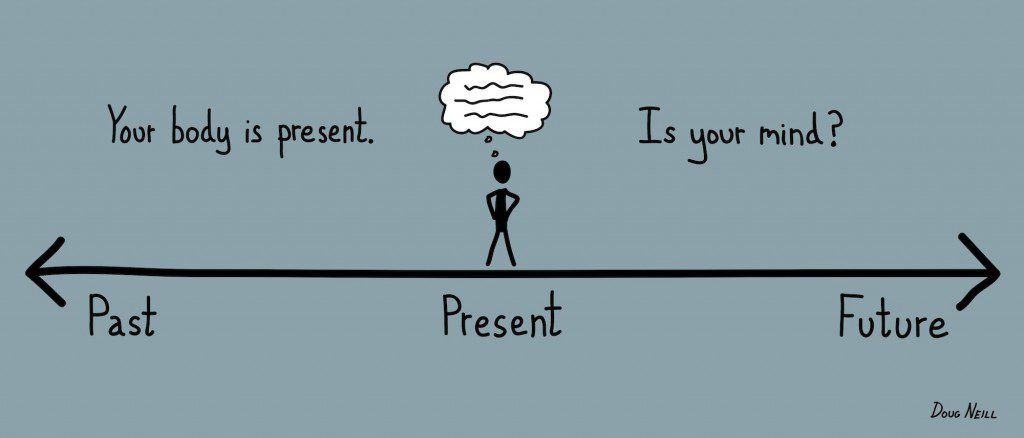
    mindfulness2

    (via)

    But I think there is hope. One of the best 2014 trend reports I’ve seen – by Zambezi – has ‘Mindful Society’ as its first trend. While that is more a take on digital devices and our time spent on them, the JWT trend forecast has ‘Mindful Living’ as their final trend, and talks about a growing interest to experience everything in a more present, conscious way. I also think that we might have unwittingly figured out a way to start out on this. One of the hottest trends this year is the quantified self – self knowledge through numbers – it encourages people to monitor all aspects of their physical, emotional, cognitive, social, domestic and working lives. (via)

    At this point, it is more focused on the physiological aspects, and there will most likely be a deluge of devices, services and allied products that would be an end in itself. However, it is also possible that we will truly understand our body, as numbers show the impact of our behaviour and consumption, and as a result, we’ll become more mindful in our actions. And maybe, just maybe, once we’re done with that, we’ll begin trying to do the same for our mind, and the decisions it makes. It’s difficult to imagine how that will work out, I agree, but hey, even five years back, did you think something you wear on your wrist could give you analytics on your sleep patterns?

    until next time, a qualified self 🙂
  • Emotion as a Service

    More than a year back, I had written about institutional realignment and had briefly mentioned the institutions of marriage and parenting. ‘The currency of relationships‘ made me think of this, and family – immediate and extended – as a societal construct/contract/ institution, and probably even as a tradition. Where we are born, and whom we are born to, are apparently out of control, but we do have an illusion of control courtesy the choices we make as we go along. Thanks to these choices, our lifestyle and our perspectives may follow a trajectory that is totally different from the circumstances and people we grew up with/in. This is not just about the people from our childhood/youth, but is a continuous process through life. Each of us find our own ways to deal with the constant flow of people through our lives. These are again choices, and like most choices involves some amount of sacrifice and bring with them their own set of consequences.

    Clipboard02

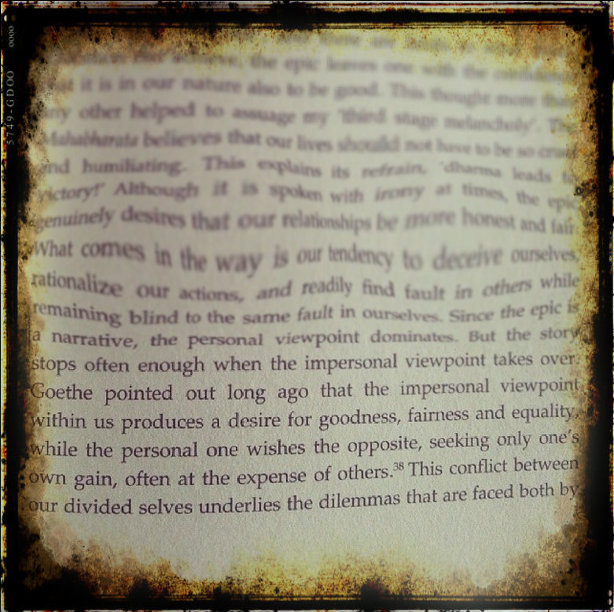
    I loved that Goethe paraphrase, because I think it sums up our relationships very well. At the risk of sounding cynical, (or receiving a ‘speak for yourself’ comment) I’d say that we’re increasingly becoming selfish as a species. I have always had the notion that most relationships are contextual, and it would be difficult to scale our emotions/feelings for others for an indefinite time frame. Yes, I do acknowledge there are exceptions, but that’s what they are – exceptions. Do a quick test and find out how many people across your life you’re still in touch with – bouts of nostalgia not included?

    It is with all this as the backdrop that I read Scott Adams’ “The Future of Marriage“. It articulates very well a thought that had crossed my mind earlier. (Of course, he obviously explores it way better than I could have) He deconstructs the institution of marriage and argues that marriage made sense “when the world was inefficient. You married a person nearby who could provide most of your important needs while hoping your lesser needs could also somehow be met.” Now, he says, the internet has allowed us to have a barter economy of relationships. In other words, a virtual spouse comprised of a dozen separate relationships. He tempers everything by saying that in the future, marriage may be one of the many options available. By sheer coincidence, and in a different context, I came across this quote attributed to Steve Macone “A tradition is a habit whose logic has faded“.

    I thought about this in the context of the expectations I had mentioned in the ‘currency of relationships’ post. If the institution of marriage can have a barter economy, why not other relationships? After all, isn’t every relationship a barter at its core? It’s just that we are rarely comfortable with voicing our expectations in the case of an emotional ‘transaction’, quantitatively or qualitatively. (generalising) Parents expect their children to look after them when they are old, in return for bringing you up; relatives expect you to return the favours they once did for you, and so on.

    So who knows, maybe our pace of life and our need to be (seen as) fair in all our relationships will conspire to form a barter ecosystem that offers emotion as a service. It is possible that an alternate path to prosperity might take us in a different direction, but in the era of the quantified self and the augmented human, when we slowly transition our selves into the cloud, maybe ‘Emotion as a Service’ (like)  is not an impossibility. What do you think?

    until next time, a qualified self

  • Brands and the Personal API

    Lifestreaming and I go way back, at least 5 years. 2008 was when I wrote about it first, though the experiments had started earlier. Most of the services I’ve mentioned in the post are now defunct, but my interest in the subject never waned. From the perspectives of memories mentioned in that post to speciation to brands using their lifestreams to build communities around it, I have had several thoughts on the subject. That’s why I found this post at GigaOm, which was about Foursquare co-founder Naveen Selvadurai sharing data logs from his life (weight, sleep, activities) and hoping developers would hack his ‘personal API‘, very very interesting. There have been stories about people and the tons of lifestreaming data they have amassed, but I had never heard of an API, and therefore consider it pioneering work.

    Pioneering, less because of the novelty, and more because I think it has the potential to become mainstream, and even, the default paradigm of creation and consumption. Since the engagement @ scale framework refuses to let go of me, I immediately thought of the personal API in that context. With technological advances, I think it’ll become easier to create one’s own APIs and you can see several companies mentioned in the GigaOm post that are working on it. So I’d hope that its evolution is as fast as (or faster than) that of self publishing (on the web) which about a decade back was a relatively complex thing to do. So, in essence, we’re talking about huge amounts of data that are being generated and captured by individual users, and this is only going to be accelerated thanks to phenomena like wearable technology.

    The current way of looking at Big Data is to synthesise actionable insights from processed and unprocessed information from touch points related or unrelated to the enterprise. As I’d mentioned in my presentation (on engagement @ scale) this is then used to target users better or drive more efficiencies.  They don’t really operate at the higher levels of community/meaning/purpose. Now think of the personal API and the data it holds. What if we looked at this individual streams of ‘Big Data’ not from the enterprise’ perspective but from the user perspective? What if brands created platforms that  would allow people to upload data that they choose to so that the brands could solve their needs better? Like I wrote in my ‘maker’ post, with massive technology leaps happening in areas like 3 D printing, there are tremendous opportunities for co-creation. Brands could even aggregate data from these individual streams to find need gaps and package that for a larger market. In fact, I’d say that this is probably what Nike+ is doing already.

    But the real story is that these personal APIs could give great insights into the individual’s purpose in life, his priorities – in short, his life’s narrative. It gives brands the window to latch on to the narrative that they can identify with, and create value and meaning in the individual’s life. I think that’s what brands originally strove to do!

    Update: Thanks MJ, for pointing me to the Nike+ Accelerator!

    until next time, AP”I”

    PS: Over at Soylent, they’re creating the nutritional equivalent of water, an ubiquitous ‘meal’ that is customised for body types. Funding? Kickstarter of course! 🙂