
Tag: Product

  • The Social Product

    A few days ago, I read this post that cited studies on consumer sentiment (US, UK) about brands being present on social media. There are plenty of interesting perspectives and nuanced insights but one key takeaway is that consumers feel there is a glut of companies on social media, though it seems the younger age group feel that presence on social media adds to trust. Around the same time, I also came across the theory of peak advertising which begins with the decreasing effectiveness of online advertising and moves through various stages to suggest alternatives to the current business models that sustain the internet.  Collectively, it would seem as though the (generic) advantage of just being present on social is plateauing, or probably even going down. There are obviously brands that are using these platforms effectively, but increasingly, social is being used as media and this is easily replicated by other brands. At a larger level, the advertising barrage on social is also reducing effectiveness. That led me to think – before the utopia of social business, what opportunities does social have beyond the traditional marketing, advertising media based approach, enterprise collaboration, and social CRM?

    In the second Myntra post, I’d written about how I felt that ‘product’ was best placed to deliver sustainable business advantage. Though it was related to the website/features in that context, I’m now considering if this is applicable across the board – to physical products as well. Also, the more I see social evolving on customer care, marketing, advertising and sales, the more I think these are becoming hygiene. I have omitted marketing because I think there is scope to build a unique brand and thus some business advantage in the long run. However, I also think that this marketing will have to significantly integrated with ‘product’.

    In this context, I found this Forrester post titled “There is no Internet of Things” extremely interesting. Though we’re in the early stages of this phenomenon, I think it’s a good time for her to have raised the point of fragmentation and apps/brands working in silos. There are some excellent examples and scenarios in that post that make it a must-read. The conceptual answer to this is in the title of this HBR post – “The Age of Social Products“, and it makes a great point on ‘shared purpose’. “In an age of social products, competitive advantage comes not from product features but from network effects.” (though at this stage, I do think it’s both and not an either/or) Nike, as mentioned in the post, (and as usual) continues to be on the cutting edge. The common theme in their case is that the product + community (user+developer) offering only uses popular social platforms to augment, and is not dependent on them.

    The current approach to social (media) is either to use $ or influence. I’m not sure there’s enough importance given to the network and the effect that’s created over a period of time. As this superb post states on the subject of disruption and diffusion states, “It’s not the nodes, it’s the network” In that light, I feel social products might be able to do more justice to the promise of ‘social’ than its current avatars, especially social media. I did think the same way about social platforms earlier, but we live in hope!
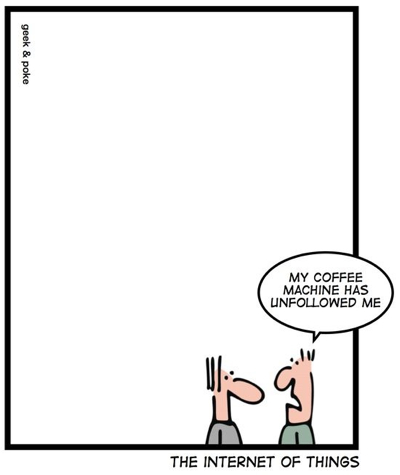
    IoT

    (via)

    until next time, objectifying social 🙂

    P.S. I was reminded of a term coined much earlier – social objects. In that context, it was anything that could be a conversation starter, and the focus was more on its ability to connect people around a subject of common interest. Social products have the ability to take that connection and give it a platform where even people who are not in the same time and place can be part of the conversation. This is beyond its ‘utility’ not just as a product but also as a device that talks to other devices and makes itself more useful. I’m actually thinking of that ‘bottle of memories’ I mentioned in an earlier post, probably in a smarter avatar – like this or this – but also ‘tagged’ (say, using an augmented reality app) with the people who are part of the stories associated with it. Now, at some point, when I see the bottle, and get particularly nostalgic, I could use the same app to see what those people are up to, and quickly ping them to start a conversation about the good old times. In the collaborative and sharing economy, think of the possibilities! (If you’re interested in this sort of thing, you should like this post) When I think about it, what we probably need to accelerate this is a browser (what it does for the web) equivalent.
  • Social @ Myntra – Part 2

    continued from Part 1

    Creating, correcting and maintaining brand perception and resolving customer issues were fundamentally the objectives when operating in the customer care and brand domains respectively. But this was not an end in itself. The end objective of the business is revenue, and that makes up the remaining story.

    3. Product: In this context, it includes the website itself, and the various features/enhancements/new products (eg. gift cards) that get introduced on a regular basis. Including social buttons on the home page and product pages were a given, though getting them above the fold was a mission I lost! The first major change was switching from FB Connect to the Open Graph. The potential applications, using social and interest graphs, are phenomenal, but we never progressed that far. At a basic level, I had slotted activities in this domain under acquisition and retention, and we have only implemented a small portion of the former. The easiest application of the social graph was using it for social proof. Kuliza’s Echo made that job relatively easy for us. It not only helped seamlessly amplify word-of-mouth, but also gave us a lot of data on consumption. One of the plans was to integrate this with Elevate, another Kuliza app – but inside Facebook, to try and beat FB’s throttling of organic reach. 🙂 Another application of Echo, which should soon see the light of day, is a Fab-like social feed. If a user has registered on Myntra using Facebook, he/she would see the actions (Likes, Purchases, Wishlist additions) of his/her friends on a separate feed inside Myntra. Our expectation is that this would prompt more social actions inside Myntra and accelerate word-of-mouth inside FB further. This was actually a Phase 1 of a larger plan I had in mind. Let me explain.

    While brand and customer connect can provide a strategic advantage on social, I’ve always felt that it was in the product domain that social could provide a sustainable strategic advantage. This came from my notion that ‘loyalty’ existed when the exit barrier for a customer to leave Myntra was high enough to beat any sustainable offering from a competitor. ‘Brand’ is one standard way to achieve it, but it is relatively less tangible, and in a commoditised marketplace, it would take more time. Generic discounting is not sustainable. I think, in this context, ‘Product’ can reach this ‘barrier’ in lesser time, and at lower costs. An ideal in my mind was using the social, intent and interest graphs of users from across various platforms to build a personalised experience, and through that, a gamified customer acquisition and retention architecture inside Myntra, (thereby minimising dependencies on other platforms) and then using social media to amplify relevant actions to further drive acquisition. But this approach has a high dependency on changes in the existing product and every new product/feature having relevant social features baked in (or at have it in the vicinity on its roadmap) to contribute to the larger agenda of the architecture. It also takes a mindset and backing. I did have a rough blueprint, but at this point in the e-commerce wars, this approach probably seemed a nice-to-have. 🙂

    4. Sales: Conventional notions claim that social media should not be used for sales pitches, but from my humble experience, I’d beg to differ. It’s just a matter of what-when-how, and how much. From generic product pitches on the Facebook Page as part of the larger content strategy, to custom links on Twitter, we have consistently shown and tracked revenue from social channels. Even Pinterest and Google+ are contributors! I must admit that in the larger scheme of Myntra’s monthly revenue, these are insignificant, but let’s just say that the total contribution are in double digit lakhs every month. In fact, it reached a point where we were given a budget to see if we could scale it. In this context, I have to mention this brilliant idea by S – she used customer generated product images from our Pinterest ‘Shopped from Us’ board every week to make sales pitches on Facebook! Works like a charm. 🙂

    The area where there were a few attempts, but didn’t really pick up was enterprise collaboration. We managed to build a fairly large community on Yammer, but what I’ve realised is that it needs champions at the highest level in all parts of the organisation using it on a consistent basis for it to be sustainable. I also had this grandiose vision of using Google+ and circles to connect customers, Customer Connect teams, Partner brands and employees in general, but this one was limited to a word document! This is an area that I believe to be a must-have as we evolve towards social business, but in the larger list of priorities, is still a few steps away.

    That gives a broad view of what I’ve been up to for two years. The generic point I’m trying to make through the two posts is that from basic business outcomes like customer satisfaction and sales to more nuanced ones like brand perception and sustainable strategic advantage, social can and should play an integral part. There will be differences in terms of scale, strategy, resources etc depending on the domain, maturity of the industry/organisation, target audience and so on, but the important part is to begin because the brand/organisation needs to evolve as well. Social media has shortcuts, I’m inclined to think that social does not. These are days of nascence, and social will continue to evolve – enterprise social networks, social business, big data, the Internet of Things (add buzzwords to taste) and more will all have their hype cycles and age of maturity. By all means, measure ROI, but remember, we spend on movie tickets, we invest in mutual funds. I think we’re clear on the expected time frame of returns in both cases.

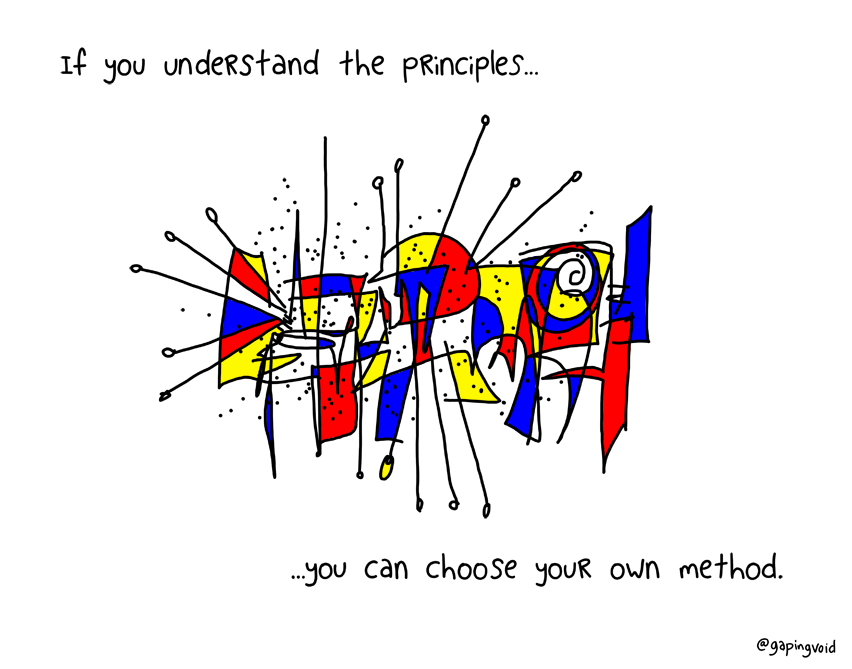
    understand_the_principles

    (via)

    Myntra will remain dear to me, like all the other brands I have worked on, but it will probably have a more lasting signature, because not since my days at GIM have I experienced such a rewiring of my worldview. This stint has given me oodles of confidence, friends whom I hope will last a lifetime, and relationships of trust that I will cherish.

    Before I end, the last hat tip – to the super S, who joined the team mid last year and has since then, proven time and again that she’s the best social ‘investment’ we made, and made this little social adventure a total joy! “I used to believe that we are here to teach what we know. Now I know that we are here to teach what we are meant to discover

    until next time, </ head – social media> 🙂