
Tag: platform

  • Platform Principles

    Though not by design thus far, I have actually been expanding on the 4P (planning to add one more) framework I wrote about in Agile @ Scale. The attempt is to help me navigate the concept of brand in a rapidly changing landscape. The Change Imperative tried to showcase some of the possibilities of these dynamic shifts, and Revisiting Brand Purpose dwelt upon purpose in the framework. This post is on platforms. Though media platforms have been around for a while and have been utilised by brands, and the internet, mobile and different OS can also be treated as platforms, I’m choosing to focus on the brand/ organisation as a platform.

    Thus far, the organisation as a platform has been built to leverage scale for competitive advantage. But technology and open platforms are easily on their way to make scale matter much less. As this post  succinctly states, connections weigh more than efficiency now. So how can the organisation move towards connections?

    My thought process on this was probably started in Social’s Second Chance. Social tools and platforms have brought the brand into full contact with the user and have caused paradigm shifts in not just marketing but across the organisation. This deck makes an insightful point that traditional marketing structures are dialectic in nature while social platforms are dialogic. That explains why brands are using social mostly as media and trying to frack it, despite there being better ways to approach it, even in the context of marketing. Experience > exposure is a lesson yet to be learnt.

    Among other reasons, one of the big factors that are contributing to a resistance in truly embracing social in entirety is a fear – loss of control. This is a great read on designing for the loss of control and my biggest takeout from it is where it quotes from ‘The Power of Pull‘ – “shaping strategies” on the individual, institutional, and societal level.

    I think there’s tremendous scope in rethinking the brand/organisation as a platform. In the bid for competitive advantage through scale and efficiency @ scale, it is possible that the organisation/brand has chosen to see value very myopically – as a transaction. What if the organisation transformed itself around connections – connecting employees to a sense of purpose, partners to the kind of work they’d want to associate with and its own narratives with that of the consumer’s? Of course there’d be transactions involved too, but how about engaging each in a way that understands and works with the unique value in every interaction within the context of a shared purpose?

    (Arguable) I think efficiency lays more stress on methods, but engagement has the potential to focus on principles. Profitability at any cost vs value creation as a means to profitability. The choice might actually make the difference between survival and irrelevance.
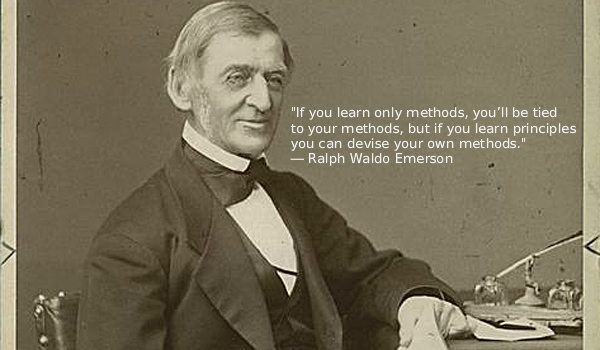
    Emerson

  • New media indeed

    When I wrote this in last week’s post – “‘social’ as it relates to friends and followers’ overrules ‘social’ as a relationship between brand and consumer”, in the context of how brands use social media, I also became  more conscious that despite me relating to Facebook and Twitter as a means to connect with friends, the platforms themselves were clearly seen as a media by the world at large. Even LinkedIn now apparently has a news aggregator.

    It is true that I consume large amounts of content via (or on) Facebook and Twitter, but I have always seen it as content shared by friends, not as media like a newspapers or TV channels. It is probably because I have always associated media with information and entertainment and never social. But that’s only a personalised view, I realise. The larger picture shows a content delivery platform – media. I guess when social scaled it didn’t know what else to do but become media. Interesting how the new media platforms worked from social connection towards utility and the old media are trying to make the journey from info and entertainment to social.

    And thus when I saw a few recent Facebook developments, I viewed it through the prism of FB as media. Facebook launched Sponsored Stories a while back, using friends’ actions as an ‘advertisement’. It updated Pages giving functionalities that helped brands interact more. Now it has completely knocked off the ‘Share’ button and replaced it with an omnipotent ‘Like’ button that will transmit a story blurb complete with thumbnail instead of the earlier single line in ‘Recent Activity’. (details) Publishers won’t complain since content will be more visible now. Facebook’s comment box plugin also got revamped with better moderation, social algorithms to surface the comments that will be most interesting to you (indicated by social signals from friends) and better distribution – now, when a user utilises the “Post to Facebook” button on a site with FB comments enabled, it can be replied to on FB and will automatically be reflected on the original website as well. If the publisher has a Page on FB, it can respond to the comment and include the people who have ‘Liked’ the page into the conversation. (details) That’s a first from FB – allowing conversations to go out. Wonder what they’re after – interest graph, a perpetually signed-in user, sole web identity provider, all of the above? But in essence, a new media platform that connects publishers with users. And in this age, brands are after all content creators too, eh?

    I would think the progression is obvious – first build a user base with awesome features, then focus on publishers  (including brands) who will make it a distribution channel, and the next step would be to make the advertisers spend more.

    While Google is busy dealing with content farms in search results, I realise that we have very little means to stay away from the Facebook way of throwing content at us. Watch your newsfeed as Facebook uses you and the content publisher to make itself more indispensable as a platform. Like I tweeted, the hope is that in trying to be everything – mailbox, location, photo storage, for everyone, Facebook might lose itself. The effect all this will have on ‘trust’ in networks, I’ll leave for another post.

    Media has always been aggregating audiences by providing information..+entertainment..+social connections… and then leasing it to brands. (advertisers) With advances in technology, it’s perhaps time for brands to create their own direct lines to consumers, outside of the new media barons. Otherwise, in their immediate comfort state of using yet another platform as media, the way they’re accustomed to, it is possible that they will continue to be at the mercy of a third party and have to play by their rules, sometimes at the risk of antagonising the end user.

    until next time, mediators = media + dictators? 😉